
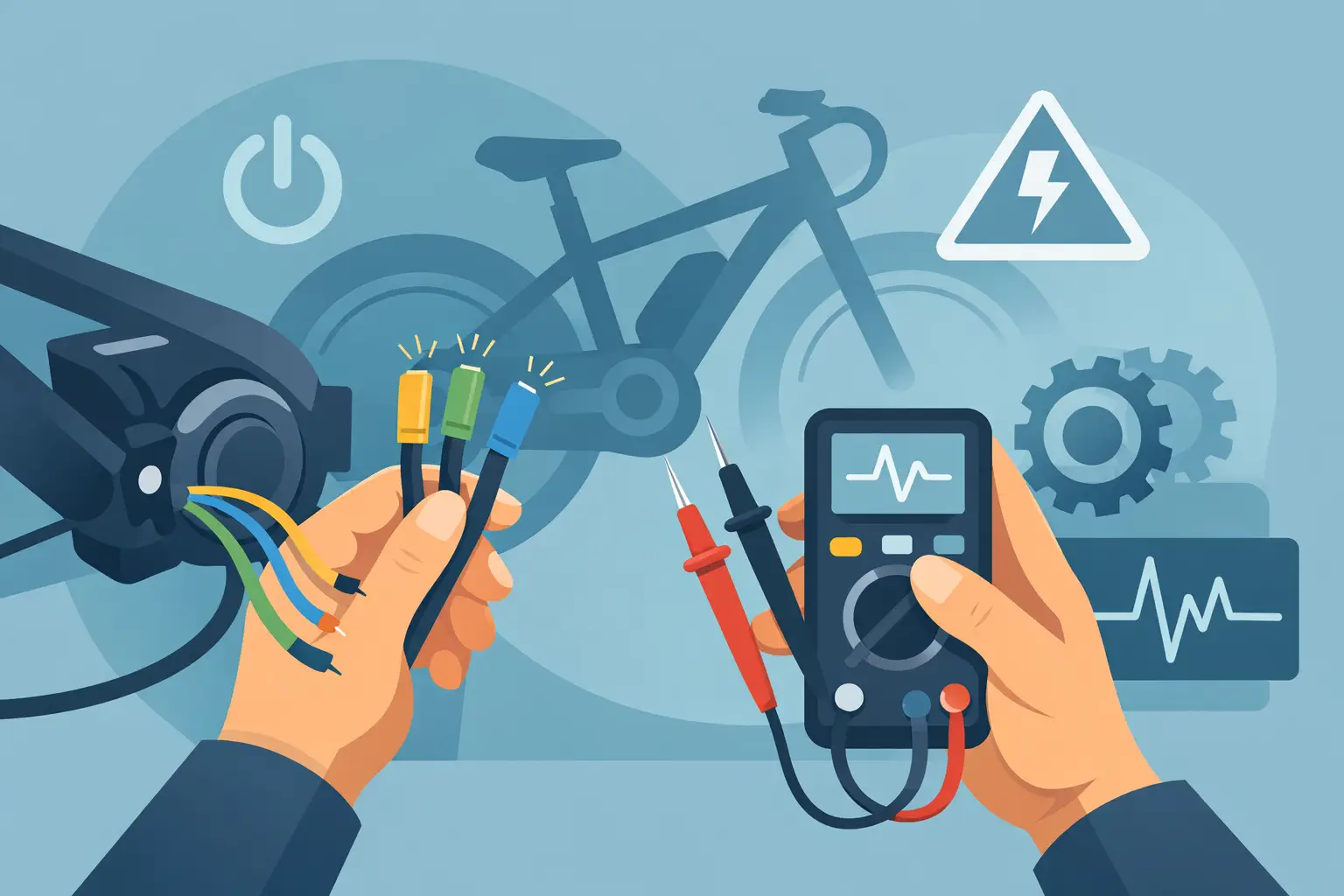
You twist the throttle or start pedaling, and the motor bucks, growls, or barely turns. Sometimes the wheel shudders from a stop. Sometimes the bike cuts in and out under load but seems fine on a stand. An ebike phase wire problem often shows up exactly like that, and it is one of the more confusing faults riders run into because the symptoms can overlap with controller, hall sensor, and motor damage.
Phase wires carry the heavy current from the controller to the motor. On most e-bikes, there are three of them, usually thicker than the smaller signal wires in the harness. When one of those wires is loose, partially burned, shorted, or broken inside the insulation, the motor can lose synchronization or power on one part of the circuit. The result is rough operation, overheating, poor torque, and in some cases a bike that will not move at all.
What an ebike phase wire problem feels like
The most common rider complaint is a harsh, choppy start. Instead of smooth acceleration, the motor may vibrate, make a grinding or growling sound, and feel weak. On hub motors, the wheel can hesitate and then lurch. On mid-drive systems, the bike may surge oddly or throw an error depending on how the system monitors current.
Sometimes the issue only appears under load. A bike might spin the wheel normally when lifted off the ground, then act up as soon as a rider is on it or when climbing a hill. That matters because phase wire faults can worsen when current demand rises. A connection that barely works at low load can fail badly when the controller sends more power.
Heat is another clue. If a phase connector is loose or partially burned, resistance builds up and the connector can get hot fast. Riders sometimes notice melted plastic near a motor cable, discoloration around bullet connectors, or a sharp electrical smell after a short ride. Those are not minor warnings. Continued use can damage the controller or motor along with the wiring fault that started the problem.
Why phase wires fail
The simplest cause is connector damage. Many e-bikes use bullet connectors, block connectors, or brand-specific motor plugs that can loosen over time, especially on bikes that see vibration, off-road riding, curb drops, or frequent transport on racks. A slightly loose connection can create arcing, and arcing creates heat. Once heat starts damaging the contact surface, the problem usually accelerates.
Wire fatigue is also common. The cable section near the axle, dropout, or frame entry point is a stress area. Every bump, turn, and cable movement adds up. On rear hub bikes, phase wires can be pinched at the axle if the wheel was installed poorly or if the axle shifted. On folding bikes and some fat-tire models, harness routing can put extra strain on motor cables.
Water intrusion is another factor, especially near low-mounted connectors or poorly sealed motor exits. Corrosion increases resistance and can affect one phase more than the others. In coastal areas like San Diego, salt air and moisture can make an already weak connection worse over time.
Then there is collateral damage. A failed controller can overheat a phase circuit. A shorted motor winding can stress the wiring. A crash can tug a harness. That is why a true diagnosis matters. Replacing a connector without checking the rest of the system can leave the real problem in place.
Ebike phase wire problem or something else?
This is where riders can get misled. Hall sensor faults, controller failures, damaged motor windings, and battery voltage drop can all create similar symptoms. A bike that jerks at startup is not automatically a phase wire issue. It could be a controller misfiring the motor phases, a hall sensor sending bad position data, or internal motor damage.
The overlap gets worse because one failure can trigger another. For example, a burned phase connector can overwork the controller. A controller with failed MOSFETs can make phase wiring look bad. A motor with internal winding damage can overheat phase leads and connectors. From the outside, all three may look like one simple wiring issue.
That is why a parts-swapping approach gets expensive quickly. If the bike has rough motor operation, the goal is not just finding a damaged wire. The goal is identifying which component failed first and what else has been affected.
How a proper diagnosis is done
A real phase wire diagnosis starts with inspection, but it does not end there. The visible checks matter. Burn marks, melted insulation, loose terminals, green corrosion, and axle-area cable damage are all red flags. If connectors have darkened metal or deformed plastic, they have likely been running hot.
After that, electrical testing tells the real story. Continuity checks can reveal an open phase. Resistance comparison between motor phases can show imbalance. Insulation testing may be needed if there is concern about a short to the motor case. With the controller disconnected, the motor side can be tested independently. With the motor confirmed or ruled out, the controller phase outputs can then be evaluated.
Load behavior is important too. Some bikes pass a simple bench check and still fail on a road test because the fault only appears when current rises. That is why experienced e-bike diagnostics often include both static testing and functional testing under realistic conditions.
This is also the point where connector type and repair quality matter. Some damaged phase leads can be repaired cleanly with the proper gauge wire, high-current connectors, and sealed routing. Others require a motor cable replacement or internal motor work. If the wire damage is near the axle on a hub motor, the repair can be more involved than it looks because access is limited and insulation has to hold up under movement and heat.
Can you keep riding with a phase wire issue?
Usually, no. If the bike is jerking, cutting out, or making abnormal motor noise, continued riding can turn a manageable wiring repair into a larger motor or controller repair. High current electrical faults tend to create heat, and heat spreads the damage.
There are rare cases where a minor connector issue is caught early, before major parts are affected. But that depends on how long it has been happening and whether the bike has already been ridden hard with the fault present. Delivery riders, commuters, and anyone relying on the bike daily should be especially careful here because repeated stop-and-go use puts a lot of stress on a weak phase circuit.
What repair might involve
The repair depends on where the failure is. If the issue is limited to an external connector, the fix may be as straightforward as replacing damaged terminals and restoring a solid high-current connection. If the wire is broken internally near a flex point, the damaged section may need to be replaced and rerouted for better strain relief.
If the damage is at the motor exit or inside the hub, labor increases because the motor often has to come apart. On some bikes, replacing the motor cable is the right repair. On others, internal splicing may be possible, but only if done carefully and with attention to heat, sealing, and long-term reliability.
If testing shows the controller was damaged too, both issues need to be addressed together. The same goes for hall sensor faults or internal motor damage. This is where riders often appreciate a diagnostic-first shop approach. It avoids the common situation where one part gets replaced, the bike still acts up, and the original cause is still sitting there.
When to bring the bike in
If your e-bike has sudden loss of power, rough acceleration, motor vibration, abnormal noise, or a hot motor connector, it is worth having it checked before riding more. The same applies if the bike only fails under load or after a few minutes of use. Those are classic signs of electrical problems that may not be obvious from a quick look.
For riders in San Diego dealing with this kind of issue, especially on hub motor bikes, moped-style e-bikes, fat-tire bikes, or high-use commuter setups, this is the kind of fault that benefits from focused electrical testing rather than general bike service. Shops that work regularly on motor circuits, controllers, and wiring repairs are better equipped to sort out whether the problem is the phase wires themselves or something upstream or downstream.
At FixEbike, this type of problem is approached the same way every complex electrical issue should be approached – by confirming the fault, checking for related damage, and repairing what actually failed instead of guessing. That usually saves time, money, and repeat breakdowns.
If your bike feels rough, noisy, or inconsistent at the motor, trust the symptom. E-bike electrical problems rarely fix themselves, but they are often very repairable when caught before the heat and stress spread the damage further.