
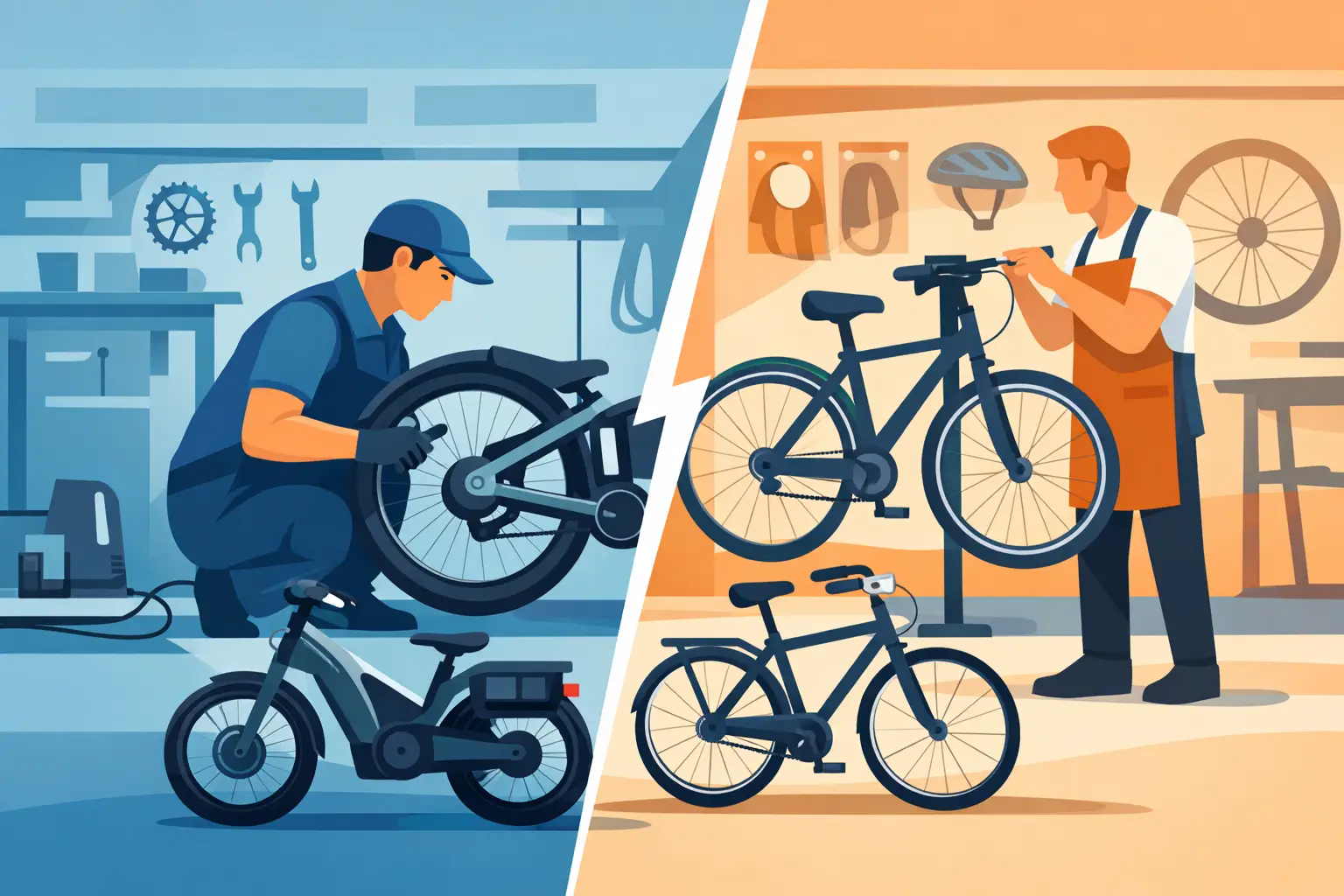
A flat on the way to work is usually a straightforward bicycle repair. A bike that turns on but will not assist, flashes an error code, or dies under load is a different kind of problem. The choice between an ebike repair shop vs bike shop matters because an electric bike combines familiar bicycle parts with a battery, motor, controller, display, sensors, and wiring that all have to communicate correctly.
A good general bike shop can be the right place for many jobs. But when the issue involves power, charging, electrical faults, or inconsistent motor performance, a specialized e-bike technician can save time, prevent unnecessary parts replacement, and get to the actual cause of the problem.
Ebike Repair Shop vs Bike Shop: The Main Difference
Traditional bicycle shops are built around mechanical service. Their technicians typically work on drivetrains, brakes, wheels, tires, bearings, chains, cables, suspension components, and fit adjustments every day. Those skills are essential for e-bikes too. An e-bike still needs properly adjusted brakes, true wheels, safe tires, and a drivetrain that shifts cleanly.
An e-bike repair shop adds electrical and powertrain diagnostics to that foundation. Instead of stopping at “the motor does not work,” a technician should be able to determine whether the problem comes from the battery, battery management system, charger, controller, display, throttle, pedal-assist sensor, brake cutoff sensor, motor cable, hall sensors, phase wiring, or a communication fault between components.
That distinction is especially important because similar symptoms can have very different causes. A bike that loses power on hills could have a weak battery, a poor battery connection, overheated controller, damaged phase wire, failing motor sensor, or simply a brake rotor rubbing badly enough to create drag. Replacing the first part that looks suspicious is not a diagnosis.
When a General Bike Shop Is the Right Choice
A reliable local bike shop remains a great option when the repair is primarily mechanical and the shop is willing to work on your e-bike’s size and design. Common examples include a tire or tube replacement, brake pad installation, rotor adjustment, chain replacement, derailleur tuning, wheel truing, pedal replacement, headset adjustment, and a standard tune-up.
This can be a practical choice for riders who need routine maintenance before a busy commuting season or after putting miles on a fat-tire or moped-style e-bike. Mechanical maintenance protects the electrical side too. A loose rear axle, worn brake pads, misaligned rotor, or damaged tire can turn a safe, dependable ride into an expensive problem quickly.
Still, it is worth calling ahead. Some bike shops do not accept heavy e-bikes, bikes with proprietary electronics, converted e-bikes, or direct-to-consumer models. Others may handle the mechanical work but not diagnose an electrical issue. That is not necessarily a sign of poor service. It is simply a question of the equipment, parts access, insurance, training, and repair scope the shop has chosen.
When You Need a Specialized E-Bike Repair Shop
Bring the bike to an e-bike repair specialist when the problem affects charging, power delivery, the motor, display, electronics, or safety systems tied to the electrical system. These repairs require more than a visual inspection and a basic tune-up.
A specialist is usually the better fit if your e-bike has any of these symptoms:
- The battery will not charge, charges briefly, or shows full but drains unusually fast.
- The display powers on but the motor will not engage.
- Pedal assist cuts in and out, surges, or only works at certain speeds.
- The bike has an error code, warning light, or communication error.
- The motor makes grinding, clicking, or abnormal humming sounds.
- Power drops when climbing hills, accelerating, or carrying cargo.
- A damaged cable, wet connector, or loose connection may be involved.
These symptoms overlap, which is why diagnostic testing matters. For example, a no-power condition may be caused by a blown fuse, weak battery cells, a BMS that has shut down, an ignition wire issue, a failed controller, or a simple connector that is not fully seated. A technician needs to test voltage, inspect connections, evaluate load behavior, and isolate components before recommending repair.
Why Electrical Diagnostics Change the Repair Process
Mechanical repairs often begin with what a technician can see, feel, and measure at the component. A worn chain can be measured. A bent rotor can be observed. A tire puncture can be located. Electrical repair often requires a more structured process because the failed part may not look damaged at all.
A proper e-bike diagnosis starts with the rider’s symptoms. Did the issue begin after rain, a crash, storage, a charger problem, or a recent repair? Does it happen only under load? Does the display stay on? Does the motor engage with the wheel off the ground but fail when ridden? Those details narrow down the test path.
From there, the technician may check battery voltage, charger output, connector condition, controller inputs and outputs, brake cutoff signals, throttle operation, pedal-assist sensor behavior, and motor wiring. On hub-motor e-bikes, hall sensor and phase wire faults can produce rough running, no movement, or a motor that draws excessive current. On systems with integrated displays and controllers, communication errors may point to a wiring break, water intrusion, or a failed electronic module.
The goal is not to make a repair sound complicated. The goal is to avoid charging a customer for parts that do not solve the issue. A diagnostic-first approach gives riders a clearer explanation of what failed, what the repair involves, and whether the repair makes financial sense for the bike.
Brand, Parts, and Repair Limits Matter
Not every e-bike can be serviced in exactly the same way. Some brands use closed systems, proprietary software, unique battery cases, or parts that only authorized dealers can order. Others use common controllers, displays, motors, and connectors that can be tested and repaired by an experienced independent specialist.
A trustworthy shop should be direct about those limits. If a proprietary part cannot be sourced, or if a battery case is damaged beyond safe repair, the rider deserves to know before work moves forward. The same is true for low-cost e-bikes with unavailable replacement components. Sometimes repair is the best value. Sometimes a targeted replacement is safer or less expensive than extended troubleshooting.
Battery work deserves particular care. E-bike batteries store significant energy and should not be opened, modified, bypassed, or charged with an unknown charger by an untrained person. A damaged pack, swollen case, burned connector, water exposure, or repeated charging failure calls for professional evaluation. Do not continue riding a bike with a battery that is hot, leaking, physically damaged, or giving off an unusual odor.
What San Diego Riders Should Ask Before Booking Service
Before bringing in your e-bike, explain the exact symptom rather than just requesting a tune-up. Include the make and model, approximate age, whether the bike was exposed to water or impact, and whether you have seen an error code. Bring the battery key and charger if charging or battery performance is part of the concern.
Ask whether the shop services your e-bike format and whether it can perform electrical diagnostics in-house. It also helps to ask how diagnostics are handled before repairs are approved. Clear answers on inspection, likely next steps, parts availability, and turnaround time are usually a good sign that the shop has a defined process.
For riders in San Diego dealing with difficult electrical or motor-related faults, FixEbike focuses on the diagnostic work that can fall outside a general bicycle shop’s service scope. That includes battery and charging concerns, controllers and displays, wiring faults, hub motors, brake systems, tires, and full mechanical service.
Your e-bike does not need a specialist for every adjustment. But when the problem is hard to explain, keeps returning, or involves power and electronics, choosing the shop that can test the system instead of guessing at it is often the fastest route back to a reliable ride.