
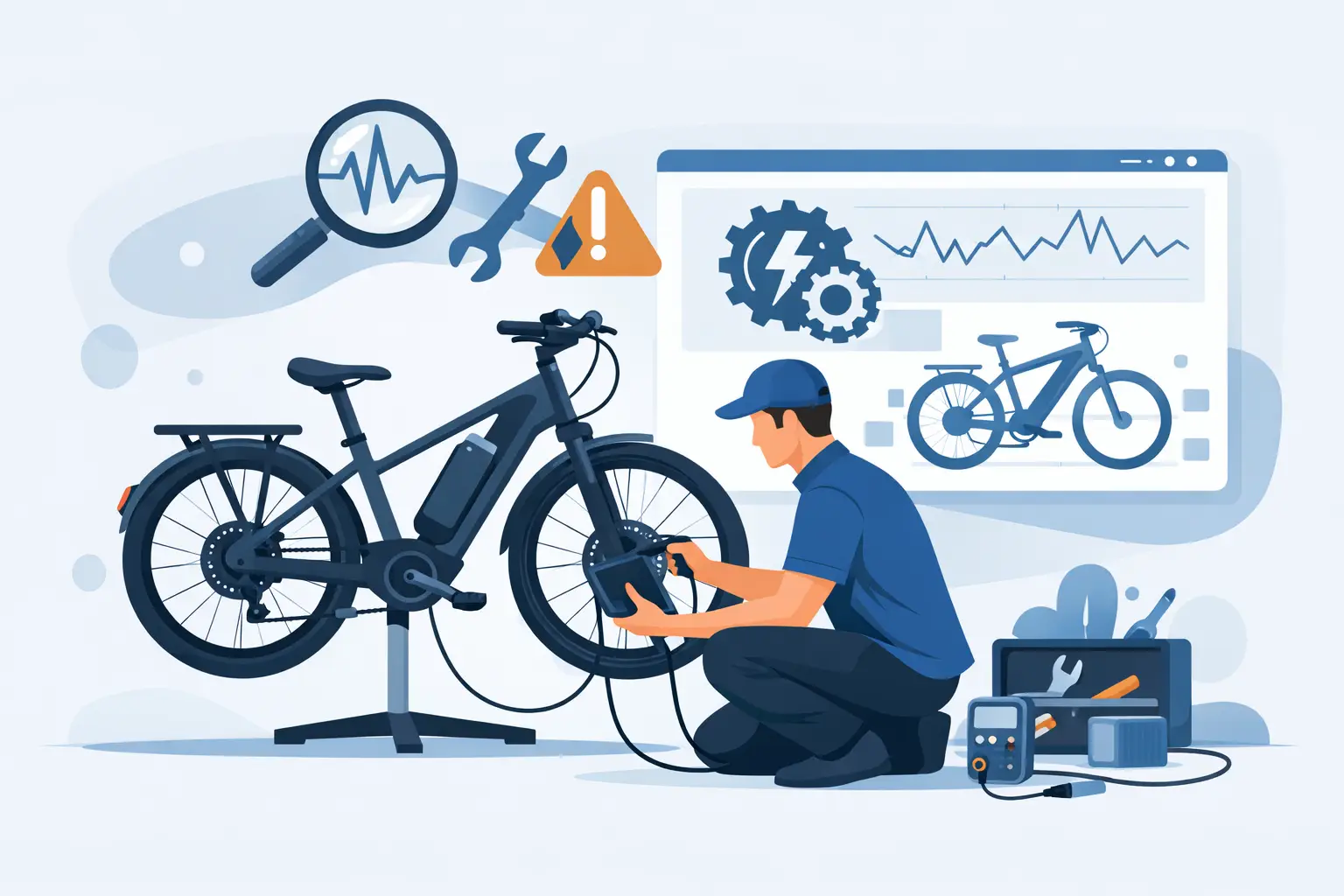
A bike that turns on but will not move, a battery that says full but dies on a hill, or a motor that cuts out halfway through a ride can point to several different failures. That is why ebike repair diagnostics should come before replacing parts. The visible symptom is not always the failed component, and guessing can turn a manageable repair into an expensive one.
For San Diego riders, reliability matters. Whether you commute through Mira Mesa, ride a fat-tire e-bike on weekends, carry kids around Poway, or depend on your bike for deliveries, you need clear answers about what is wrong and what it will take to fix it. A proper diagnostic process checks the complete system: battery, charger, wiring, controller, display, motor, sensors, and mechanical parts that affect how the bike rides.
What Professional Ebike Repair Diagnostics Actually Check
An e-bike is a bicycle and an electrical vehicle in one package. A brake rub, loose axle, damaged connector, or worn tire may feel like a power problem. At the same time, a bike can look mechanically sound while a weak battery cell group, failed hall sensor, or controller fault prevents it from operating correctly.
Good diagnostics start by listening to the rider’s description of the problem. Does the issue happen only under load? After a certain number of miles? When the bike is hot? Does the display shut off, show an error code, or stay on while the motor quits? Those details help narrow the path before testing begins.
The technician then performs a visual inspection for damaged wiring, loose plugs, corrosion, overheated connectors, pinched cables, water intrusion, and signs of impact. After that comes electrical testing. Voltage alone is not enough. A battery may show normal voltage at rest yet drop sharply when the motor demands current. That voltage sag can trigger a shutdown even though the display initially reports a healthy charge level.
Mechanical checks are part of the same process. Brakes, drivetrain, wheel trueness, tire condition, axle hardware, and bearing resistance all affect safety and performance. If a hub motor wheel is not secured correctly or the cable exits the axle at a sharp angle, the electrical repair will not last.
Common Symptoms and What They Can Mean
The Battery Will Not Charge
A no-charge problem can come from the charger, charge port, battery fuse, internal battery management system, or the battery pack itself. The first step is confirming the charger output with a meter, then checking whether power reaches the battery through the charge port.
If the charger is working but the battery will not accept a charge, the BMS may be blocking charging due to an internal imbalance, low-voltage condition, temperature issue, or cell fault. Some packs can be repaired at the component level. Others are too damaged, unsafe, or unsupported to justify repair. The right answer depends on the battery’s condition, construction, and availability of compatible parts.
Do not force a charger connection, bypass protective circuits, or continue charging a battery that is swollen, unusually hot, leaking, or smells burnt. Those are safety issues, not do-it-yourself troubleshooting projects.
The Motor Has No Power or Cuts Out
When the display powers up but the bike will not assist, the motor is only one possible cause. A failed brake cutoff sensor can tell the controller that the brakes are constantly applied. A throttle, pedal-assist sensor, display communication line, controller, or wiring connection can create the same no-power complaint.
Intermittent cutouts are especially important to diagnose under realistic conditions. A bike may spin normally on a repair stand with no load, then fail when a rider accelerates uphill. Testing can include checking battery voltage under load, phase wiring condition, hall sensor signals, controller output, and motor cable continuity.
Hub motors often develop problems where the cable enters the axle. The wire can be stretched, cut, or internally damaged from a crash, loose axle hardware, or repeated movement. If the motor runs roughly, makes a grinding sound, jerks, or vibrates, a hall sensor or phase-wire issue may be involved. Continuing to ride can damage the controller as well as the motor.
The Display Shows an Error Code
Error codes are useful clues, but they are not final diagnoses. The same code may refer to a communication fault, sensor signal issue, controller problem, or low-voltage event depending on the e-bike brand and system. A code should be checked against the bike’s wiring, measured values, and actual behavior.
For example, a communication error may come from a loose display plug, bent connector pin, damaged harness, water intrusion, or a failed controller. Replacing the display first may not solve anything. The goal is to identify where communication stops, then repair the fault at its source.
The Bike Feels Weak on Hills
Power loss under acceleration is commonly tied to battery health, but it is not always a battery replacement issue. A weak cell group can cause voltage drop under load. An undersized or failing controller, high-resistance connector, partially damaged motor cable, or brake drag can also make an e-bike feel slow.
The rider’s expectations matter too. A heavily loaded cargo bike, steep grade, low tire pressure, and a nearly depleted battery all reduce performance. Diagnostics separate normal limitations from an actual fault, so you do not pay for parts that cannot solve the problem.
Why Part Swapping Usually Costs More
It is tempting to start with the component that seems most likely: buy a new battery, replace the controller, or order a display online. Sometimes that works. Often, it creates a second problem because e-bike electrical parts are not universally compatible.
Voltage, connector style, pin layout, firmware, communication protocol, motor type, current limits, and mounting details all matter. A 48V controller may physically connect to a bike but still be wrong for its motor or display. An incompatible replacement can produce error codes, poor performance, or permanent component damage.
A diagnostic-first approach saves time by verifying the failed part before replacement. It also reveals whether the repair is limited to a connector, fuse, wiring section, sensor, or serviceable internal component. Small faults are easier to address before heat and electrical resistance damage more expensive parts.
What to Do Before Bringing Your E-Bike In
You do not need to take the bike apart before service. In fact, leaving the system intact often helps preserve the evidence of an intermittent problem. Bring the battery and charger if the issue involves charging, range, shutdowns, or power loss. If you have the key, bring that too.
Write down what happens and when. Note any error code, whether the bike was wet, whether it fell over, how long the battery lasts, and whether the problem starts after a bump or hill. A short video of the display or motor behavior can be useful when a fault does not happen every time.
Avoid repeatedly cycling a system that has a burning smell, melted connector, damaged battery case, or exposed wiring. Turn it off, remove the battery if it can be removed safely, and have it inspected. Electrical faults can worsen quickly when high current is involved.
The Value of a Clear Repair Plan
After testing, you should have more than a vague recommendation to replace parts. A useful repair plan identifies the likely cause, explains what was tested, outlines the recommended repair, and discusses any factors that could affect cost or turnaround time. Some issues are straightforward, such as a damaged connector or worn brake sensor. Others require deeper testing, particularly intermittent controller faults or battery BMS problems.
At FixEbike, the goal is to make difficult electrical problems understandable without oversimplifying them. Not every repair is worth doing, especially on severely damaged or unsupported systems. But when a repair makes sense, accurate testing provides the confidence to move forward instead of guessing.
If your e-bike has started acting differently, do not wait for a complete breakdown. A charger that behaves oddly, a motor that cuts out once a week, or a display that flickers can be an early warning. Getting the real fault identified while the bike is still rideable can protect your budget, your safety, and your next ride.