
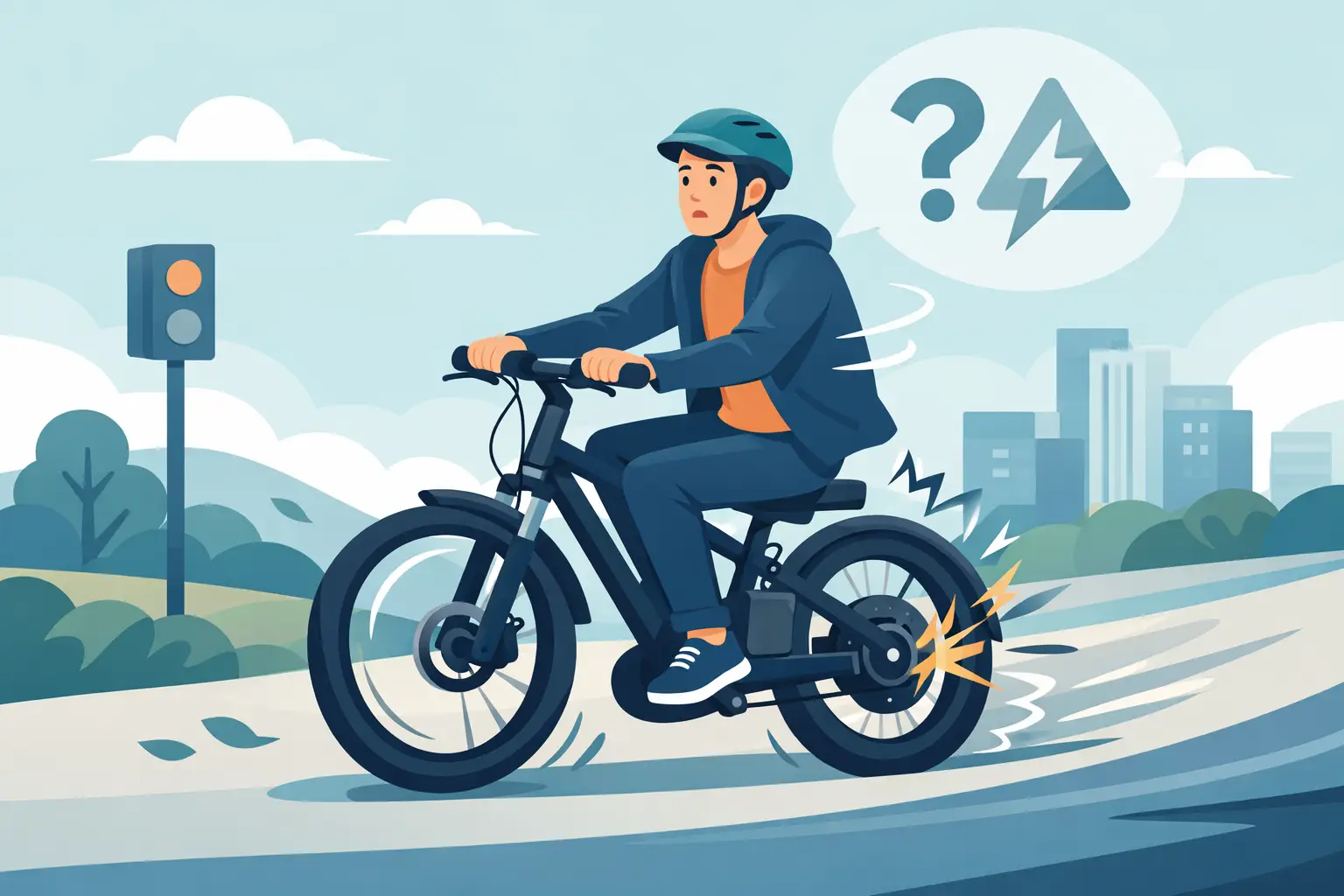
A smooth e-bike should add power predictably. When it suddenly lunges, cuts out, pulses, or feels like the motor is grabbing and releasing, it can turn an ordinary ride into a safety issue. If you are asking, why does my ebike jerk, the answer is usually not just “the motor is bad.” Jerking can come from the battery, controller, wiring, motor sensors, pedal-assist system, brakes, or even a loose mechanical part.
The pattern matters. Does it happen only when accelerating hard? Only under pedal assist? After hitting a bump? When the battery is below half charge? Those details help narrow down the real fault and prevent replacing parts that are not actually the problem.
Why Does My Ebike Jerk? Start With the Symptom
“Jerking” means different things to different riders. Some bikes surge forward and then lose power repeatedly. Others make a stuttering or grinding sensation from the rear wheel. A bike may also feel as though the brakes are briefly applying, or it may cut motor power every time the rider pedals.
Pay attention to whether the issue happens with the throttle, pedal assist, or both. If the bike jerks on throttle but runs normally on pedal assist, the throttle or its wiring deserves attention. If it happens only while pedaling, the cadence sensor, torque sensor, crank area, or pedal-assist settings may be involved. When it jerks under both types of power, the battery, controller, motor, or main wiring connections are more likely suspects.
A display error code can be helpful, but do not assume it gives the whole story. A communication code, motor code, or low-voltage warning may be caused by the component itself, a damaged connector, corrosion, a weak battery pack, or a controller that is reading the system incorrectly.
A Battery Voltage Drop Can Cause Sudden Surging
A battery can show a normal charge level on the display and still fail when the bike asks for real power. This is especially common when the issue appears on hills, during hard acceleration, with a heavy rider or cargo load, or when the battery has aged.
Inside the battery pack, cells and the battery management system, often called the BMS, must deliver enough current without letting voltage collapse. If voltage drops too far under load, the controller may reduce power or shut down momentarily. The result can feel like a repeated jerk, surge, or on-off motor cycle.
Cold weather can make a marginal battery act worse, but San Diego riders also see battery problems caused by heat exposure, long storage periods, water intrusion, or leaving a pack fully charged for extended periods. A loose battery in the frame mount can create similar symptoms. If it moves over bumps or has worn contact pins, power can disconnect for a fraction of a second and return immediately.
Do not try to solve a suspected battery issue by bypassing the BMS, forcing connectors together, or opening a lithium battery pack. A proper diagnostic checks pack voltage at rest, voltage under load, charging behavior, connector condition, and whether the BMS is cutting output.
Motor Hall Sensors and Phase Wires Create a Distinct Stutter
Hub motors depend on a set of phase wires and hall sensor wires to operate smoothly. The phase wires carry motor power. Hall sensors tell the controller where the motor is in its rotation. When one of those signals is missing, intermittent, or mismatched, the wheel can shudder, vibrate, pulse, or make a harsh growling sound instead of pulling smoothly.
This problem may start after a tire change, wheel removal, crash, or snagged cable. The motor cable often exits near the axle, where it can be pinched, bent sharply, or damaged by a loose axle nut. On fat-tire and moped-style e-bikes, that cable can also be stressed by suspension movement or racks and accessories installed close to the wheel.
A damaged hall sensor inside the motor can produce jerking that becomes more obvious at low speed or during takeoff. A phase-wire connection issue may create weak power, abnormal heat, or a motor that only runs inconsistently. These faults need testing, not guessing. Replacing a controller without checking the motor cable, hall signals, and phase connections can leave the original problem in place.
Controller Problems Can Make Power Come and Go
The controller is the traffic manager between the battery, motor, display, throttle, and sensors. It decides how much current reaches the motor and when. If it has moisture damage, overheated internal components, a failing connector, or a communication fault, power delivery may become erratic.
Controller issues are often confused with battery or motor failures because the symptoms overlap. A controller that overheats may work normally for the first few minutes, then begin cutting power after a climb or a long high-speed run. Water exposure can cause intermittent behavior that appears days later as corrosion develops in a connector or inside the housing.
Aftermarket modifications can also complicate the picture. Installing a higher-current controller, changing a display, adding lighting accessories, or using an incompatible battery can cause surging or protective shutdowns. More power is not automatically better if the motor, battery, wiring, and connectors were not designed for the added current.
Brake Cutoff Sensors May Be Telling the Motor to Stop
Most e-bikes use brake cutoff sensors. When you pull a brake lever, the sensor tells the controller to stop motor power. That is a useful safety feature, but a misaligned, damaged, or stuck brake sensor can falsely signal that the brakes are applied.
The result is often a frustrating pulse: power starts, cuts out, returns, and cuts out again. It may happen when turning the handlebars, riding over bumps, or lightly touching a lever. On some bikes, a lever that does not fully return to its resting position can keep the cutoff active.
There is also a mechanical version of this problem. A rubbing brake rotor, seized caliper, loose axle, worn chain, damaged freewheel, or slipping belt can make a bike feel jerky even when the electrical system is working correctly. If the rear wheel is difficult to spin by hand with the bike powered off, start by checking for brake drag and wheel resistance.
Pedal-Assist Sensors Can Cause Jerking Only While Pedaling
If throttle operation is smooth but pedal assist is erratic, inspect the pedal-assist system. A basic cadence sensor uses a magnet ring and sensor near the crank. Dirt, a cracked magnet ring, an incorrect gap, or a loose sensor can make the controller receive inconsistent pedal signals.
Torque sensors are more sophisticated and can feel more natural when functioning correctly. But they can also cause uneven assistance if the sensor is damaged, its calibration is off, or a related wiring connection has failed. On some bikes, changing assist settings, wheel size settings, or firmware parameters can make power delivery feel abrupt even if no part has physically failed.
Loose crank arms, worn bottom bracket bearings, or a chain skipping under load can be mistaken for pedal-assist jerking. The difference is that a drivetrain problem usually has a mechanical knock or slip tied directly to pedal force, while an electrical interruption may occur even when the pedals are turning smoothly.
Checks You Can Make Before Scheduling a Repair
Start with the easy, low-risk checks. Turn the bike off, remove the battery if the manufacturer allows it, and inspect visible connectors for looseness, bent pins, moisture, burned plastic, or damaged insulation. Make sure the battery is locked securely in its mount. Look closely at the motor cable near the axle and at any spot where a cable enters the frame.
With the bike powered off, spin both wheels and listen for rubbing or resistance. Check that brake levers return fully. Inspect the chain, cassette, derailleur, and crank arms for obvious looseness or damage. If the problem began after a flat repair or transport, confirm that the wheel is seated correctly and the axle hardware is tight.
Avoid repeatedly riding a bike that jerks hard, makes grinding motor noises, smells hot, or shuts down under load. Continuing to force it uphill can damage a controller, overheat wiring, or turn a repairable motor issue into a more expensive one. Do not use a charger, battery, controller, or adapter that was not designed for the bike’s voltage and connector setup.
When an E-Bike Needs Electrical Diagnosis
A proper diagnosis is worthwhile when the jerking is intermittent, happens under load, returns after a basic connector check, or comes with an error code. The technician should evaluate battery behavior under load, inspect the harness, test hall sensors and phase wiring, check brake cutoff operation, and verify controller and display communication. Mechanical inspection belongs in the same process because an electrical complaint can hide a brake, wheel, or drivetrain problem.
At FixEbike, that diagnostic-first approach helps San Diego riders avoid the common cycle of replacing a battery, then a controller, then a motor without identifying the failed signal or connection. The goal is to find the source of the interruption and repair what is actually causing it.
A jerking e-bike is rarely something to ignore, but it is often fixable once the symptom is traced to its source. Bring notes about when it happens, how much battery charge remains, whether throttle and pedal assist behave differently, and any display messages you have seen. Those details can turn a confusing ride problem into a clear repair path and get you back to riding with confidence.