
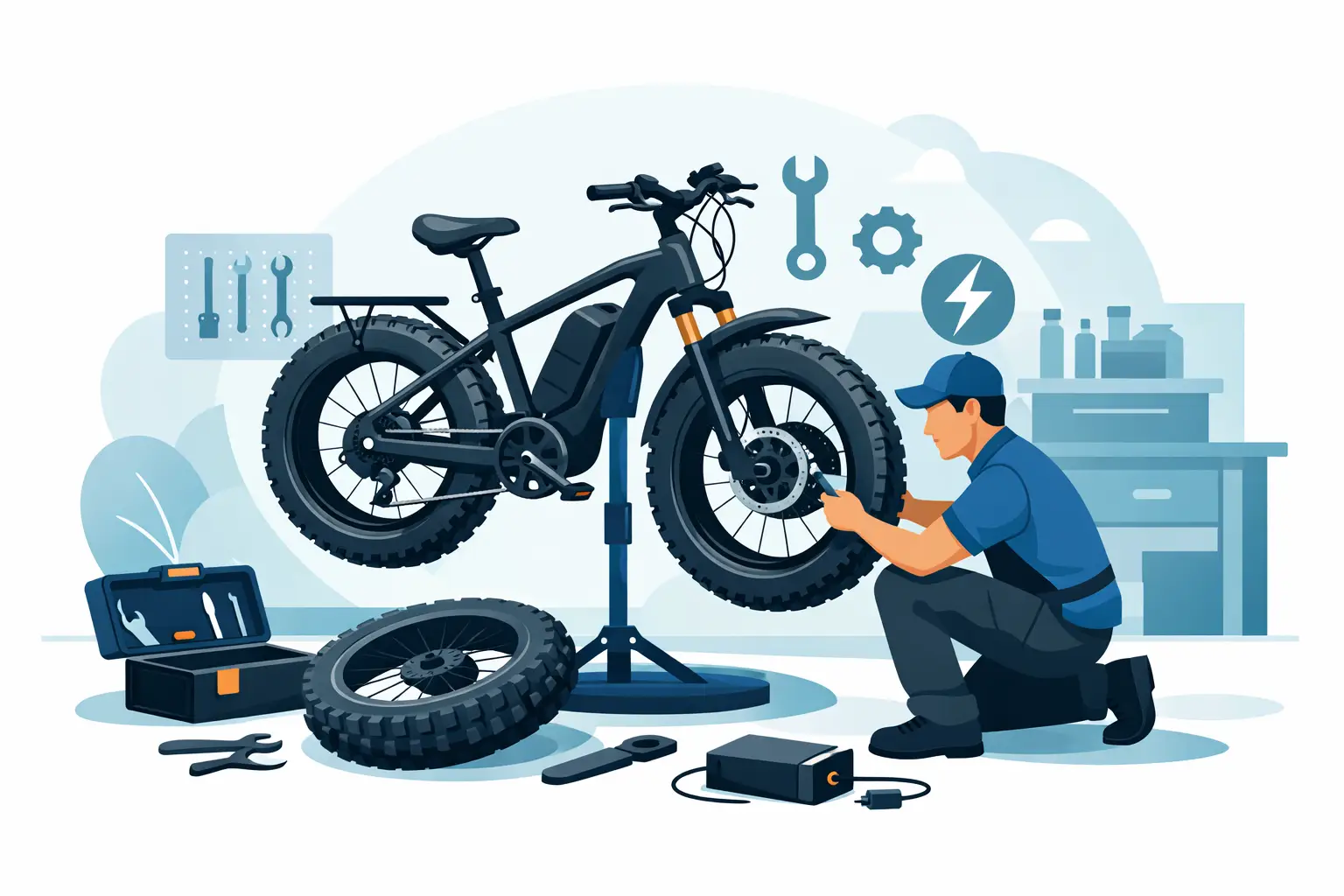
A fat tire e-bike can hide a problem longer than a standard commuter bike. Its wide tires soften bumps, its heavier frame feels planted, and its motor may still pull well enough to get you home. Then the issue becomes harder to ignore: a rear wheel starts pulsing under power, the battery drops from half charge to empty, or a brake rub turns into a loud, hot rotor.
Ebike repair for fat tire bikes is not just regular bike service with wider tubes. These bikes place more load on tires, brakes, wheels, wiring, motors, and battery connections. A good repair starts by separating the symptom you feel from the component that is actually causing it.
Ebike Repair for Fat Tire Bikes Starts With Diagnosis
Fat tire e-bikes are commonly used for beach paths, neighborhood errands, commuting, trails, and delivery-style riding. That use adds up. A heavier bike, a higher-powered hub motor, and a rider carrying cargo can put significant stress on the rear wheel and drivetrain. Sand, dust, washboard roads, curb drops, and repeated hard braking make the job tougher.
The first step is to reproduce the complaint and inspect the complete system. If the bike cuts out when climbing, the motor is not automatically the problem. A weak battery cell group, a battery management system restriction, a loose discharge connector, a damaged phase wire, or a controller overheating under load can all produce a similar loss of power.
The same applies to charging issues. A charger light can appear normal while the battery is not accepting a full charge. Voltage readings, connector condition, charging-port integrity, and battery behavior under load tell a much clearer story than a quick visual check.
The tire size changes the repair approach
Most fat tire bikes use 20-inch or 26-inch wheels with tires around 4 inches wide. Those tires offer comfort and traction, but they are heavier to accelerate and slow down. Incorrect pressure can make the bike feel unstable, vague in corners, or unusually hard on the battery. Too little pressure risks pinch flats and tire damage. Too much pressure reduces the cushioning that riders expect from a fat tire setup.
Tire replacement also requires attention to the wheel itself. On a rear hub motor bike, removing the wheel means disconnecting the motor cable, supporting a heavy motorized wheel, and reinstalling torque hardware correctly. A pinched motor cable, poorly seated axle, or missing torque washer can create a much bigger problem than the original flat.
Electrical Problems That Need More Than a Parts Swap
Electrical faults are where fat tire e-bike repairs often become confusing. Many bikes use a simple-looking system made up of a battery, controller, display, throttle, pedal-assist sensor, motor, brake cutoffs, and wiring harness. Each component depends on the others. Replacing parts without testing can be expensive and still leave the fault in place.
A motor that jerks, vibrates, or makes a growling sound under acceleration may have damaged hall sensor signals, phase-wire trouble, controller output problems, or internal motor damage. If the wheel spins freely on a stand but struggles with a rider on it, load testing matters. Problems that do not appear without load are common.
Intermittent power loss deserves the same careful approach. A bike that turns off after hitting a bump may have a loose battery cradle connection, an internal battery issue, a cracked solder joint, or wiring that has rubbed through near the headset or rear dropout. The display may shut down because it lost power, but that does not prove the display itself has failed.
Water exposure is another concern in San Diego, even when the bike is not ridden through heavy rain. Coastal moisture, wet storage, and washing a bike with direct spray can corrode connectors over time. Green or white residue at a connector, damaged seals, and loose pins can create voltage drops or communication errors. Cleaning and securing a connection may solve the problem, but corrosion that has traveled inside a harness or component may require repair or replacement.
At FixEbike, diagnostic work focuses on finding the failed circuit or component before recommending a repair. That can include checking battery voltage, testing controller outputs, examining hall sensor behavior, inspecting phase wiring, and confirming that brake cutoffs, throttle signals, and pedal-assist inputs are operating as they should.
Brakes and Wheels Carry More Weight
A fat tire e-bike may weigh 65 to 90 pounds before the rider, gear, child seat, or cargo is added. Brakes that felt acceptable when new can become weak quickly when pads wear, rotors glaze, or calipers lose alignment. Squealing is not always a safety issue, but a soft lever, reduced stopping power, pulsing at the lever, or a rotor that becomes extremely hot should be addressed promptly.
Mechanical disc brakes often need periodic cable adjustment as pads wear. Hydraulic brakes can need caliper alignment, pad replacement, rotor service, or a proper bleed when the lever feels spongy. Contaminated pads are another frequent cause of poor braking, especially after chain lubricant, cleaning chemicals, or tire sealant reach the rotor.
Wheel service matters just as much. Heavy hub motors place stress on spokes, particularly on the rear wheel. A loose spoke can lead to more loose spokes, a wobble, broken nipples, or a rim that no longer runs true. Catching a small wheel issue early is usually less costly than waiting until the rim or motor wheel needs major rebuilding.
Common Fat Tire Bike Issues That Look Like Something Else
Several problems are easy to misread. A bike that feels slow may have a dragging brake, underinflated tires, a failing battery, a controller in a reduced-power mode, or a motor issue. A clicking noise may come from loose spokes, crank arms, pedal threads, brake hardware, a freewheel, or the motor under torque. The location where you hear a noise is not always where it originates.
Battery range complaints also require context. Range changes with rider weight, hills, wind, tire pressure, cargo, assist level, temperature, and how often the throttle is used. A real battery problem is more likely when the voltage drops sharply, the display percentage falls unpredictably, the bike shuts down under acceleration, or charge time has become noticeably shorter.
For moped-style fat tire bikes, suspension and frame hardware should be checked along with the electrical system. Loose fasteners at the rear shock, fork, rack, fenders, handlebars, and axle area can create rattles and affect handling. These bikes are built for comfort, but they still need routine inspection after rough use.
What You Can Check at Home and What to Bring In
Before scheduling service, check that the battery is seated and locked, the charger and charging port are undamaged, tire pressure is reasonable, and no cable has been pulled tight or crushed. Look for obvious cuts in the tire, loose axle hardware, a bent brake rotor, or a display error code. Write down when the issue occurs: during charging, on hills, after several miles, only with throttle, or only with pedal assist. That information speeds up diagnosis.
Avoid opening a battery pack, bypassing a fuse, modifying battery connectors, or testing high-current wiring with improvised tools. Lithium-ion battery work carries fire and shock risk, and incorrect wiring can damage a controller or motor in seconds. If a battery is swollen, unusually hot, leaking, smells burnt, or has been severely impacted, stop using and charging the bike until it can be inspected.
A professional service visit is especially worthwhile when the bike has a persistent electrical fault, a motor noise under load, a charging failure, a brake safety concern, or a damaged rear hub motor wheel. The goal is not to replace the most likely part. It is to identify the reason the part failed and make sure the rest of the system is safe to ride.
Keep Small Problems From Becoming a No-Ride Day
Fat tire bikes benefit from regular checks because their weight and power magnify minor wear. Keep tires properly inflated for your riding conditions, clean the drivetrain, inspect brake-pad thickness, and listen for new wheel or motor noises. After trail riding or beach use, wipe down the bike and inspect connectors, axle areas, and moving parts for grit and moisture.
If your bike begins cutting out, braking poorly, or losing power, do not wait for a complete breakdown on a busy road or remote trail. A clear diagnosis now can often protect the battery, motor, and controller from a more costly failure later.