
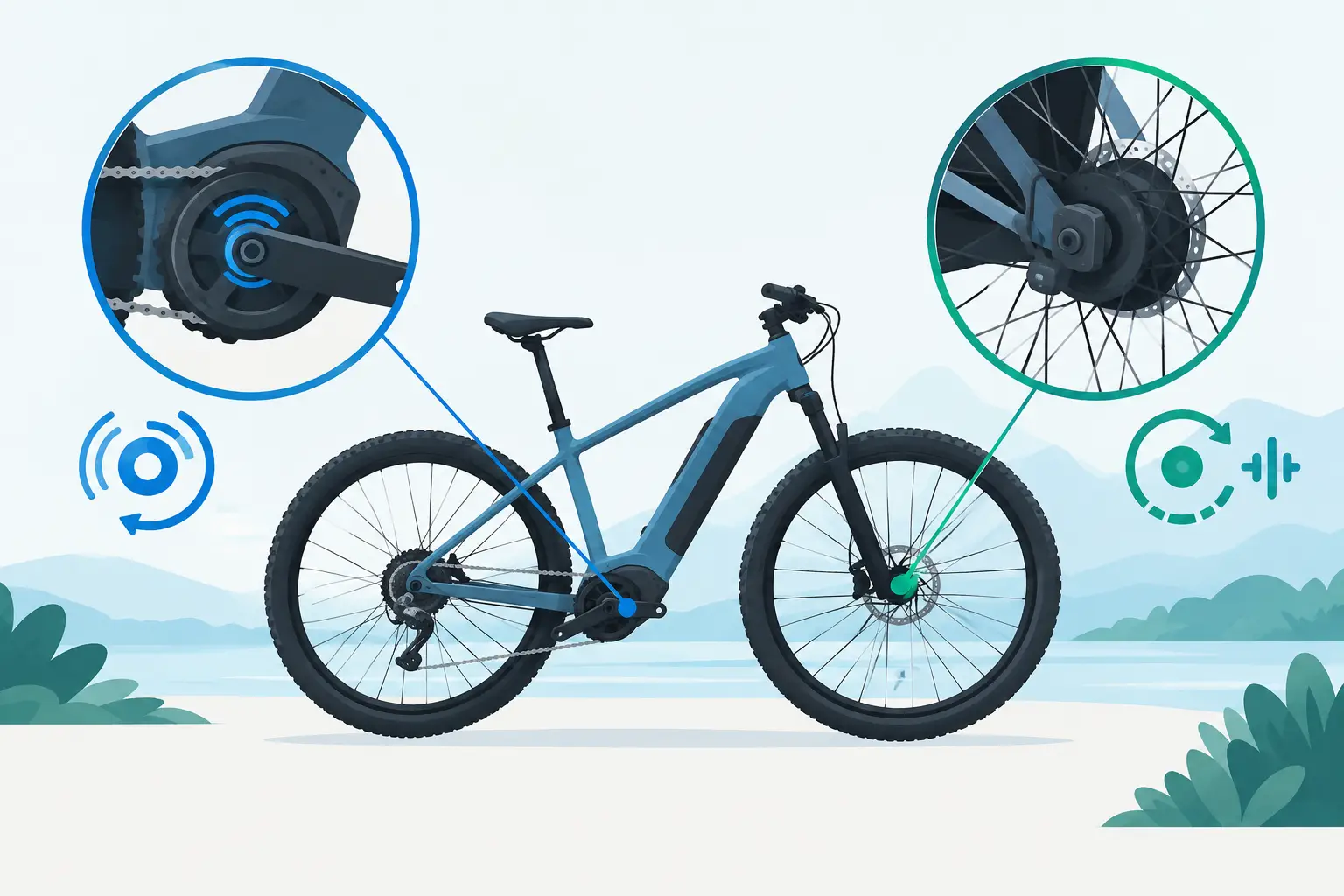
A bike that surges forward after half a pedal turn can feel completely different from one that adds power in direct proportion to how hard you push. That difference usually comes down to ebike torque sensor versus cadence sensor pedal assist. Neither system is automatically better. The right choice depends on how you ride, what level of control you want, and what you expect when climbing, starting from a stop, or moving through traffic.
For repair purposes, knowing which system your e-bike uses also helps separate normal behavior from a real electrical fault. A delay in assistance may be normal on one bike and a sign of a bad sensor, loose connector, controller issue, or damaged wiring on another.
What a cadence sensor does
A cadence sensor detects whether the pedals are turning. Most use a magnet disc near the bottom bracket and a stationary pickup sensor. As magnets pass the pickup, the controller receives a signal that the rider is pedaling and applies power based on the selected assist level.
The key point is that a basic cadence sensor does not measure how hard you are pedaling. Pedal lightly or pedal hard, and the motor may deliver roughly the same programmed assistance once it sees pedal movement. On many hub-motor commuter, fat-tire, and moped-style e-bikes, this creates a relaxed, scooter-like ride feel.
Cadence-based pedal assist is popular because it is simple, affordable, and effective for casual riding. Select a higher assist setting, turn the cranks, and the motor does much of the work. For riders carrying cargo, recovering from an injury, or commuting without arriving sweaty, that can be exactly the point.
The trade-off is response. A cadence system may need part of a pedal rotation before it recognizes movement. Some have 5, 8, or 12 magnets, while others use more magnets for quicker engagement. Controller programming matters too. Two e-bikes with similar-looking cadence discs can behave very differently at takeoff.
How a torque sensor changes the ride
A torque sensor measures pedal force, not just pedal rotation. Depending on the bike, it may be built into the bottom bracket, crank area, rear axle, or drivetrain. When you push harder, the sensor reports more force to the controller, which responds with more motor assistance.
This usually feels more like riding a strong version of an ordinary bicycle. Start gently, and power comes in gently. Stand up for a hill or press hard to merge through an intersection, and the motor adds more support. The connection between your effort and the bike’s response is more immediate and intuitive.
Torque sensing is common on many premium commuter, road, and mid-drive e-bikes. It is especially useful where traction, balance, and precise low-speed control matter. On a crowded bike path, a torque-sensing system can be easier to modulate than a cadence bike that applies a fixed amount of power as soon as it detects crank movement.
That natural feel does require the rider to contribute. If you prefer to rotate the pedals with minimal effort while the bike does nearly all the work, a torque sensor may feel less powerful at first. It is not necessarily delivering less power. It is asking for more rider input before delivering it.
Ebike torque sensor versus cadence: ride differences
The practical difference shows up most clearly in everyday situations. At a stoplight, a cadence bike may have a short delay followed by noticeable motor engagement. A torque-sensing bike typically begins assisting as pressure reaches the pedal, with less of a sudden push.
On hills, cadence assist can make climbing easy as long as the selected power level is high enough. But it may not react to the fact that you are suddenly pushing harder. Torque assist responds to that added effort, so it tends to feel more controlled when a route changes from flat pavement to a steep grade.
On longer commutes, the choice is personal. Cadence assist can reduce effort and make a heavy e-bike manageable over distance. Torque assist can make the ride feel engaging and efficient, particularly for riders who still want exercise. Battery range is not determined by sensor type alone, but torque-based riders often use less energy when they pedal consistently. A cadence bike set to high assist can draw more battery power because it supplies a larger fixed amount of help even when the rider is barely pedaling.
Neither option makes an e-bike unsafe by itself. Proper brake adjustment, tire condition, throttle operation, controller programming, and the rider’s familiarity with the bike all matter. A powerful cadence system simply deserves a little more attention during low-speed starts until you understand how quickly it comes on.
When normal sensor behavior looks like a problem
Many repair visits begin with a rider saying, “My pedal assist is delayed,” or “The motor only works when I pedal really hard.” Those descriptions are useful, but they do not always mean the sensor has failed.
A cadence sensor may naturally take a partial revolution to activate. If it works consistently after that delay, it may be operating as designed. A torque sensor may feel weak when the rider is barely pressing on the pedals, especially in a low assist setting. That can also be normal.
A real problem is more likely when the behavior changes suddenly. If your e-bike once engaged smoothly but now cuts in and out, surges without a matching change in pedal effort, provides no assist, or displays an error code, the sensor circuit should be checked. The issue could be the sensor itself, but it could also be a pinched cable, corroded connector, damaged magnet disc, controller fault, water intrusion, or low system voltage under load.
On a cadence system, a cracked or shifted magnet ring is a common mechanical cause of intermittent pedal assist. The sensor may be mounted too far from the magnets, the disc can wobble, or debris can interfere with the pickup. These are often straightforward repairs once the source is confirmed.
Torque sensor diagnosis is more involved. The sensor signal needs to be evaluated alongside battery voltage, controller communication, display settings, brake cutoffs, and motor operation. Some torque sensors require calibration, while others are integrated into parts that must be replaced as an assembly. Guessing at components can be expensive, which is why a diagnostic-first approach matters.
Hybrid systems and settings that affect feel
Not every e-bike fits cleanly into one category. Some bikes blend torque and cadence data, using pedal movement to confirm that the rider is active and torque input to adjust power. Others use a torque sensor but include aggressive controller programming that makes the bike feel more like a cadence model.
Assist settings can also change the experience dramatically. Level 1 on a torque-sensing commuter may provide a subtle boost, while Level 5 can feel very strong when you press hard. On a cadence bike, higher levels may increase the speed limit, motor current, or both. A display setting changed accidentally can make riders believe a sensor has failed when the bike is simply in a lower support mode.
Throttle-equipped e-bikes add another layer. If the throttle works but pedal assist does not, the motor and battery may be fine while the pedal sensor circuit, brake cutoff, or controller input needs attention. If pedal assist works but the throttle does not, that points in a different direction. Those details help narrow a diagnosis quickly.
Which sensor is right for your riding?
Choose a cadence sensor if you want easy assistance with minimal pedal effort, a simpler system, and a relaxed ride on flatter routes. It is a practical fit for many fat-tire cruisers, utility bikes, and riders who value motor help over a traditional cycling feel.
Choose a torque sensor if you want smooth starts, more natural control, and assistance that rises with your effort. It is often the better fit for active commuters, riders navigating hills, and anyone who wants the e-bike to feel predictable through turns and changing terrain.
If your current bike no longer feels predictable, do not assume you chose the wrong sensor type. A sudden change in response is worth checking. At FixEbike, the goal is to identify whether you are feeling normal system behavior, a setup issue, or a component fault before recommending a repair. A properly functioning pedal-assist system should make every ride feel familiar enough that you can focus on the road ahead.