
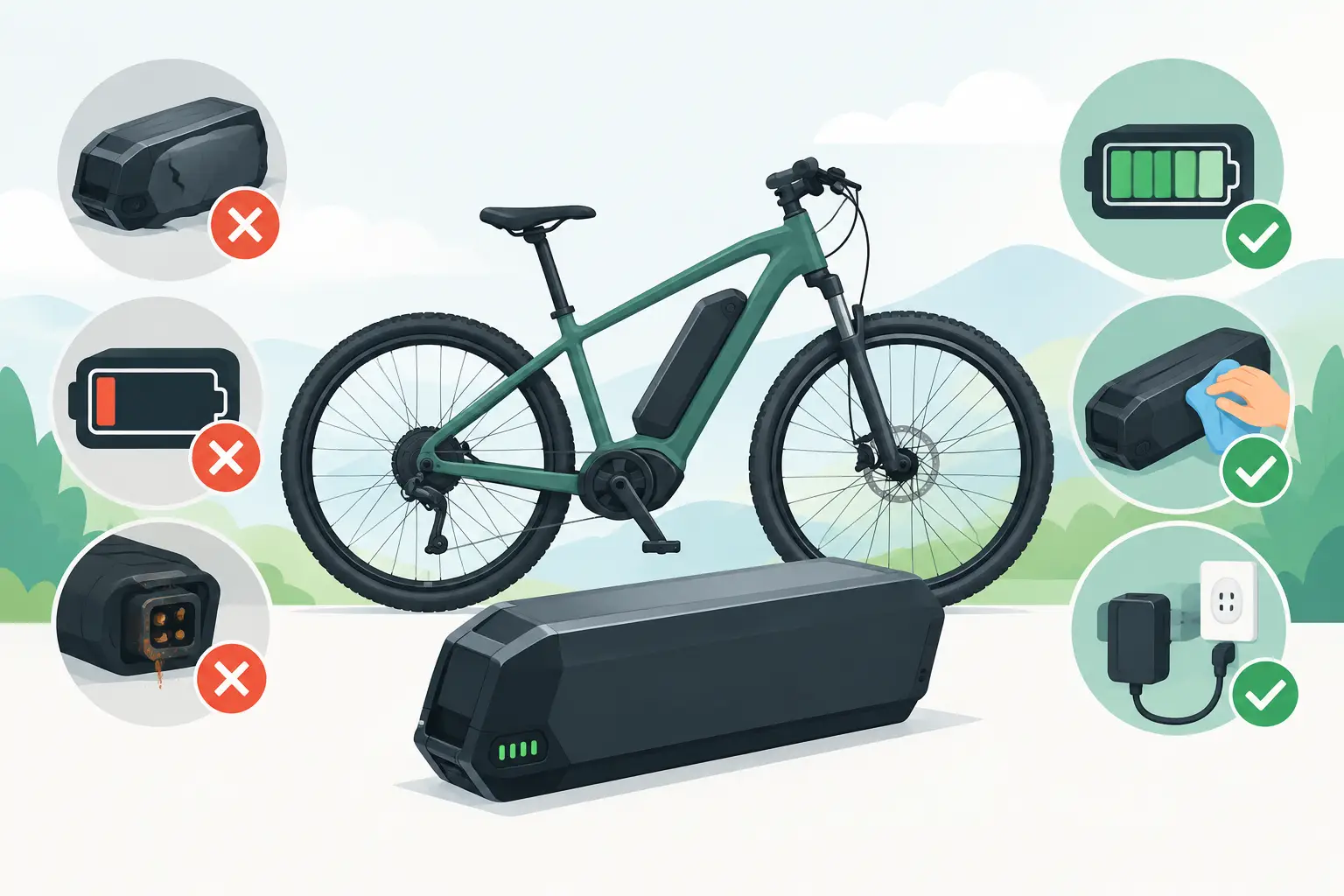
A battery that suddenly will not charge is frustrating. A battery that gets unusually hot, cuts power on a hill, or has a swollen case is a safety issue. Ebike batteries are the most energy-dense and often the most expensive part of an electric bike, so the right response is not to guess or keep riding until the problem gets worse.
For riders around San Diego, battery problems often show up after a long hot summer, a period of storage, or months of daily commuting. The battery may be the cause, but it is not always the cause. A failed charger, damaged charge port, loose connector, controller fault, or voltage drop in the wiring can create similar symptoms. Proper diagnosis matters because replacing a battery before testing the system can be an expensive mistake.
How Ebike Batteries Work
Most modern e-bikes use lithium-ion battery packs. Inside the outer case are many individual cells connected in series and parallel to produce the voltage and capacity the bike needs. A 48V battery, for example, is not one large 48V cell. It is a managed group of smaller cells working together.
The pack also contains a battery management system, commonly called a BMS. This circuit monitors cell groups, manages charging and discharge, and helps protect the pack from conditions such as overcharging, excessive current, low voltage, and overheating. When the BMS detects a serious issue, it may shut the battery down. To a rider, that can look exactly like a dead battery.
That is why a battery that will not power the bike is not automatically beyond repair. The issue could be cell imbalance, a BMS fault, a blown fuse, corrosion at a connection, or an external electrical problem. On the other hand, a pack with degraded cells or physical damage may need replacement. The difference should be established through testing, not assumptions.
Common Ebike Battery Symptoms and Their Causes
The battery will not charge
Start with the basics: confirm the wall outlet works, inspect the charger cable, and check whether the charger indicator behaves normally. A charger with a green light may still be faulty, especially if it never changes state when connected to the battery.
If the charger is functional, the issue may be a damaged charge port, a broken internal wire, a tripped BMS, or a pack voltage that has dropped too low after long storage. Some batteries will refuse to accept a charge once their voltage falls below the BMS protection threshold. Attempting to bypass that protection without proper equipment is not a safe DIY repair.
The bike turns on but loses power under load
A display can look normal while a weak battery struggles the moment the motor demands current. This commonly appears on steep hills, during fast acceleration, or with a heavier rider or cargo load. The bike may cut out, then work again after a brief rest.
Voltage sag is often involved. As cells age, their internal resistance rises, causing voltage to drop sharply under load. The BMS may then shut the pack off to prevent over-discharge. A motor or controller drawing excessive current can produce the same symptom, so both the battery and powertrain need to be checked.
Range has dropped noticeably
Every lithium-ion battery loses capacity over time. How quickly depends on cell quality, charge cycles, heat exposure, storage habits, rider weight, terrain, tire pressure, and how much throttle or assist is used. A range drop that develops slowly may be normal aging. A sudden major drop points more strongly toward a failing cell group, BMS issue, poor connection, or inaccurate battery-level display.
Do not judge battery health only by the bars on the display. Many displays estimate charge from voltage, and voltage changes depending on load. A battery can show several bars while having little usable capacity left when climbing a grade.
The battery or charger gets hot
Warm is normal after a demanding ride or during charging. Hot enough that you cannot comfortably keep your hand on it is not. Stop using the battery if it becomes excessively hot, smells unusual, makes popping or hissing sounds, leaks, or shows swelling, cracking, or melted plastic.
A damaged lithium-ion pack should not be charged indoors, stored near combustible materials, opened, or placed in regular trash. Move away from the bike, avoid handling it more than necessary, and arrange for qualified evaluation and proper disposal. Fire risk is low when a quality battery is used and maintained correctly, but visible damage changes the situation.
Battery Care That Actually Extends Service Life
There is no way to prevent battery aging entirely, but a few habits make a meaningful difference. Heat is one of the biggest factors in Southern California. Avoid leaving the battery in direct sun, a sealed car, or a hot garage for extended periods. If the bike has been sitting in the sun after a ride, let the battery cool before charging.
Use the charger supplied for the battery or a verified charger with the correct voltage and connector. A charger that physically fits is not necessarily compatible. Incorrect charging voltage can damage the pack or create a safety hazard.
For daily riders, charging to full is often practical and completely reasonable when you need the range. If you have more range than you need, stopping short of 100 percent can reduce long-term stress on the cells. The bigger priority is avoiding long periods at either extreme: do not routinely store a battery empty, and do not leave it fully charged for months.
For storage longer than a few weeks, keep the battery in a dry, temperature-stable location and check it periodically. A partial charge is generally better than storing it fully drained or fully charged. Remove the battery from the bike if possible, especially if the bike is stored in an unconditioned garage.
Keep terminals clean and dry. A loose battery mount, worn key lock, damaged case, or corroded connector can interrupt power and imitate an internal battery failure. On moped-style and fat-tire e-bikes, vibration and rough roads can make these connection issues more common.
Why Battery Diagnosis Requires More Than a Voltmeter
A voltage reading is useful, but it does not tell the whole story. A battery can show an apparently normal voltage at rest and still collapse under load. Good diagnosis may include testing charger output, pack voltage, voltage under load, discharge behavior, connector condition, BMS operation, and communication signals on proprietary systems.
The rest of the bike matters too. A shorted controller, failing hub motor, damaged phase wire, or hall sensor problem can overwork a healthy battery or cause shutdowns that look like battery trouble. Conversely, a weak pack can make a healthy motor system appear faulty. This is why component swapping without measurements often wastes time and money.
At FixEbike, battery concerns are approached as an electrical-system diagnosis. The goal is to identify whether the problem is within the pack, charging equipment, wiring, controller, display, or motor circuit before recommending repair or replacement.
Repair, Rebuild, or Replace?
The right answer depends on battery age, case condition, brand support, replacement availability, and the actual failure. A damaged or swollen pack is generally a replacement case, not a rebuild project. A battery with a failed fuse, connection, charge port, or BMS may be repairable if the cells test healthy and the pack can be serviced safely.
A rebuild can make sense for certain quality packs, particularly when a compatible replacement is unavailable. It is not automatically the best value. Rebuilding requires matching appropriate cells, correct spot-welding methods, insulation, BMS compatibility, and careful testing. Cheap rebuilds using unknown cells can create range, reliability, and safety problems.
Replacement is often the most predictable option for older packs with widespread cell degradation. Whenever possible, use an original manufacturer battery or a reputable compatible unit designed for the bike’s voltage, mount, connector, and controller requirements. A random low-cost pack may not fit securely, may have incorrect discharge capability, or may lack the protections needed for your bike.
When to Stop Riding and Get It Checked
Stop riding immediately if the battery is swollen, cracked, wet inside, excessively hot, leaking, smoking, or smells burnt or chemical-like. Also stop if the bike repeatedly cuts out under normal use, the charge port is loose or scorched, or the battery has been involved in a hard crash.
For less urgent problems, schedule service when range has dropped sharply, charging has become inconsistent, the battery-level display behaves erratically, or the bike loses power only under acceleration or hills. Catching a connection or charger problem early can prevent a roadside breakdown and may save the battery from deeper discharge damage.
Your e-bike should feel dependable when you head out for work, errands, school drop-off, or a ride along the coast. When the power system starts acting differently, treat that change as useful information, not something to ride around until it leaves you stranded.