
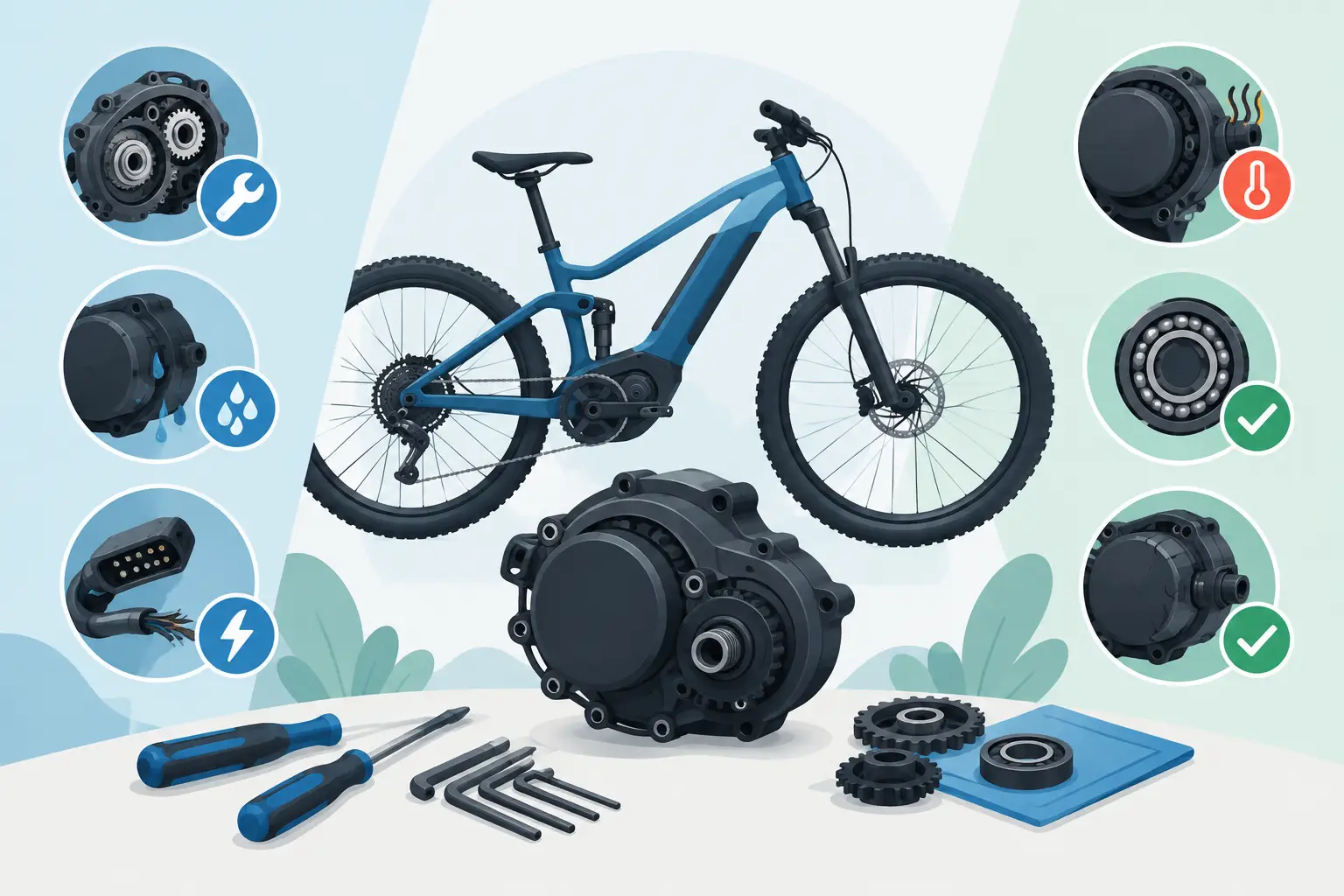
A mid drive repair comparison starts with one fact that catches many riders off guard: a loss of assist does not automatically mean the motor has failed. Mid-drive systems connect the motor to the bike’s drivetrain, battery, controller, display, sensors, and wiring. A problem in any one of those areas can feel exactly like a motor problem from the saddle.
For San Diego commuters, recreational riders, and families relying on an e-bike every day, the goal is not to replace expensive parts quickly. It is to identify the actual fault, explain the repair options clearly, and get the bike riding reliably again.
What Makes Mid-Drive Repairs Different?
A hub motor drives the wheel directly. A mid-drive motor applies power through the chain, cassette, derailleur, and rear wheel. That design gives mid-drives strong climbing performance and efficient use of the gears, which matters on grades around Poway, Rancho Bernardo, and Escondido. It also means mechanical drivetrain condition has a much bigger effect on how the e-bike feels.
When a mid-drive bike makes noise, slips under load, or loses power, the issue may be electrical, mechanical, or both. A worn chain can skip across a worn cassette and feel like intermittent motor engagement. A bent derailleur hanger can create shifting trouble that becomes much more obvious when motor torque is applied. At the same time, a battery voltage drop, damaged harness, or internal motor sensor fault can cause true power loss.
That is why a proper diagnosis should look beyond the visible symptom. Replacing a motor because the bike surges, clicks, or displays an error code can be an expensive guess.
Mid Drive Repair Comparison: Common Problems and Fixes
The most useful comparison is not simply motor repair versus motor replacement. It is comparing the likely failure point, the repair path, and the long-term value of each option.
Drivetrain wear versus internal gear wear
A chain, cassette, chainring, and derailleur are wear items. Mid-drive riders often wear them faster than riders on non-electric bikes because the drivetrain handles both human pedaling force and motor torque. Skipping under load, grinding during shifts, chain drops, and poor gear engagement commonly point to external drivetrain wear or adjustment.
These repairs are usually straightforward when caught early. A technician can measure chain wear, inspect tooth profiles on the cassette and chainring, check derailleur alignment, and set shifting correctly. Replacing a worn chain before it damages the cassette may keep the repair much more affordable.
Internal reduction gears are different. Some mid-drive motors use nylon or composite gears that can wear, crack, or lose teeth over time. Symptoms may include a loud grinding sound, a motor that spins without producing normal drive, or power that engages inconsistently. Internal gear service requires opening the motor, inspecting the drive assembly, and confirming that the problem is not actually coming from the chain, cassette, crank interface, or freehub.
External drivetrain service is generally less involved and should be handled as routine maintenance. Internal motor gear repair is more specialized, but it can be worthwhile when the motor housing, electronics, and primary components are otherwise in good condition.
Battery or connection fault versus motor fault
A battery can show a full charge and still fail under real riding load. Weak cell groups, a Battery Management System issue, corroded contacts, or a loose battery mount connection can cause the voltage to drop when the bike asks for higher current. The rider may experience pulsing assist, unexpected shutdowns on hills, or a bike that turns on normally but will not deliver full power.
This can easily be mistaken for a damaged mid-drive motor. The same is true of damaged connectors, pinched wiring, water intrusion, or a harness that intermittently disconnects as the handlebars turn or the bike hits bumps.
A good diagnostic process checks battery voltage, voltage behavior under load when appropriate, connector condition, harness continuity, and communication between components before condemning the motor. If the problem is in the battery, wiring, controller, or display, replacing the motor will not solve it.
Battery repair and battery replacement are not interchangeable choices. In some cases, a failed BMS, damaged connector, or isolated wiring issue can be repaired safely. In other cases, battery age, cell condition, physical damage, or water exposure makes replacement the safer recommendation. The right choice depends on test results, battery construction, and availability of suitable components.
Sensor and communication issues versus complete motor failure
Modern mid-drives rely on several signals to deliver controlled assist. Speed sensors, cadence sensors, torque sensors, brake cutoffs, displays, and controllers all need to communicate correctly. If a speed sensor magnet is out of position or its cable is damaged, the system may limit assistance or show a fault. If a brake cutoff sensor is stuck in the activated position, the bike can behave as if the brakes are constantly being applied.
Torque sensor issues can be more subtle. A rider may feel delayed engagement, weak assist, assist that comes on too aggressively, or behavior that changes from one ride to the next. Error codes can help, but they are a starting point, not a final diagnosis. The same code may result from a connector issue, a failed sensor, a controller problem, or an internal motor fault depending on the system.
When a sensor or external wiring fault is confirmed, targeted repair is usually preferable to a full drive-unit replacement. If diagnostics show an internal sensor failure in a sealed motor that cannot be serviced reliably or supported with parts, replacement may become the more practical option. This is where brand, model, age, and parts availability matter.
Controller replacement versus motor replacement
On some e-bikes, the controller is separate from the motor. On others, it is integrated into the drive unit. A failed controller can cause no power, erratic power delivery, display errors, or a bike that powers on but does not respond to pedaling or throttle input where equipped.
A separate controller can often be tested and replaced without replacing the motor. An integrated controller may require more involved repair or a replacement drive unit. The key is confirming the failure before parts are ordered. A controller that appears dead may be losing power due to a battery mount contact, fuse, ignition wire, or damaged main harness.
There is no one-size-fits-all answer. A replacement motor can be sensible when internal electronics are damaged, repair parts are unavailable, and the rest of the system is in good shape. Component-level repair can make more sense when the fault is isolated and the repair produces a dependable result at a fair cost.
When Repair Is the Better Value
Repair is often the better path when the problem is limited to a wearable drivetrain component, connector, wiring section, external sensor, battery connection, or serviceable internal motor component. It is also a strong option when a quality mid-drive system has plenty of useful life left and replacement would cost far more than the confirmed repair.
The condition of the entire bike matters. If the frame, wheels, brakes, battery, and drivetrain are all neglected, putting major money into a single motor repair may not be the best investment. On the other hand, a well-maintained commuter bike with a specific electrical fault can be worth repairing even if the diagnosis takes more time than a basic bicycle service.
Riders should also consider downtime. A low-cost part is not automatically the best choice if it is poorly matched, unreliable, or difficult to support later. Compatibility matters with displays, controllers, battery voltage, connectors, firmware, and motor specifications.
What a Useful Mid-Drive Diagnosis Should Include
A meaningful inspection begins with the rider’s symptoms: when the fault occurs, whether it happens under load, what the display shows, whether the bike has been exposed to rain, and whether any recent work was performed. From there, the technician should inspect the drivetrain, battery mount, wiring, connectors, brakes, sensors, and system operation.
Testing should narrow the problem down rather than simply identify the most expensive possible part. On difficult cases, that can involve checking for voltage drops, examining phase and sensor wiring where applicable, confirming communication signals, and evaluating the motor’s mechanical operation separately from the external drivetrain.
At FixEbike, that diagnostic-first approach helps prevent unnecessary replacements and gives riders a clear explanation of what failed, what can be repaired, and what each option means for reliability.
If your mid-drive starts clicking on climbs, cutting out after a few minutes, showing an unfamiliar error, or losing assist when you need it most, avoid forcing the bike through the problem. Continued riding can turn a small drivetrain or wiring issue into a larger repair. Getting the fault checked early gives you the best chance of returning to dependable, quiet rides with fewer surprises.