
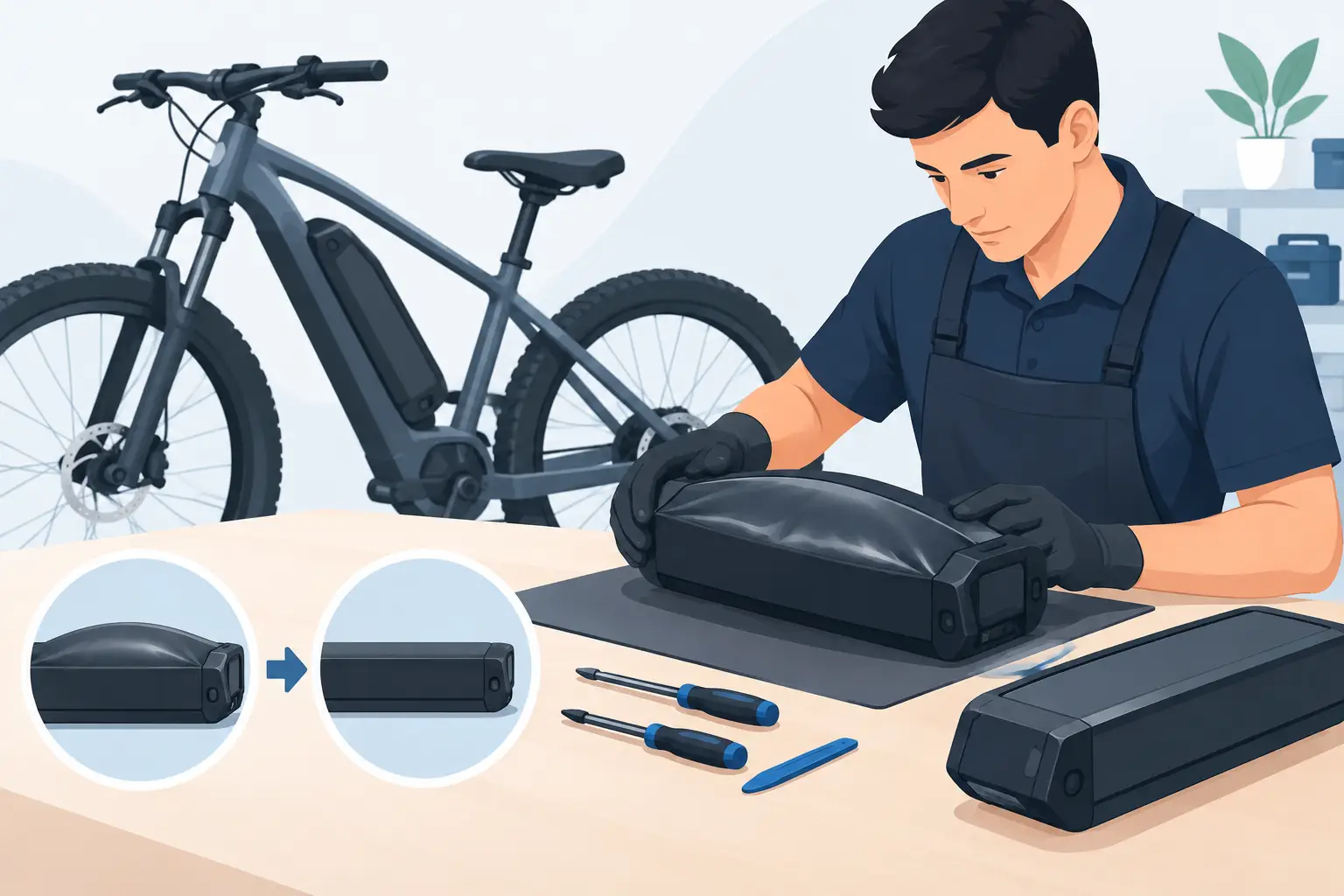
A battery swelling ebike repair example is not a typical repair story where a loose wire gets reconnected and the bike goes home the same day. When a lithium-ion battery case starts to bulge, the pack has experienced a failure condition. The priority is to stop using and charging it, isolate the bike safely, and determine whether the rest of the e-bike was damaged by the event.
A swollen battery can appear as a battery door that will not close, a pack that rocks in its mount, a warped plastic case, or a hard-to-remove battery. Sometimes the change is subtle. Riders may first notice reduced range, unusual heat while charging, a charger that shuts off early, or a battery that no longer fits correctly in the frame.
Why an e-bike battery swells
Most e-bike batteries use lithium-ion cells contained in a protective housing. Inside the pack, a battery management system, or BMS, monitors cell voltage, temperature, charging, and discharge behavior. Swelling occurs when failing cells generate gas inside the pack. That gas has nowhere to go, so the cells and outer case expand.
Age can contribute, but age alone does not tell the whole story. A battery may swell after repeated exposure to high heat, charging with an incorrect charger, water intrusion, an internal short, physical impact, or a cell imbalance that the BMS can no longer manage. A pack can also fail after sitting fully charged in a hot garage for extended periods.
The key point is simple: a swollen lithium-ion e-bike battery is not safe to keep riding, charging, opening, compressing, or storing inside a home. It may continue working for a short time, but apparent operation does not mean the pack is stable.
A real-world style battery swelling ebike repair example
Consider a typical commuter e-bike brought in after its owner noticed the down-tube battery was becoming difficult to remove. The rider had also seen a drop in range over several weeks. The bike still powered on, but the battery cover had begun to bow outward and the case no longer sat flush against the mounting rail.
The first step is not to plug in a charger or force the battery out of the bike. The technician visually inspects the case, terminals, mounting cradle, charge port, wiring, and frame area. If the case is visibly distorted, cracked, hot, leaking, or has a chemical odor, it is treated as an unsafe battery immediately.
In this example, the pack had expanded enough to place pressure on the retaining mechanism. Careful handling was needed to avoid cracking the housing or damaging the battery terminals. Once removed and secured for appropriate disposal, the battery was not rebuilt or put back into service. Swollen packs require replacement, not a reset, a new fuse, or another charge cycle.
The repair work then shifted to the e-bike itself. The battery mount was checked for cracked plastic and bent contacts. The battery connector and charge port were inspected for heat discoloration or corrosion. The controller wiring was examined for pinched insulation, and the system was tested with a known-good compatible battery where appropriate.
That testing matters. A failed battery can be the entire problem, but it can also expose another issue. For example, a damaged charge port, wrong replacement charger, water-contaminated battery cradle, or controller fault could contribute to abnormal charging behavior. Installing a new battery without checking these related components can put the replacement pack at risk.
In this case, the e-bike’s cradle contacts showed heat damage from poor contact pressure. The damaged mount was replaced, the charging system was verified, and the bike was tested under load with a compatible battery. The rider left with a safe power system rather than simply a new pack installed on top of an unresolved electrical problem.
What a proper diagnosis should include
A swollen battery changes the service path. The pack itself is removed from use, but a complete evaluation should look beyond the battery. This is especially true on moped-style, fat-tire, off-road, and delivery e-bikes, where higher current draw can expose weak connections and charging issues faster.
A proper inspection generally includes the battery mounting area, battery terminals, charge port, charger output, controller connections, main power wiring, and any visible fuse or circuit protection. The motor system may also need a load test after a replacement battery is installed. A bike that cuts out under acceleration could have a battery issue, but it could also have voltage drop from a loose connector, damaged phase wiring, or a controller problem.
Compatibility is another part of the diagnosis. Voltage must match, but that is not enough. The replacement battery must have the correct connector, physical fit, mounting interface, polarity, discharge capability, and communication arrangement when the system uses data connections. A 48-volt pack is not automatically interchangeable with every other 48-volt pack.
What riders should do when they notice swelling
If a battery looks swollen or no longer fits properly, turn the e-bike off and do not charge it again. Avoid pressing on the case, trying to reshape it, or forcing it into the frame. Do not leave it in a car, garage corner, apartment hallway, or near combustible materials while deciding what to do.
If it can be removed without force and without handling a hot, damaged, or leaking pack, place it away from people and flammable items in a dry, well-ventilated area until you can arrange professional guidance or approved hazardous battery disposal. If the battery is hot, smoking, hissing, leaking, or giving off a strong chemical smell, move away from the area and contact emergency services.
Do not put a lithium-ion e-bike battery in regular trash or curbside recycling. Disposal rules vary by location, and damaged packs require special handling. A repair shop can help assess the e-bike and advise on the next service step, but disposal should follow local hazardous battery procedures.
Can a swollen e-bike battery be repaired?
For the rider, the practical answer is no. A swollen battery should not be repaired for continued use. Replacing individual cells inside a visibly swollen pack does not remove the underlying safety concern, and opening a damaged lithium-ion battery pack can create serious fire and electrical hazards.
There is a difference between diagnosing a battery-related e-bike problem and attempting to revive a failed swollen pack. A technician can inspect the bike, identify whether the battery is the only fault, repair the bike-side electrical issues, and help match a safe replacement battery. The swollen pack itself should be retired.
This can feel frustrating when the e-bike is otherwise in good condition. Still, it is usually less costly than ignoring the warning signs and risking damage to the controller, wiring harness, frame, or property. The right decision depends on the age of the bike, availability of a compatible replacement pack, condition of the motor system, and total repair cost.
Preventing the next battery problem
No battery lasts forever, but storage and charging habits make a real difference. Use the charger designed for the battery, keep the pack dry, and avoid charging immediately after a hard ride when the battery is still hot. If the bike will sit for weeks, avoid storing the battery at a full charge or completely empty.
San Diego riders should also take heat seriously. Leaving an e-bike battery in direct sun, a sealed vehicle, or a hot garage can accelerate cell wear. Check the battery case and mounting rail regularly, especially after a crash, curb strike, or wet-weather ride.
If your battery has begun to swell, treat that change as a clear stop-riding signal. A careful diagnosis can protect the rest of the e-bike and give you a straightforward path back to safe, dependable riding.