
A pedal assist problem can make an otherwise healthy e-bike feel unpredictable. You start pedaling and get no motor support, the power cuts in and out, or the bike suddenly surges after a delay. Ebike pedal assist sensor repair starts with identifying whether the sensor is actually at fault or whether the problem is in the magnet ring, wiring, controller, brake cutoff system, or display settings.
For riders around San Diego, this matters because pedal assist faults are often mistaken for battery or motor failures. Replacing parts based on a guess can get expensive quickly. A proper diagnosis follows the signal from the crank area to the controller and confirms what has failed before repair work begins.
What the Pedal Assist Sensor Does
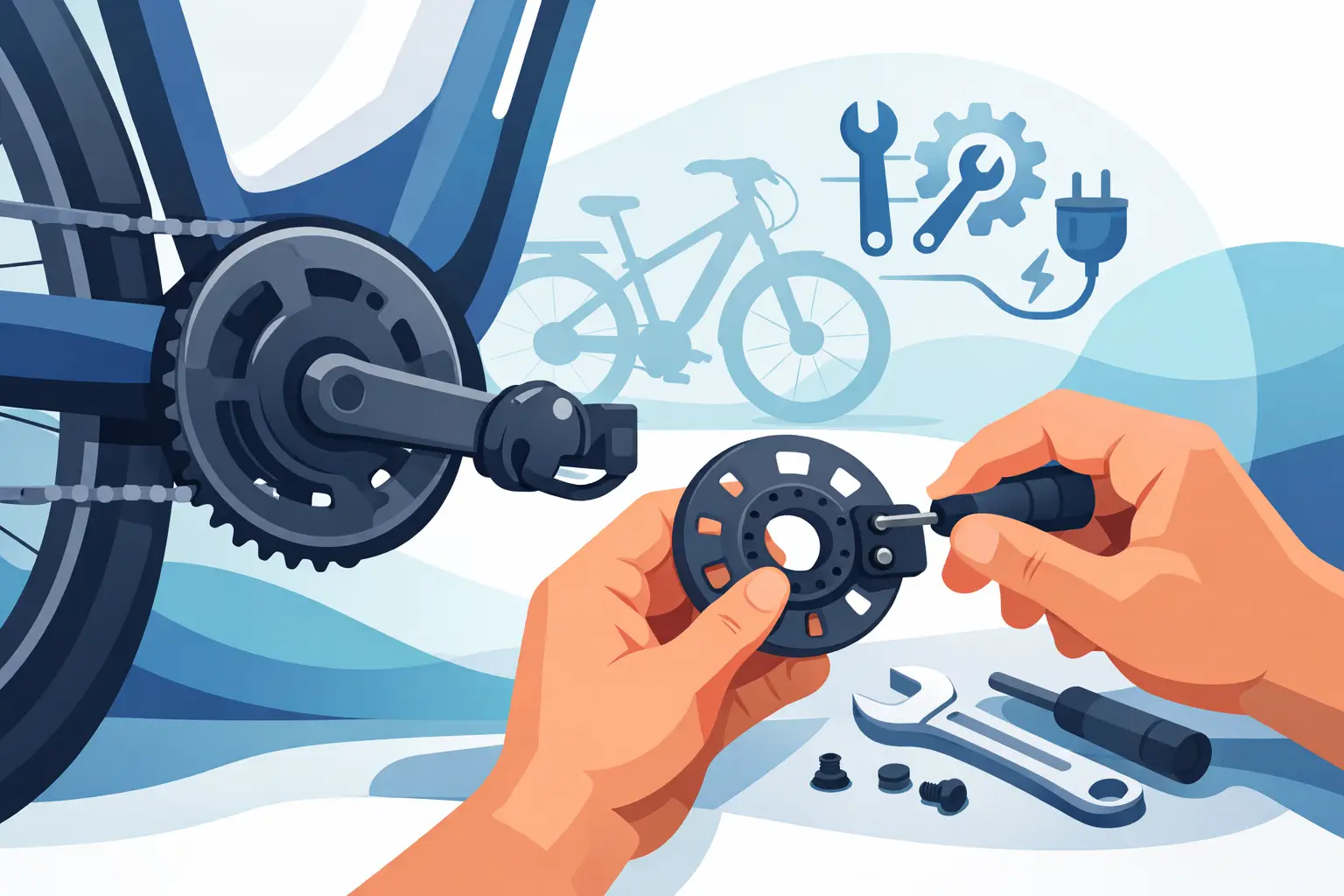
Most e-bikes use a pedal assist sensor, commonly called a PAS sensor, near the bottom bracket and crankset. A magnet disc rotates with the pedals while a fixed sensor reads that movement. The sensor sends a low-voltage signal to the controller, telling it that you are pedaling and, on some systems, which direction you are pedaling.
The controller then combines that signal with your selected assist level, speed information, battery voltage, brake input, and motor limits. If the PAS signal is missing, erratic, or interpreted incorrectly, the controller may withhold power even when the battery and motor are in good condition.
Not every e-bike uses the same system. Many entry-level commuter and fat-tire bikes use a basic cadence sensor. Higher-end bikes may use a torque sensor that measures pedaling force rather than simple crank rotation. Torque sensor troubleshooting is more involved and often depends on manufacturer-specific parts, calibration, and controller communication.
Signs You May Need Ebike Pedal Assist Sensor Repair
A failed pedal assist sensor does not always create an error code. In fact, many bikes simply stop assisting while the display appears normal. The most common symptom is no motor response when pedaling, even though throttle operation still works. That pattern strongly points toward the PAS circuit, but it is not proof by itself.
Intermittent assist is another common complaint. Power may come on only after several pedal rotations, cut out over bumps, or work for the first few miles and then fail. Those symptoms can indicate a cracked sensor wire, loose connector, damaged magnet ring, or moisture inside a connection.
Other warning signs include assist activating backward or only in one pedal position, a grinding or rubbing sound around the crank area, assist that remains on briefly after you stop pedaling, or assist that disappears when the handlebars are turned. The last symptom often points away from the sensor itself and toward a wiring issue near the frame, controller compartment, or cable harness.
A pedal assist failure can also be caused by a stuck brake cutoff signal. If the controller thinks either brake lever is engaged, it may block motor output even though the PAS sensor is sending the correct signal. This is why a technician should not treat every no-assist complaint as a sensor replacement.
Start With the Simple Checks
Before removing components, check the basics that do not require electrical testing. Make sure the battery is charged and fully seated, the display is powered on, and the assist level is set above zero. Some displays allow pedal assist to be disabled while leaving other functions active.
Look closely at the crank area with the bike powered off. The magnet disc should sit close to the sensor without rubbing it. On many bikes, the gap is only a few millimeters. If the disc has slid sideways, cracked, lost magnets, or become packed with dirt, the sensor may not read it consistently.
Also inspect the sensor cable where it leaves the bottom bracket area. This section is exposed to water, road debris, crank movement, and occasional impact. Look for pinched insulation, exposed copper, a connector that has pulled apart, or green or white corrosion around the pins.
If your bike has removable external connectors, disconnect the battery first, then inspect and reconnect the PAS plug carefully. Match alignment arrows or keyways and do not force the connector. Bent pins can turn a simple connection issue into a harness repair.
Avoid cutting wires, bypassing brake connectors, or probing unknown pins while the battery is connected. E-bike wiring often shares grounds and low-voltage signals with the controller and display. A short circuit or incorrect jumper can damage a controller that was working perfectly before the test.
Why Sensor Problems Are Often Misdiagnosed
The pedal assist sensor is a simple part, but the system around it is not. A sensor may receive power from the controller yet fail to return a changing signal as the magnet disc spins. In another case, the sensor signal may be correct at the connector, but a controller input fault prevents assist.
Controller problems are especially easy to overlook. Water intrusion, heat damage, failed internal circuitry, or a damaged wiring harness can interrupt the PAS signal. A display configuration issue can also limit assist on certain e-bike systems. Some bikes require a specific wheel size, speed setting, or startup sequence before pedal assist operates normally.
Mechanical issues matter too. A loose crank arm, worn bottom bracket, bent chainring, or damaged magnet disc can change the sensor gap as you pedal. The bike may work on a repair stand but fail under normal riding vibration. That is why diagnosis should include both a visual inspection and a functional test.
How a Shop Diagnoses the Real Fault
Professional pedal assist diagnosis starts by confirming the rider’s exact symptom. Does the throttle still work? Does the problem happen all the time or only after bumps, rain, or long rides? Is there an error code? Those details narrow the testing path.
A technician then checks battery voltage, display operation, brake cutoff inputs, sensor alignment, connector condition, and controller power supply. With proper test equipment, the PAS sensor can be checked for voltage and signal changes while the crank rotates. The wiring can be tested for continuity and shorts, and the controller can be evaluated when the sensor signal is known to be good.
This approach prevents unnecessary parts replacement. A damaged magnet ring may only need adjustment or replacement. A broken cable may be repairable without replacing the full harness. If the sensor is sealed into a particular bottom bracket assembly, the correct repair may involve replacing that assembly rather than attempting to force apart a non-serviceable unit.
At FixEbike, we see this regularly on commuter e-bikes, moped-style bikes, fat-tire models, and delivery bikes. The goal is not just to make the motor turn on in the shop. It is to identify why the system failed and verify that the repair holds up during real use.
When to Stop Riding and Get It Checked
No pedal assist is inconvenient, but erratic assist deserves more caution. If power surges unexpectedly, stays engaged after you stop pedaling, or cuts in and out in traffic, stop using the e-bike until the issue is diagnosed. Unpredictable motor response can create a safety risk, especially on busy streets, hills, or when carrying a child or cargo.
You should also arrange service if the sensor area has been damaged in a crash, the wiring is visibly cut, water entered the controller compartment, or the bike displays a persistent electrical error. Continuing to ride can turn a repairable wiring or connector issue into a larger controller failure.
A clean sensor area, properly secured wiring, and occasional inspection after wet rides go a long way toward preventing PAS problems. When pedal assist stops behaving the way it should, a focused diagnosis is usually faster, safer, and less costly than replacing components one by one.