
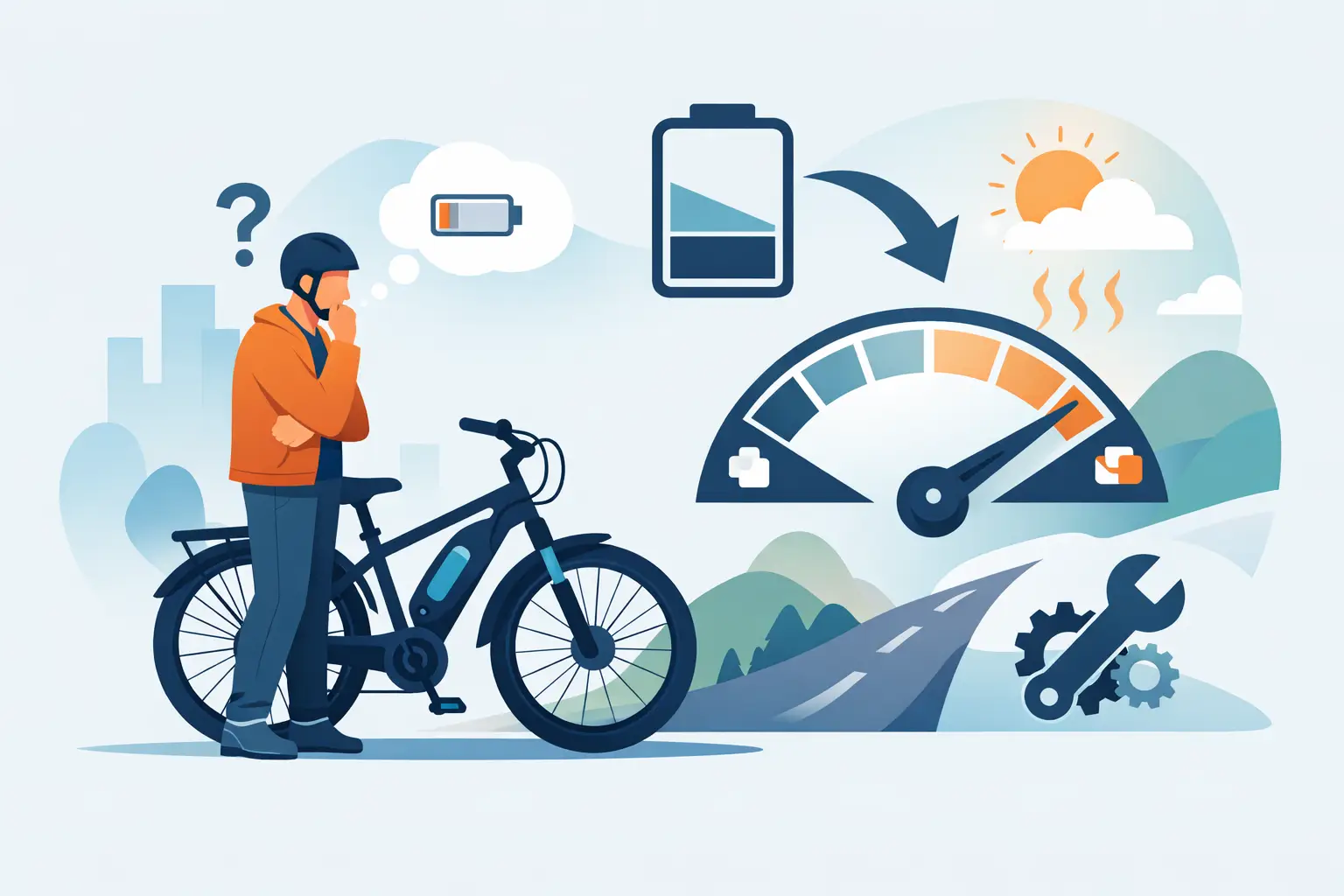
Your ebike range suddenly decreased, but the battery indicator still says it is charged. That is frustrating, especially when a commute that once felt easy now leaves you watching the display or pedaling home with little assistance. A sudden drop in range is not always a worn-out battery. It can come from tire pressure, dragging brakes, a charging issue, temperature, riding conditions, or an electrical fault that causes the system to waste power.
The useful question is not just, “How far did it go?” It is, “What changed?” A real range diagnosis compares battery voltage, charging behavior, mechanical resistance, motor load, and the conditions of the ride. That helps separate a normal range change from a problem that needs repair.
Why Your Ebike Range Suddenly Decreased
Range is an estimate, not a fixed promise. The number a manufacturer lists is usually based on lighter assistance, moderate speeds, flat terrain, a healthy battery, proper tire pressure, and a rider who is contributing some pedal power. San Diego riders may see very different results climbing Poway roads, riding into coastal wind, carrying cargo, or using maximum assist on a fat-tire e-bike.
A gradual reduction over months or years can be normal battery aging. A major change from one ride to the next is more likely tied to a specific condition or fault. Start by thinking back to the first ride when the range changed. Was the bike stored in a cold garage? Did it sit unused for several weeks? Was a tire repaired, a wheel removed, or a new accessory installed? Did the charger behave differently?
Those details matter because range loss often starts outside the battery itself.
Cold weather and riding load
Lithium-ion batteries deliver less usable energy in cold conditions. The battery may show a normal charge level at the start of the ride, then lose bars faster under acceleration or on hills. This is typically temporary once the battery returns to a moderate temperature, but charging a battery that is very cold can be harmful. Bring it indoors and let it warm up before charging.
Load also matters more than many riders expect. Full-throttle starts, high assist levels, steep hills, soft terrain, headwinds, a child seat, panniers, or a heavier rider all require higher current from the battery. A moped-style or fat-tire bike can feel powerful while drawing enough power to cut practical range substantially.
If the reduced range happens only on a tougher route or during colder weather, the bike may be operating normally. If it happens on the same route, in similar conditions, move on to the mechanical and electrical checks.
Check the Simple Causes Before Blaming the Battery
Low tire pressure is one of the fastest ways to lose range. A tire that looks reasonably full can still be far below its recommended pressure. Rolling resistance rises, the motor works harder, and range falls. Check both tires with a gauge, using the pressure range printed on the tire sidewall as a starting point. The correct pressure depends on tire type, rider weight, and terrain, so do not inflate beyond the tire’s maximum rating.
Brake drag is another common cause. Lift each wheel and spin it by hand. The wheel should rotate freely without the brake rotor rubbing heavily or stopping almost immediately. A slight disc-brake sound can be normal, but a wheel that feels difficult to turn needs attention. A misaligned caliper, sticky piston, damaged rotor, or overtightened mechanical brake can make the motor work against the brakes for every mile.
Also check for a chain that is dry, rusty, or binding, and make sure the wheels are correctly installed. On hub-motor bikes, an improperly seated rear wheel or loose axle hardware can affect both mechanical operation and wiring. These are basic checks, but they can make a noticeable difference without replacing a single electrical part.
Battery Problems That Reduce Usable Range
A battery can charge to what appears to be 100% and still have less usable capacity than it did before. As lithium-ion cells age, their capacity declines and their internal resistance increases. Under a heavy load, voltage can drop faster than expected. The display may lose several bars on a hill, then recover somewhat when the bike is parked or the load decreases.
That behavior is called voltage sag. Some sag under hard acceleration is normal. Excessive sag, early power cutoffs, or a battery that drops from full to empty unusually quickly can indicate weak cell groups, an aging pack, poor internal connections, or a battery management system issue.
Charging behavior provides useful clues. If the charger turns green almost immediately, the battery may not be accepting a full charge. If it never reaches its normal full-charge voltage, the charger, charge port, battery fuse, wiring, or battery management system may be involved. A damaged charge port can create intermittent charging that looks like a range problem until the battery is tested properly.
Do not open a lithium battery pack at home. Battery repair requires the right equipment and procedures. Swelling, unusual heat, a chemical smell, melted connectors, water intrusion, or visible damage are reasons to stop using and charging the battery until it can be inspected.
Why the display can be misleading
Many e-bike displays estimate battery level from voltage rather than measuring remaining capacity precisely. Voltage naturally drops under load and rebounds at rest. That means a five-bar display may not tell the full story, especially on a high-power bike.
A better diagnostic process checks the battery’s actual voltage at rest, voltage under load, charger output, connector condition, and communication with the controller where applicable. On smart batteries, an internal BMS can restrict output if it detects a low cell group, overcurrent condition, temperature concern, or communication fault. The bike may still turn on, but deliver less range or reduced power.
Electrical Faults Can Make an Ebike Waste Power
Not every electrical fault causes a complete shutdown. Corroded connectors, partially damaged phase wires, hall sensor issues, failing controllers, or water-damaged wiring can make a motor run inefficiently. The rider may notice reduced power, a rough or jerky start, abnormal motor noise, intermittent assistance, or a system that gets hot faster than usual.
On a hub-motor e-bike, phase wiring and hall sensors help the controller run the motor smoothly. When those signals are compromised, the motor can draw more current for the work it produces. That can feel like poor range, even if the battery itself tests well.
Look for error codes, but do not assume a lack of an error code means there is no electrical problem. Many entry-level displays provide limited diagnostics. A technician can test voltage drop across wiring, inspect connectors for heat damage, evaluate controller output, and check motor operation under load. This is especially useful when range loss appears alongside power surging, throttle delay, or a motor that cuts out on hills.
When a Range Test Is Worth Scheduling
A controlled test is helpful when the change is clear and repeatable. Fully charge the battery with the correct charger, record the starting display reading, set tire pressure, and ride a familiar route using the same assist level you normally use. Note the terrain, wind, cargo, and approximate distance when the first battery bar drops or power changes.
If the bike has lost a large portion of its normal range under similar conditions, or it shuts down before the display reaches empty, it needs more than guesswork. Replacing a battery without testing the charging system, controller, motor load, and wiring can be expensive and may not solve the actual issue.
For riders in the San Diego area, FixEbike can diagnose the complete system, including battery performance, BMS behavior, charger output, controller faults, motor issues, and mechanical drag. That diagnostic-first approach is particularly valuable for bikes with intermittent faults or no clear display error.
Keep riding records for a week if the bike is still safe to use. A few notes about temperature, route, assist level, and battery behavior can turn a confusing range complaint into a clear repair path and get you back to riding with confidence.