
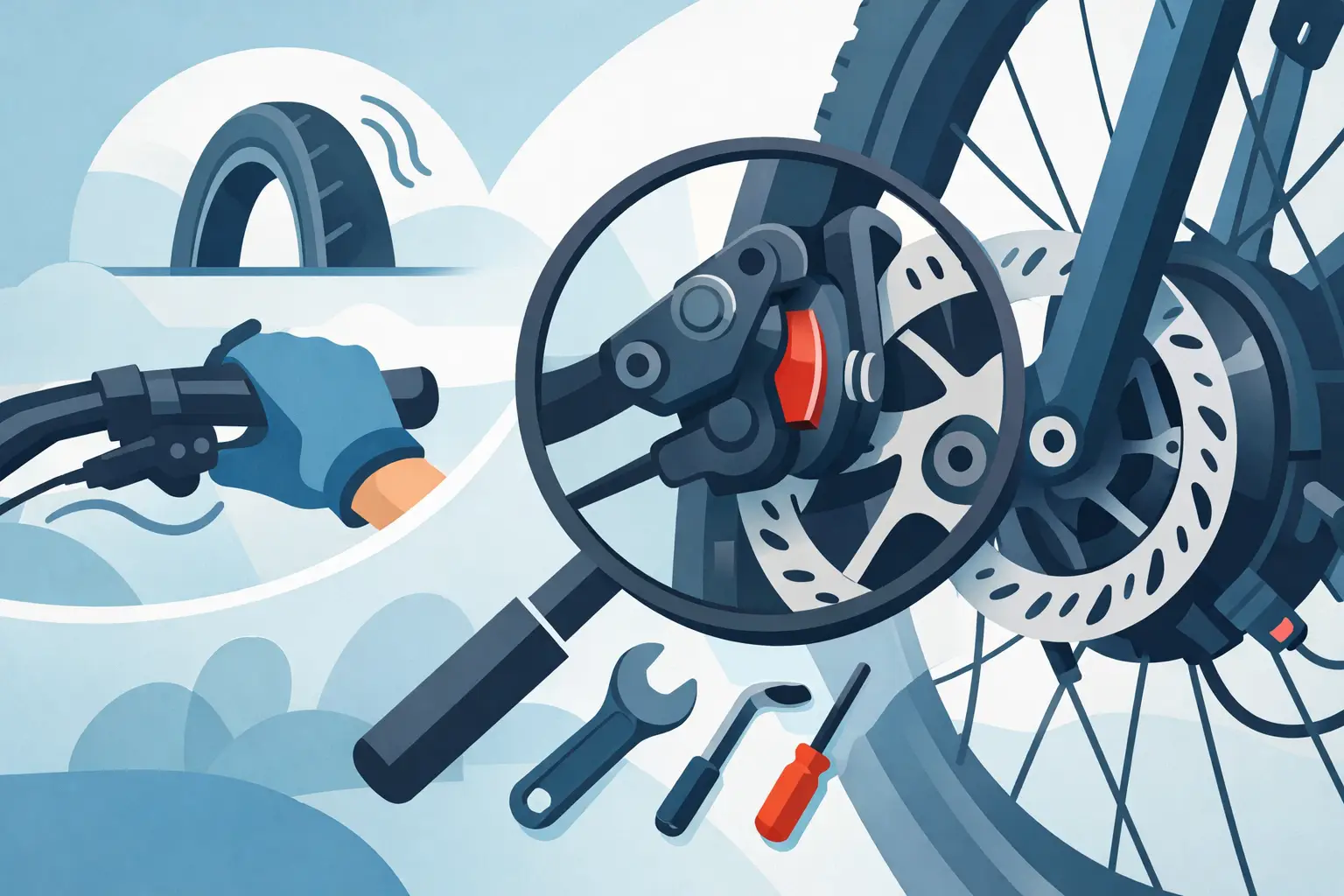
A brake that rubs lightly when you spin the wheel can be annoying. A brake that drags hard, heats up the rotor, or makes the wheel difficult to turn is a safety and range problem. Learning how to fix ebike brake rubbing starts with identifying whether the issue is simple caliper alignment, a bent rotor, a sticking piston, or something more serious in the brake system.
E-bikes put more demand on brakes than standard bicycles. They carry more weight, reach higher average speeds, and often travel farther between stops. A small alignment problem that might be tolerable on a lightweight bike can quickly become uneven pad wear, reduced stopping power, and an overheated rotor on a fat-tire or moped-style e-bike.
Start by Finding Where the Brake Is Rubbing
Lift the wheel off the ground and spin it by hand. Watch the rotor as it passes through the brake caliper. If you hear a light, repeating scrape once per wheel rotation, the rotor is often slightly out of true. If the rubbing is continuous through the entire rotation, the caliper may be off-center or the pads may not be retracting correctly.
Do this check with the motor switched off. On some e-bikes, moving the wheel or pressing the brake lever can affect a brake cutoff sensor, and you do not want the bike powered while your hands are near the drivetrain or wheel.
Look through the top or rear of the caliper, depending on the brake design. The rotor should sit centered in the gap between the pads. If it is visibly closer to one pad, start with caliper alignment. If it moves side to side as the wheel spins, inspect the rotor first.
Before adjusting anything, make sure the wheel is fully seated in the dropouts or axle mounts. A loose quick-release, improperly installed thru-axle, or axle that shifted after a flat repair can make a properly adjusted brake appear misaligned. This is especially common on hub-motor rear wheels, where the axle hardware, torque washers, and cable routing all need to sit correctly.
How to Fix Ebike Brake Rubbing From Caliper Misalignment
Most disc brake rubbing comes from a caliper that is no longer centered over the rotor. This can happen after transport, a wheel removal, a hard bump, pad replacement, or normal vibration over time.
For hydraulic disc brakes, loosen the two bolts that secure the caliper to its mount just enough that the caliper can move side to side. Squeeze and hold the brake lever firmly, then tighten the mounting bolts evenly while continuing to hold the lever. Release the lever and spin the wheel again.
This method works often, but not always. If the rotor is not perfectly straight or the pistons are extending unevenly, simply squeezing the lever may align the caliper poorly. In that case, use a light behind the caliper or look closely at the pad gap while making very small manual adjustments. Tighten the bolts to the brake manufacturer’s specified torque, alternating between bolts so the caliper does not shift as it is secured.
Mechanical disc brakes require a slightly different approach. Many mechanical calipers have one fixed pad and one moving pad. Center the caliper first, then adjust the stationary pad using its pad-adjustment screw until it sits close to the rotor without touching it. Use the barrel adjuster at the lever or caliper to remove excess cable slack, but do not tension the cable so far that the moving pad remains partially engaged.
A properly adjusted brake should spin freely with little or no sound, while still engaging firmly before the lever reaches the handlebar. A faint whisper at one point in rotation is usually less urgent than a brake that creates constant resistance.
Check for a Bent or Contaminated Rotor
A rotor can bend from a tip-over, a bike rack, shipping damage, or squeezing the brake lever while the wheel is removed. Even a minor bend can create the familiar once-per-rotation scrape.
To confirm it, spin the wheel slowly and watch the rotor pass between the pads. Mark the point where it contacts. A rotor truing tool is the correct tool for making small, controlled corrections. If you do not have one, it is better to have the rotor serviced than to bend it repeatedly with pliers or an adjustable wrench. Improvised tools can damage the braking surface, leave contamination behind, or bend the rotor beyond recovery.
Replace the rotor if it is deeply scored, badly warped, cracked, worn below its minimum thickness, or discolored blue from overheating. A blue or rainbow-colored rotor has been exposed to excessive heat. It may still look straight, but heat can change its behavior under braking and contribute to noise, fading, or pulsing.
Keep oil, chain lube, tire sealant, and spray cleaners away from the rotor and pads. Contamination does not usually cause rubbing, but it can cause squealing and poor braking that riders sometimes mistake for a rubbing issue. If the pads have absorbed oil or lubricant, replacement is normally more reliable than trying to clean them.
Inspect Pads, Pistons, and Brake Hardware
If caliper alignment does not solve the problem, inspect the pads. Worn pads can sit unevenly in the caliper, and loose pad-retaining hardware can allow them to rattle or drag. Replace pads before the friction material is worn down to the metal backing plate. Metal-on-metal braking can destroy a rotor quickly.
Hydraulic brake pistons should retract slightly when the lever is released. If one piston moves while the other stays extended, the caliper may rub on one side even after alignment. This often results from dirt around the piston, old brake fluid, a damaged seal, or a caliper that needs service.
Do not force a piston back with a screwdriver against the pad surface. Remove the wheel and pads, use the correct pad spreader or plastic tire lever, and push the pistons back carefully and evenly. If a piston will not retract, fluid leaks from the caliper, or the lever feels spongy after adjustment, the brake needs professional inspection. Hydraulic fluid on pads or rotors is a stop-riding condition until the problem is repaired.
Also check that the rotor bolts or center-lock lockring are secure, the caliper adapter bolts are tight, and the wheel bearings do not have side-to-side play. A loose hub bearing can let the rotor wander into the pads under load, creating a rub that is not obvious when the bike is on a stand.
E-Bike Details That Change the Diagnosis
On a rear hub-motor e-bike, the motor cable and axle hardware make wheel removal more involved than on a standard bike. If the wheel was recently removed to fix a flat, verify that every washer and torque arm is reinstalled in the correct order. Incorrect axle seating can affect rotor alignment and may create a much more serious axle or cable problem.
Heavier e-bikes also reveal brake issues under real riding loads. A wheel may spin freely in the workshop but rub when a rider is seated, particularly if the rotor is marginally bent, the axle is loose, or the frame and fork mounts are out of alignment. Test the brake cautiously in a safe area after any adjustment. Confirm that the wheel spins freely, the brake stops the bike decisively, and the lever does not pull to the grip.
Some e-bikes use brake lever sensors that cut motor power when braking. If a brake lever was replaced or its wire was damaged during service, the motor cutoff may not work correctly. Brake rubbing itself will not usually cause an electrical fault, but a bike with a non-functioning brake cutoff deserves a proper diagnosis before it returns to traffic.
When Brake Rubbing Needs Professional Repair
Basic alignment is a reasonable home repair if you have the right tools and understand disc brakes. Stop and schedule service if the rotor is severely bent, the caliper leaks, a piston sticks, the wheel has bearing play, the brake lever feels soft, or the bike pulls to one side while braking.
It is also worth having the system checked when rubbing returns quickly after adjustment. Repeated rubbing can point to a bent mount, damaged hub, loose axle hardware, worn pads, or a rotor that is no longer true. On powerful commuter and cargo-style e-bikes, those issues are not worth guessing at.
FixEbike can inspect the full brake system, including pads, rotors, calipers, hydraulic hoses, wheel alignment, and e-bike brake cutoff function. The goal is not just to make the noise disappear, but to make sure your e-bike rolls freely and stops predictably when you need it most.
A quiet brake is satisfying, but reliable braking is the real result to aim for. If the adjustment feels uncertain or the brake is still dragging after a careful check, park the bike and get the underlying problem corrected before your next ride.