
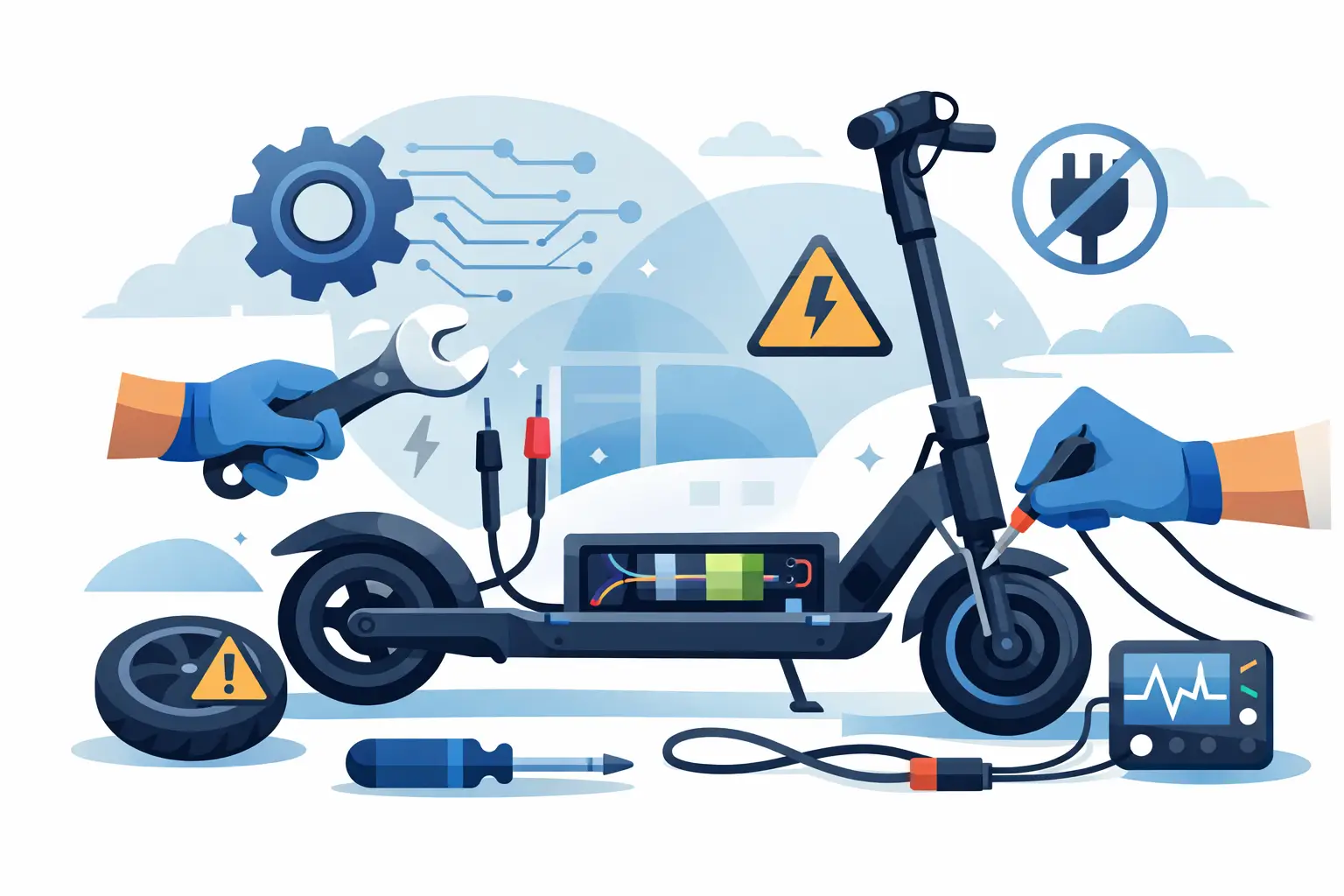
A scooter that will not turn on, loses power under load, or charges inconsistently rarely needs a guess. Electric scooter electrical repair starts with testing the system in the right order: charger, battery, wiring, controller, display or throttle, and motor. Each part affects the next, so replacing components before confirming the fault can turn a straightforward repair into an expensive one.
For San Diego riders, electrical problems often show up when a scooter is needed most: on the way to work, during a delivery shift, or after it has been sitting in a hot garage. The good news is that many faults are repairable when the root cause is identified early.
What Electric Scooter Electrical Repair Actually Involves
Electrical repair is more than swapping in a new battery or controller. A technician needs to verify voltage at key points in the system, inspect connectors and wiring, check for communication errors, and determine whether the problem occurs at rest or only when the scooter is under load.
A scooter can show a full battery icon while still having a battery pack that drops voltage too quickly. It can power up normally while a damaged phase wire prevents the motor from accelerating. It can also have a working motor but refuse to move because the controller is not receiving a correct throttle, brake cutoff, or hall sensor signal.
This is why a diagnostic-first approach matters. The symptom tells you where to begin, but it does not always identify the failed part.
Start With the Symptom, Not the Part
The fastest repair path depends on what the scooter is doing. A scooter that is completely dead is diagnosed differently from one that turns on but will not drive.
Scooter Will Not Power On
Start with the basics: confirm that the battery is charged, the charging port is not damaged, and the main battery connector is fully seated. Some scooters use an inline fuse, ignition switch, or keyed power circuit between the battery and controller. A blown fuse, loose ignition wire, or corroded connector can make a healthy battery appear dead.
Voltage testing is the next step. The battery must be checked at its output, then again where power enters the controller. If voltage is present at the pack but missing at the controller, the issue is usually in the fuse, wiring harness, connector, or power switch circuit.
Scooter Powers On but Will Not Move
When the display lights up but the wheel does not turn, the battery is not automatically the problem. Check whether a brake lever is stuck in the cutoff position, since many scooters disable motor power whenever the controller sees a brake signal.
The throttle, controller, motor hall sensors, and motor wiring also need testing. A damaged hall sensor can cause jerky movement, no movement, or a motor that only works intermittently. A controller fault may allow the display to power on but prevent current from reaching the motor.
Power Cuts Out While Riding
A scooter that shuts down under acceleration or on hills often has a voltage-drop issue. The battery may show normal voltage with no load but sag below the controller’s low-voltage cutoff when the motor demands more current. This can be caused by worn battery cells, a failing battery management system, a loose high-current connector, or undersized or heat-damaged wiring.
The conditions matter. If the problem only happens on steep hills, with a heavier rider, or after several miles, testing must account for real riding load. A quick voltage reading in the shop is useful, but it is not the entire diagnosis.
Battery and Charging Faults Need Careful Testing
Battery problems are among the most common scooter repairs, and they are also the area where shortcuts create the most risk. Lithium-ion packs contain high energy. Swelling, overheating, water damage, a burnt smell, or melted connectors should be treated as a stop-riding issue.
A charger can be tested for correct output voltage, but a working charger does not prove the battery is healthy. The battery management system, often called the BMS, can prevent charging or discharge when it detects an unsafe condition. In some cases, the BMS is doing its job because one cell group is weak or out of balance. In others, the BMS itself has failed.
It is also worth inspecting the charge port. A loose, bent, or burned charge port can create intermittent charging and excessive heat. Do not force a charger plug into a damaged port. Repeatedly wiggling it can worsen the connection and damage the wiring behind it.
Battery repair may be appropriate when the pack, BMS, wiring, and cell condition support it. Replacement can make more sense when a battery is heavily degraded, physically damaged, or not economically repairable. The right answer depends on battery age, availability of compatible parts, and the overall condition of the scooter.
Controller, Throttle, and Display Problems
The controller is the scooter’s power manager. It takes battery power and uses throttle input, motor feedback, and safety signals to control the motor. Because it handles both high-current power and low-voltage communication signals, a controller issue can look like several unrelated problems.
Common controller-related symptoms include sudden loss of acceleration, error codes, rough motor operation, no response from the throttle, or a wheel that resists turning after a failure. Heat, water intrusion, damaged connectors, and incorrect replacement parts can all contribute to controller faults.
A display or dashboard may show an error code, but codes should be treated as a starting point rather than a final diagnosis. The same code may be triggered by a bad sensor, wiring fault, connector issue, or failed controller channel. Reading the code without testing the related circuit can lead to unnecessary part replacement.
Throttle issues are usually checked by verifying the throttle’s reference voltage, ground, and signal output. Brake cutoff sensors should be checked at the same time. These components use small signal wires, which are easily damaged where the wiring harness bends near the handlebars or folding stem.
Motor and Wiring Issues Often Hide in Plain Sight
Hub motors are durable, but they are not immune to electrical damage. Internal hall sensors can fail, phase wires can overheat, and cable damage can occur where the motor wire exits the axle. That area deserves close attention because the cable moves, flexes, and can be pinched during tire or wheel service.
A motor with damaged phase wiring may hum, jerk, run weakly, or refuse to start. If the scooter has been ridden with a loose connector, signs of heat damage may be visible at the plug: darkened pins, melted plastic, or a burnt odor. Replacing only one half of a damaged high-current connector is not always enough. Both mating sides and the wire condition need inspection.
Water is another variable. Even scooters advertised as water-resistant can develop problems after rain, washing, or riding through standing water. Moisture can corrode pins slowly, creating faults weeks after the original exposure. Drying a scooter may restore operation temporarily, but corroded connectors and compromised insulation still need attention.
When a DIY Check Is Reasonable
Owners can safely handle a few basic checks with the scooter powered off. Look for loose external connectors, damaged cable jackets, bent charging-port pins, or debris around the folding mechanism that may pinch wires. Confirm the charger is the correct model and avoid using a charger with an unknown voltage or connector configuration.
Do not open a lithium battery pack, bypass a BMS, bridge a fuse, or probe high-current connections without the proper equipment and experience. Those actions can create shock, burn, and fire hazards, and they can make a repairable scooter much harder to restore.
If you are bringing a scooter in for service, note exactly when the issue occurs. Mention whether it happens after charging, under acceleration, after rain, at a certain battery level, or only when a particular error code appears. That information can shorten the diagnostic process substantially.
Get the Fault Confirmed Before Buying Parts
Online replacement parts can be tempting, especially when a controller or battery looks similar to yours. Compatibility, however, depends on more than connector shape. Voltage, current limits, communication protocols, motor sensor type, firmware, and connector pinout all matter. An incorrect controller can damage the motor, battery, or display even if it powers on.
At FixEbike, electrical diagnostics focus on confirming the failed circuit before recommending repair or replacement. That may mean the fix is a connector repair or brake sensor adjustment rather than a costly battery or controller.
A reliable scooter should feel predictable: it charges normally, accelerates cleanly, and does not leave you wondering whether it will make it home. When something changes, stop riding if there is heat, smoke, swelling, or repeated power loss, and have the electrical system tested before a small fault becomes a roadside failure.