
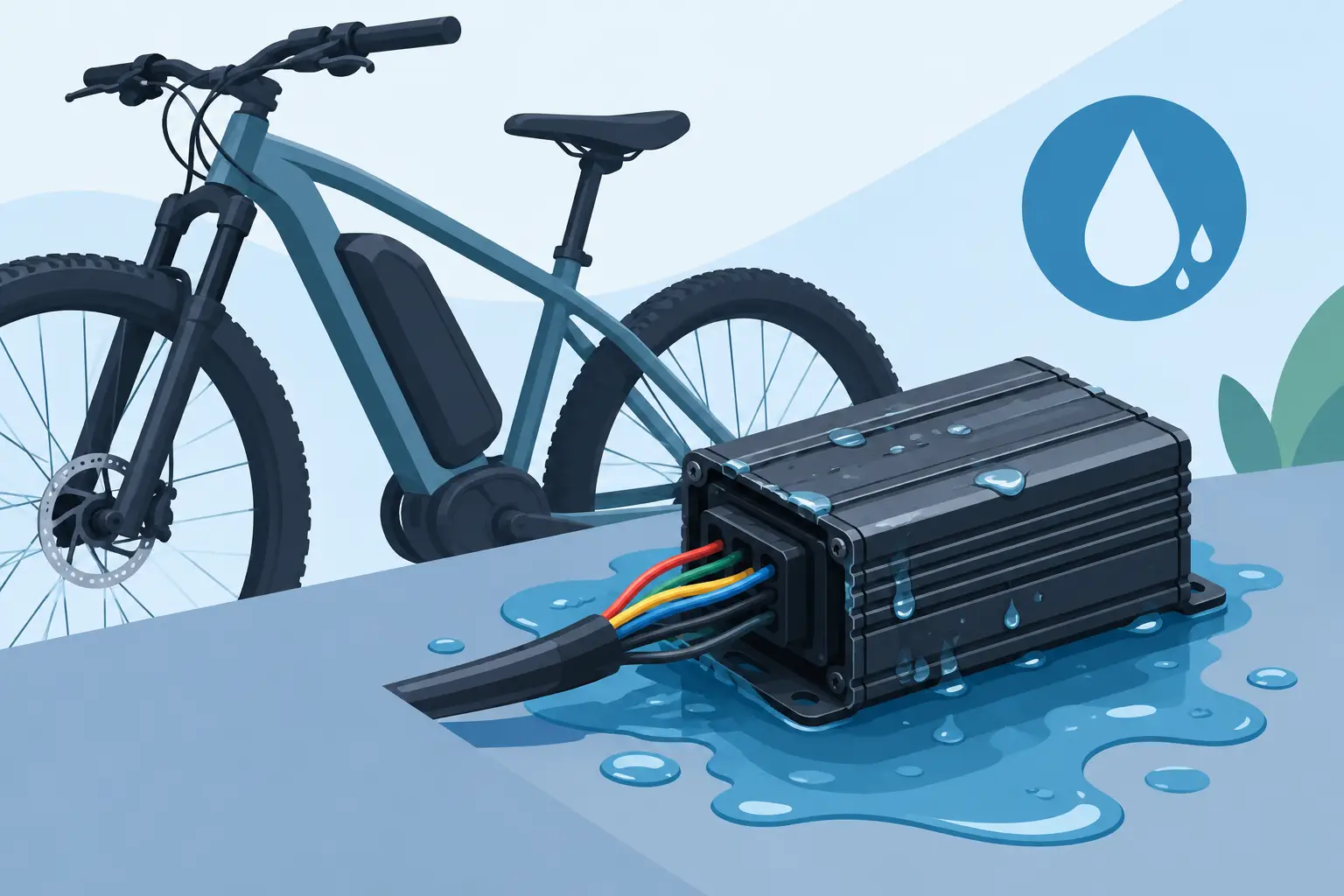
A wet ride does not automatically mean your e-bike controller has failed. But can water damage an ebike controller? Yes, especially when water reaches a connector, cable entry point, cracked case, or circuit board. The symptoms may show up immediately, or they may arrive days later as corrosion develops inside the electrical system.
For San Diego riders, the risk is not limited to heavy rain. Washing an e-bike with a hose, riding through standing water, transporting it in wet weather, or leaving it outside during marine-layer moisture can all introduce water where it does not belong. A controller is designed to manage high current between the battery and motor, so even a small moisture-related fault can cause confusing and serious ride problems.
Why water can damage an ebike controller
The controller is the electronic control center of an e-bike. It takes power from the battery, reads signals from the throttle, pedal-assist sensor, display, brake cutoffs, and motor hall sensors, then delivers controlled power to the motor. Most controllers sit in a metal box or compartment, but that does not mean they are waterproof.
Many e-bikes use connectors and housings that are water-resistant rather than fully sealed. That distinction matters. Water resistance may handle occasional splashes and light rain. It may not handle a pressure washer, repeated soaking, a submerged battery tray, or water collecting inside a frame.
When moisture enters the controller area, it can create a temporary short between low-voltage signal circuits, interfere with sensor readings, or cause corrosion on terminals and circuit-board traces. Corrosion is often the delayed problem. The bike may work after it dries, then later develop intermittent power loss because moisture left behind oxidation in a connector or inside the controller.
Salt air adds another variable near the coast. Salt-contaminated moisture conducts electricity more readily than clean water and accelerates corrosion. A bike that seems fine after a damp ride can still develop electrical issues if connections were already loose, damaged, or poorly sealed.
Signs of water damage to an ebike controller
A water-related controller fault does not always look like a completely dead bike. In many cases, the bike powers on but behaves unpredictably. The display may turn on while the motor will not engage, or the motor may cut out under load.
Watch for symptoms such as a sudden loss of pedal assist, throttle failure, error codes that were not present before, flickering display power, or a motor that jerks, hums, or runs roughly. A controller that gets unusually hot, emits a burnt-electronics smell, or repeatedly blows a fuse needs immediate attention.
Some symptoms overlap with other failures. A wet or corroded brake cutoff connector can prevent motor power and make it look like a bad controller. A damaged hall sensor wire, loose battery connection, failed display, or voltage drop under load can produce similar behavior. That is why replacing the controller based on one symptom alone can waste money.
What a delayed failure looks like
Delayed failures are common after water exposure. You might dry the bike, ride it home without a problem, and then find that it will not power up two days later. Or it might only cut out when you hit a bump, climb a hill, or use full throttle.
That pattern often points to moisture or corrosion in a connection. Vibration moves the damaged connection just enough to interrupt communication or power. A proper diagnosis checks the controller, wiring harness, battery output, display connection, motor phase wires, and hall sensor signals instead of assuming one part is at fault.
What to do after your e-bike gets wet
If the bike was caught in light rain and operates normally, do not panic. Turn it off, remove the battery if the model allows it, and wipe down the frame, battery contacts, controller area, display, and visible connectors. Let the bike dry fully in a covered, ventilated location before charging or riding again.
If it was heavily soaked, went through deep water, or was washed with a strong stream of water, do not keep testing it by turning it on repeatedly. Repeatedly applying power to a wet system can turn a repairable moisture issue into a damaged controller, battery connection, or wiring harness.
Avoid using a hair dryer on high heat, placing a battery near a heater, or spraying water-displacing products into every connector. Excess heat can damage seals, wiring insulation, and battery components. Sprays can leave residue and may push contaminants deeper into a connector. Gentle airflow and time are safer than forcing the process.
Before reconnecting the battery, look for standing water in the controller compartment, green or white corrosion on terminals, damaged cable insulation, loose connectors, and blackened or melted plugs. If you see heat damage, burnt wiring, or corrosion at the battery terminals, leave the system disconnected and have it inspected.
Can you ride an e-bike after rain?
Usually, yes. Most quality e-bikes can handle normal rain and road spray when their seals, connectors, and cable routing are in good condition. The trade-off is that “rain-capable” does not mean “hose-proof” or “submersion-proof.” Riders who commute year-round should treat electrical sealing and inspection as regular maintenance, not a one-time concern.
Do not ride if the display flashes, the motor surges, the bike gives repeated error codes, or there is any sign of battery or controller overheating. Motor behavior that feels rough or jerky can indicate phase-wire or hall-sensor communication problems. Continuing to ride can increase stress on the controller and motor.
How a controller is diagnosed after water exposure
A useful electrical diagnosis starts with the basics: battery voltage, battery connector condition, fuse integrity, and visible harness damage. From there, a technician checks whether the controller is receiving correct voltage and whether it is properly communicating with the display, throttle, brake cutoffs, pedal-assist sensor, and motor.
On many hub-motor bikes, phase wires and hall sensor wires are especially important. Water inside a motor connector can create false hall signals or phase-to-phase faults that mimic a controller failure. On integrated commuter and moped-style e-bikes, the controller may be hidden in the frame or battery cradle, making access and testing more involved.
The goal is to identify the failed part before replacement. Sometimes a controller can be saved by correcting a wiring or connector problem. Other times, corrosion has reached the circuit board or power transistors and replacement is the reliable option. If a replacement controller is needed, it must match the system voltage, motor type, current limits, connector layout, and communication protocol. A controller that physically fits may still not work correctly with the existing display or battery management system.
FixEbike handles this kind of diagnostic work for riders dealing with water exposure, power loss, error codes, and hard-to-trace electrical faults. A clear diagnosis helps avoid replacing a controller when the actual failure is a connector, sensor, wiring section, or battery-side issue.
Preventing water-related controller problems
The best protection is simple: keep the controller compartment sealed, avoid pressure washing, and inspect connectors before they become a problem. After wet rides, wipe down the bike instead of storing it wet in a closed garage or vehicle. Moisture trapped in a tight compartment takes longer to evaporate.
Make sure any rubber grommets are seated where cables enter the controller housing. Check that the battery is fully latched and that its contacts are clean and dry. If you regularly ride in rain, periodically inspect motor and frame connectors for dirt, looseness, or early corrosion.
Do not modify wiring with household electrical tape and assume it is weatherproof. Poor splices allow water into copper strands, where corrosion can travel under the insulation. Proper connectors, strain relief, and sealed repairs are worth the effort on an e-bike carrying high battery current.
A wet e-bike is not always a broken e-bike. The smart move is to dry it carefully, avoid charging or riding when the system is acting abnormal, and address intermittent electrical symptoms before a small moisture problem turns into a stranded ride.