
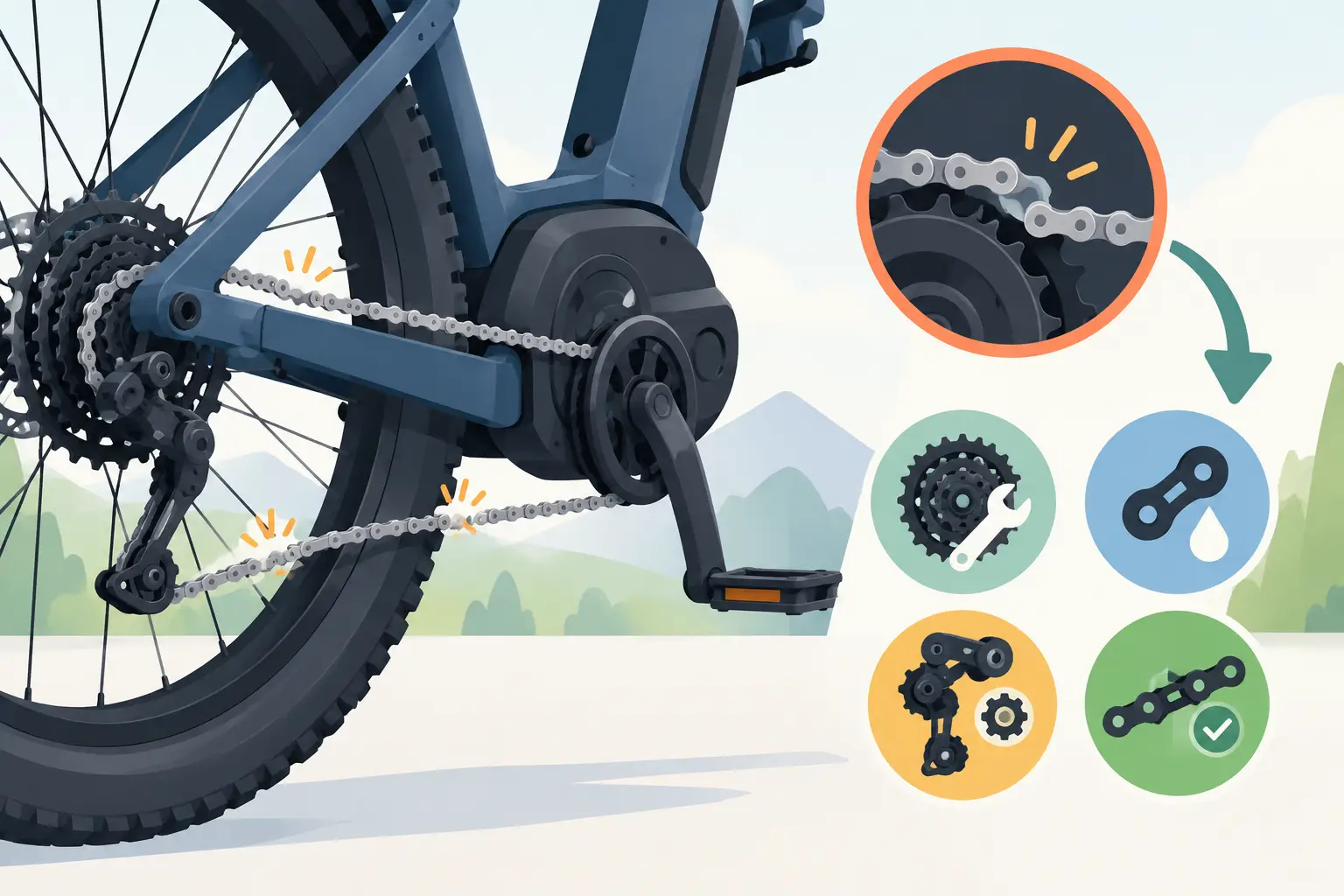
A chain that slips under pedal pressure is more than an annoyance. Ebike chain skipping can throw off your balance at an intersection, make a hill climb feel unpredictable, and quickly damage parts that might otherwise be serviceable. Because an e-bike adds motor torque to the drivetrain, a small wear issue can become obvious much faster than it would on a standard bicycle.
The good news is that most skipping problems have a clear cause. The key is separating normal shifting adjustment needs from worn drivetrain parts, a damaged derailleur, or an issue that only feels like the chain is slipping. A proper diagnosis saves money because replacing one part at random can leave the real problem untouched.
What Ebike Chain Skipping Usually Feels Like
Riders describe chain skipping in a few different ways. The pedals may suddenly lurch forward with a sharp clunk. The chain may climb toward the next cog and then drop back. It may skip only when you are pushing hard, only in one or two gears, or only when the motor is assisting on a steep grade.
Those details matter. A skip in one rear gear commonly points to a worn or damaged cassette cog. Skipping across several gears can come from a stretched chain, incorrect derailleur adjustment, cable friction, or a bent derailleur hanger. If it happens only when the motor engages, the drivetrain may be worn enough that added torque is exposing the problem.
There is also a separate sensation that gets confused with chain skip: a hub motor may cut in and out, a controller may limit power, or an internal geared hub may slip. In those cases, the pedals and chain may be moving normally. That is why a technician should confirm exactly where the slip occurs before recommending parts.
The Most Common Mechanical Causes
A worn chain and cassette
Chains do not actually stretch like a rubber band. Their pins and rollers wear, increasing the distance between links. That wear prevents the chain from seating correctly on the teeth of the cassette and chainring.
On an e-bike, chain wear can progress quickly, especially for commuters, delivery riders, and riders who regularly use high assist levels. Once a worn chain has been ridden long enough, it wears the cassette teeth to match. Installing only a new chain on a badly worn cassette may make the skipping more noticeable because the fresh chain no longer fits the worn tooth profile.
A shop can measure chain wear with the correct gauge and inspect the cassette teeth for hooked, pointed, or uneven profiles. Depending on the condition, the repair may be a chain alone or a chain and cassette together. On some bikes, the front chainring should be checked at the same time.
Derailleur adjustment or cable problems
A rear derailleur must line up precisely with each cassette cog. If cable tension is too loose or too tight, the chain can hesitate between gears, chatter, or jump under load. This is often a relatively straightforward adjustment, but the underlying reason for the change matters.
New shift cables can settle after installation. Older cables can fray, corrode, or drag inside their housing. A cable that does not move smoothly may cause shifting to work inconsistently, even if it seems acceptable while the bike is on a repair stand. A technician should inspect the cable, housing, shifter, derailleur movement, and limit screws rather than just turn the barrel adjuster until the noise goes away.
A bent derailleur hanger
The derailleur hanger is designed to bend or break before the derailleur or frame takes the full force of an impact. A fall on the drive side, a bike rack mishap, or the bike tipping over in a garage can bend it slightly. Even a small misalignment can cause poor shifting and chain skipping in certain gears.
This cannot be judged accurately by eye alone. The hanger needs to be checked with an alignment tool. If it is bent, it may be straightened if the material and condition allow, or replaced when that is the safer option.
Cassette, chainring, or freewheel damage
A single bent tooth, damaged cog, loose cassette lockring, or worn freewheel can create a skip that appears in one predictable spot. Riders sometimes notice this as a clunk every time the crank reaches a certain position or when the rear wheel rotates through a particular point.
Fat-tire and moped-style e-bikes commonly use freewheels or drivetrain parts that vary widely in quality and availability. The repair approach depends on the exact system. Matching tooth count, chain speed, spacing, and the bike’s intended gearing is important, particularly when replacement parts are not standard bicycle-shop inventory.
Why Motor Torque Makes the Problem Worse
An e-bike drivetrain handles your pedaling force plus motor power. That does not mean every e-bike needs expensive upgrades, but it does mean worn components have less margin before they fail under load.
Shifting while applying hard pedal and motor power is a common contributor. Mid-drive e-bikes are especially demanding because motor torque passes through the chain, cassette, and derailleur. Ease off the pedals briefly when shifting, let the chain settle onto the cog, then resume power. This small habit reduces tooth wear and helps prevent chain damage.
Hub-motor e-bikes generally place less motor torque through the chain, but riders still put substantial force through the drivetrain on hills and during acceleration. A chain that barely skips on flat ground may slip sharply when climbing Black Mountain Road or heading home with cargo in a rear rack.
When It Is Not Actually the Chain
If the bike surges, loses drive, or makes a grinding sound but the chain remains firmly engaged on the gears, the issue may be elsewhere. This is particularly relevant on e-bikes with hub motors, internal geared hubs, or electronic shifting systems.
A failing motor clutch can feel like intermittent drivetrain slip on some hub motors. Loose crank arms, worn bottom bracket bearings, damaged pedal threads, or a slipping belt drive can also create a sudden loss of pedal resistance. Electrical issues can cause abrupt motor cutout that riders interpret as a skipped chain, especially if the display changes speed or shows an error code at the same time.
This is where a diagnostic-first approach matters. Replacing a cassette will not repair a motor clutch, controller communication fault, or voltage drop under load. Likewise, electrical troubleshooting should not distract from a chain that is plainly worn and skipping on the cogs.
What You Can Check Before Bringing It In
Start with a basic visual inspection while the bike is powered off. Look for a dry or rusty chain, stiff links, debris wrapped around the derailleur, loose axle hardware, or a derailleur that appears crooked. Check whether the skipping happens in one gear or several, whether it occurs only under motor assist, and whether the bike was recently dropped, transported, or exposed to heavy rain.
Do not continue riding aggressively if the chain skips under hard load. Repeated slipping can round off cassette teeth, damage the chainring, and increase the chance of a sudden pedal drop. Avoid forcing shifts while climbing, and do not place hands near the chain or derailleur while the rear wheel is turning.
Cleaning and lubricating a dirty chain can improve noisy shifting, but it will not reverse wear. Excess lubricant can attract grit, especially on dry San Diego trails and dusty bike paths. Use an appropriate bicycle chain lubricant sparingly, wipe away the excess, and keep household oils away from the drivetrain.
A Repair That Lasts Starts With the Right Parts
A lasting repair is not always the cheapest single component. If a worn chain has damaged the cassette, replacing both together usually prevents a quick repeat visit. If the hanger is misaligned, adjustment alone will not stay accurate. If the drivetrain is in good condition but the cable housing is contaminated, a new chain may not solve the shifting problem.
At FixEbike, drivetrain service begins by checking chain wear, cassette and chainring condition, derailleur alignment, cable movement, and wheel installation. For e-bikes, we also verify whether the reported skip is mechanical or related to motor power delivery. The goal is to repair the actual fault, explain what caused it, and get the bike shifting safely again.
A clean, correctly adjusted drivetrain makes every ride quieter and more predictable. If your bike skips when you need power most, stop trying to pedal through it and have the system checked before a minor wear issue becomes a larger repair.