
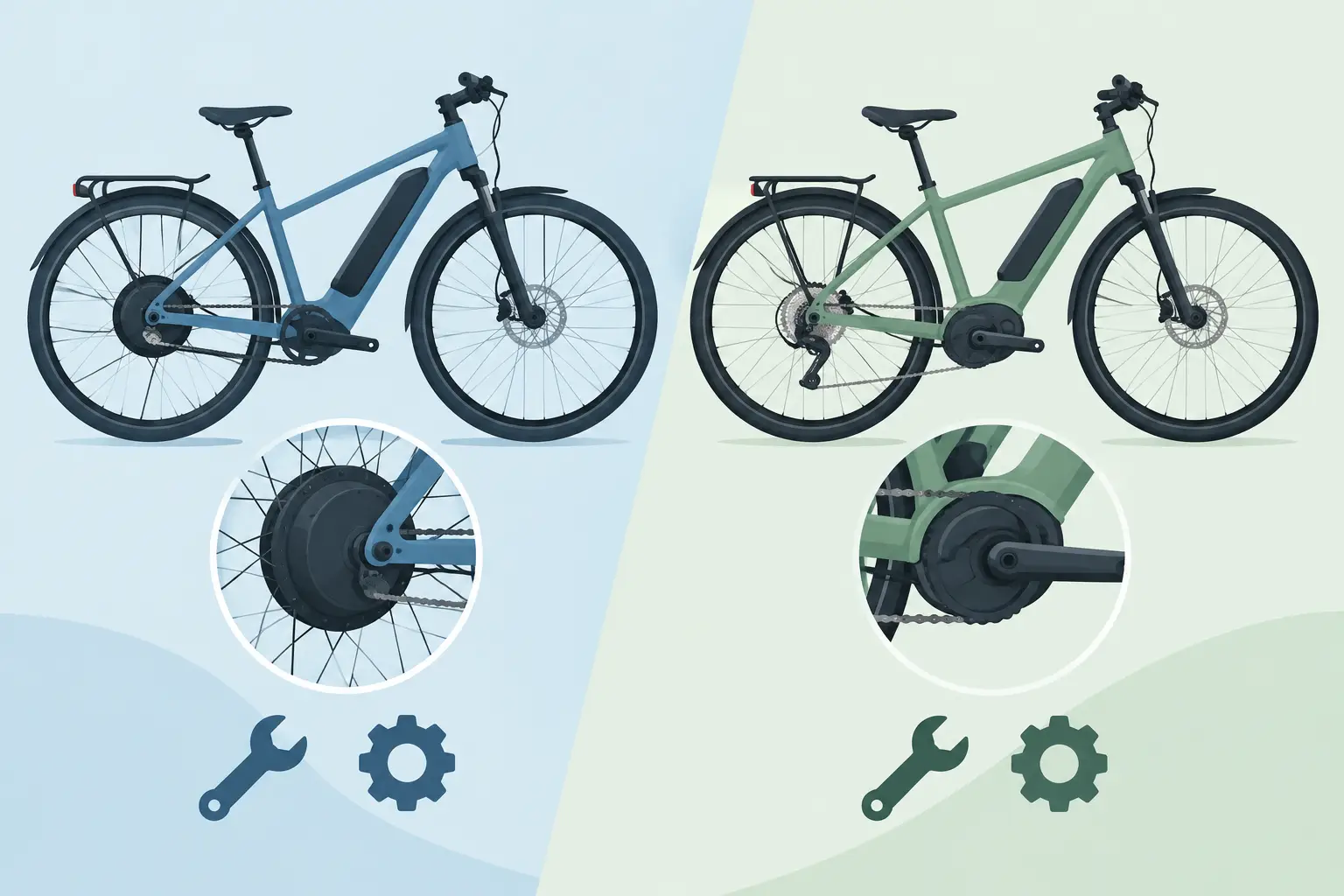
A motor problem can feel the same from the saddle – weak assist, strange noise, intermittent power, or no movement at all. But hub drive vs mid drive service is not a one-size-fits-all repair. The motor location changes what wears out, what must be tested, and whether the fault is electrical, mechanical, or both.
For San Diego riders, that difference matters. A commuter carrying cargo up a grade in Rancho Bernardo puts stress on an e-bike differently than a casual beach-path rider. Before replacing an expensive part, the right repair process starts by identifying the drive system and tracing the actual source of the problem.
Hub Drive vs Mid Drive Service: The Core Difference
A hub-drive e-bike has its motor inside the front or rear wheel hub. The motor turns the wheel directly, usually without relying on the bike’s chain, cassette, or derailleur to deliver power. Hub drives are common on commuter bikes, fat-tire e-bikes, folding models, and many moped-style e-bikes.
A mid-drive motor sits at the bike’s bottom bracket, near the pedals. Instead of turning the wheel directly, it applies power through the chain and rear drivetrain. This setup is common on higher-performance commuter, mountain, and cargo e-bikes because it uses the bike’s gears to help the motor climb and accelerate efficiently.
That basic design changes the service path. Hub-drive repairs often center on the motor wheel, axle wiring, controller, hall sensors, phase connections, and battery output. Mid-drive repairs can involve the motor, controller, display communication, torque or cadence sensors, and the complete drivetrain.
Neither system is automatically better to repair. The practical question is which components are affected, whether replacement parts are available, and whether a component-level repair is possible.
What Hub-Drive Service Usually Involves
A hub motor has fewer external moving parts than a mid-drive system, but it still operates in a demanding location. Rear hub motors especially see water, road debris, heat, torque, and repeated stress at the axle cable exit.
When a hub-drive bike loses power, the motor itself may not be the problem. A damaged cable near the axle, loose phase-wire connection, failed hall sensor, weak battery under load, or controller fault can all produce similar symptoms. A bike that powers on normally but shudders, runs roughly, or stops under throttle often needs electrical testing before anyone calls it a bad motor.
Hub-drive service may include testing battery voltage and voltage drop under load, checking controller output, inspecting motor phase wires, measuring hall sensor signals, repairing damaged wiring, or opening the motor to inspect internal gears and bearings. Geared hub motors can develop worn nylon gears or clutch issues. Direct-drive hub motors have a different internal layout and may develop bearing, sensor, or winding problems instead.
Wheel Work Is Part of the Job
Because the motor is built into the wheel, a hub-drive repair may also involve tire, tube, spoke, rim, and axle work. Removing a rear hub wheel requires care around the motor cable, torque hardware, derailleur, and chain. On a heavy fat-tire e-bike, handling the wheel safely is not a minor detail.
If a rider has repeated flats, broken spokes, a loose axle, or a rubbing brake rotor along with an electrical issue, it makes sense to address both areas during the same service visit. A motor wheel has to be secure and properly aligned before the electrical system can be evaluated under real riding load.
What Mid-Drive Service Usually Involves
Mid-drive systems are compact and powerful, but their power passes through the chain, cassette, chainring, and derailleur. That makes drivetrain condition a major part of mid-drive service.
A worn chain or cassette can cause skipping under motor load, especially on hills. Riders sometimes describe this as a motor slipping or cutting out. In reality, the motor may be working correctly while the drivetrain cannot hold torque. A technician needs to check chain stretch, tooth wear, derailleur adjustment, chainline, and shifting performance before assuming the drive unit has failed.
Mid-drive diagnostics also focus on pedal input. Depending on the system, the bike may use torque sensing, cadence sensing, speed sensing, or a combination of these signals. If the display turns on but assist does not engage correctly, the issue could be a sensor, magnet alignment, brake cutoff signal, wiring harness, firmware-related communication fault, controller issue, or internal motor electronics.
Internal Mid-Drive Problems Need Careful Diagnosis
Grinding, clicking, excessive play at the crank, or a harsh knocking sound can indicate internal gear, bearing, clutch, or reduction-drive wear. Some mid-drive units can be serviced at the component level. Others are more practical to repair through approved assemblies, depending on the brand and available parts.
The right answer depends on the specific motor, mileage, riding conditions, and total condition of the bike. Replacing a drive unit without checking the battery, wiring, sensors, and drivetrain can leave the original problem unresolved.
Which System Costs More to Maintain?
There is no universal winner, but mid-drive ownership usually requires more regular drivetrain maintenance. Because the motor adds power through the chain and gears, chains, cassettes, chainrings, and derailleur adjustments can wear faster than on a comparable non-electric bike. Riders who climb steep hills, haul cargo, or shift under heavy load should expect to inspect those parts more often.
Hub drives tend to place less motor torque through the chain and cassette, so standard drivetrain wear may be lower. However, hub-drive repairs can become more involved if the motor cable is damaged, the wheel needs rebuilding, or a motor internal fault requires opening the hub. Replacement wheels and motor assemblies can also vary widely in availability.
Battery condition affects both designs. A battery that looks charged at rest can sag in voltage when a motor demands current. That can cause reduced power, shutdowns, error codes, or behavior that appears to be a motor problem. Testing the battery and its battery management system is part of an accurate diagnosis, not an afterthought.
Symptoms That Need Professional E-Bike Diagnostics
Some issues are safe to check at home, such as confirming the battery is seated, inspecting a visible connector, or looking for a damaged tire. But electrical faults can be misleading, and repeated trial-and-error part swapping gets expensive quickly.
Bring the bike in for diagnostics if it has any of these problems:
- The motor cuts in and out, especially under acceleration or climbing.
- The wheel jerks, hums, or runs rough instead of spinning smoothly.
- The display shows an error code or loses communication with the battery or motor.
- The bike turns on but provides no pedal assist or throttle response.
- There is a burning smell, unusual heat, damaged wiring, or a battery that will not charge normally.
- A mid-drive skips, clunks, or slips under power even after basic shifting adjustments.
A complete diagnosis looks beyond the symptom. For example, a rear hub motor that will not run may have a failed hall sensor, but it may also have a controller issue or a broken wire hidden inside the axle. A mid-drive that stops assisting may have an internal fault, but a stuck brake cutoff signal or failed speed sensor can create the same complaint.
Choosing the Right Service for Your E-Bike
Start with clear information: when the problem occurs, whether it happens under load, any error codes, recent water exposure, crash damage, battery changes, and unusual noises. Those details help narrow the test process and can save time.
At FixEbike, the goal is to identify the failed component or system before recommending a repair. That may mean electrical testing first, drivetrain inspection first, or both. A hub-drive wheel and a mid-drive motor require different hands-on procedures, but both deserve the same approach: verify the fault, explain the options, and repair what is actually causing the issue.
If your e-bike is still riding but feels different than it used to, do not wait for a complete failure. A noisy bearing, worn chain, loose axle connection, or intermittent electrical signal is usually easier to address before it leaves you without power on the way home.