
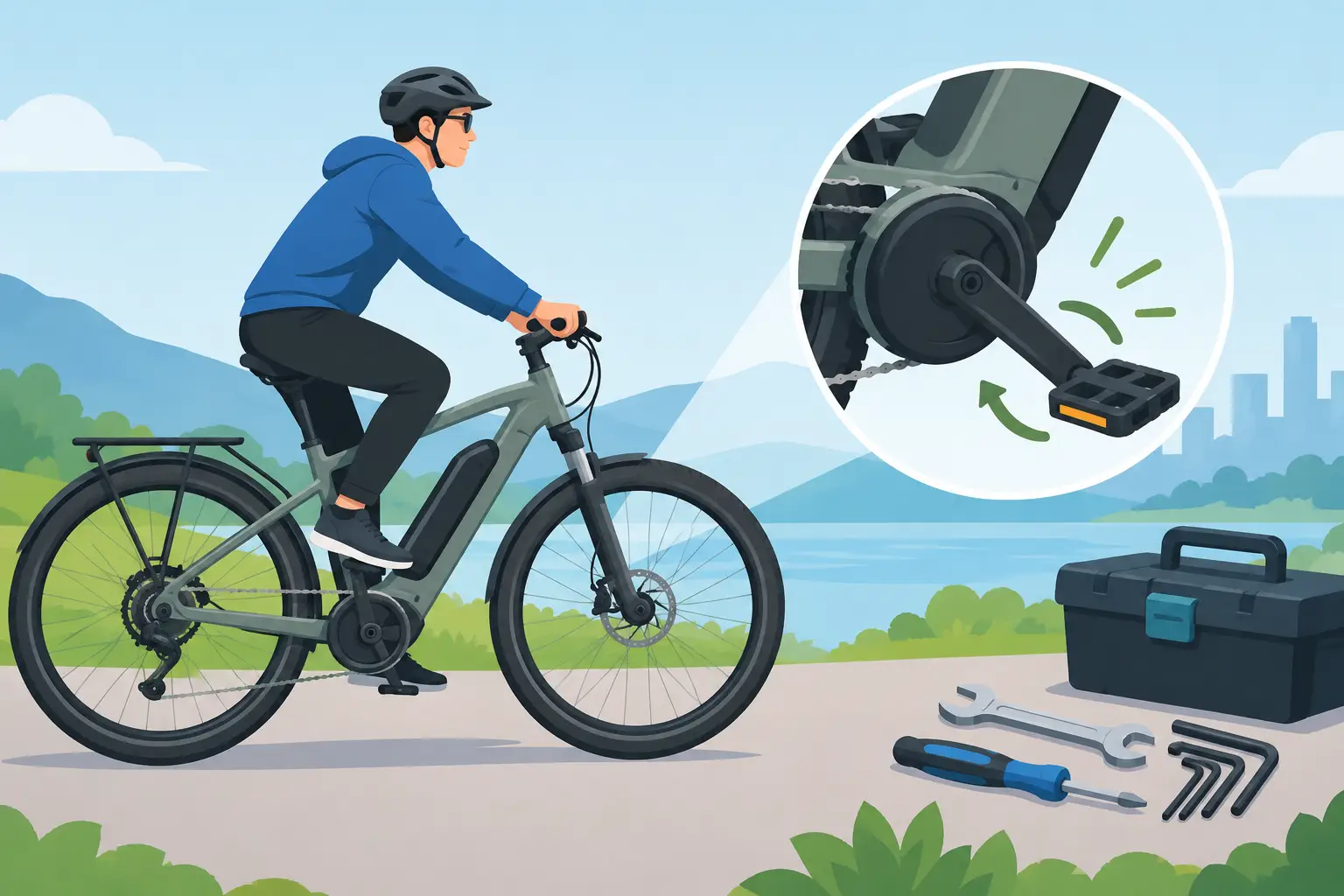
When an e-bike starts moving or adding power without normal pedal input, it can turn a simple ride into a safety problem. Riders searching for how to fix ebike ghost pedaling are usually describing one of two different faults: the pedals physically spin when they should coast, or the motor activates even though nobody is pedaling. The distinction matters because the repair can involve anything from a worn freewheel to a faulty pedal-assist sensor, controller, or wiring connection.
Before testing anything, turn the e-bike off, remove the battery if possible, and support the bike securely. Keep hands, clothing, and tools away from the chain, rear wheel, and crankset. If the bike surges unexpectedly, do not test it while sitting on the saddle or riding in traffic.
First, Identify What Ghost Pedaling Means on Your E-Bike
A pedal-assist e-bike should use a sensor near the crank to detect pedal movement. Once it sees that movement, the controller sends power to the motor. Some systems have a slight delay when assistance starts or stops. That is normal, especially on less expensive cadence-sensor bikes, as long as the delay is brief and predictable.
Ghost pedaling is not normal when the motor starts from a stop without pedal movement, keeps pushing after you stop pedaling, or delivers erratic bursts of power. It is also not normal if the crank arms rotate with the rear wheel while you are coasting. These symptoms can look similar from the saddle, but they point to different components.
If the motor engages by itself, focus on the pedal-assist system, throttle, controller, display settings, and wiring. If the pedals are being dragged around mechanically, inspect the freewheel, chain, derailleur, and drivetrain instead.
Check the Easy Causes Before Disassembling Anything
Start with a controlled test. With the rear wheel off the ground and the battery removed, slowly turn the pedals forward and backward. The chain and rear wheel should move forward when you pedal forward. When you stop or rotate the cranks backward, the rear wheel should not force the pedals around.
Then reinstall the battery, leave the bike on its stand, and switch the display on. Do not touch the pedals or throttle. Watch for a motor response, a speed reading that appears while the wheel is still, or an error code on the display. Any of those signs narrow the problem quickly.
A stuck throttle is one common cause that gets overlooked. Thumb throttles can bind from impact damage, sticky residue, water intrusion, or a damaged return spring. Twist throttles can fail to return fully after a crash or a bar-end accessory installation. Confirm the throttle moves freely and snaps back to its resting position. If it does not, stop using the bike until it is repaired.
Also check whether the display has a walk-assist feature. Walk assist is designed to move the bike slowly while a button is held down. A damaged button or moisture inside the display can make it seem like walk mode is activating on its own.
How to Fix Ebike Ghost Pedaling Caused by the PAS Sensor
The pedal-assist sensor, often called a PAS sensor, is mounted near the bottom bracket or crank spindle. Most basic systems use a magnetic ring and a stationary sensor. As the magnets pass the sensor, it signals the controller that the rider is pedaling.
If that magnet ring shifts, cracks, collects metal debris, or sits too far from the sensor, the controller may receive inconsistent signals. A loose sensor bracket can create the same issue. On some bikes, the ring may rotate independently of the crank or sit backward after a previous repair. That can cause delayed assistance, sudden engagement, or power that does not stop when expected.
With the battery removed, inspect the area around the crank arms. Look for a magnet disc that is rubbing, wobbling, missing magnets, or sitting unusually far from its sensor. Check that the sensor cable is not pinched, cut, or pulled tight. Do not force the magnet ring into place or pry against the bottom bracket seal. Those parts can be fragile, and an incorrect gap can make the issue worse.
If the hardware looks intact but the motor still activates without pedaling, the sensor itself may be failing internally. Water damage and damaged wiring are frequent causes, particularly on bikes stored outdoors or transported on a rear rack in wet conditions. Replacing a PAS sensor may be straightforward on one model and much more involved on another, depending on crank and bottom bracket design.
Inspect Brake Cutoffs, Controller Inputs, and Wiring
Brake levers with electronic cutoffs tell the controller to stop motor power when braking. A failed cutoff switch usually causes the opposite issue – no motor assist – but damaged wiring can create unpredictable controller behavior. Check both brake-lever connectors for loose plugs, corrosion, crushed insulation, or wiring pulled tight at the handlebars.
Next, inspect visible harness connections from the display, throttle, controller, and motor. Many e-bikes use waterproof-looking connectors that are only reliable when fully seated, aligned correctly, and kept dry. A partially disconnected signal wire can cause intermittent pedal-assist behavior. Never reconnect plugs by force, and do not guess at wire colors when making repairs. Wire color standards vary widely between brands and replacement parts.
Controller faults are less common than a sensor or connector issue, but they do happen. A controller with water damage, a failed internal transistor, or an input-circuit problem may send power at the wrong time. Some systems also develop communication faults between the controller and display. If ghost pedaling began after a controller, display, battery, or throttle replacement, compatibility should be checked before replacing more parts.
This is where a proper diagnostic process saves money. Replacing parts one at a time can become expensive and still leave the original fault in place. A technician can test sensor signals, throttle voltage, brake cutoff operation, controller output, and motor behavior under controlled conditions.
If the Pedals Spin While Coasting, Check the Drivetrain
Pedals that rotate when the rear wheel turns are usually a mechanical issue, not an electrical one. The most likely cause is a freewheel or freehub that is sticking. The freewheel is the mechanism that allows the rear wheel to keep spinning while the rider stops pedaling. When it binds, the wheel can drive the chain forward and turn the cranks.
On a rear hub motor bike, the threaded freewheel can wear out, seize from rust, or become contaminated after water exposure. On mid-drive and conventional rear-wheel setups, the problem may be inside the cassette freehub body. A dry, dirty, or damaged freehub can make a clicking sound, drag the chain, or intermittently push the pedals forward.
Do not spray heavy lubricant into the freewheel or freehub as a permanent repair. It may briefly quiet the symptom while attracting dirt or washing out the grease that belongs inside nearby components. A worn freewheel is usually replaced. A serviceable freehub may need cleaning, correct lubrication, or replacement parts.
Inspect the chain and derailleur as well. A stiff chain link, bent derailleur hanger, badly worn chain, or debris caught near the jockey wheels can add enough drag to make coasting feel abnormal. If the chain skips, climbs gears, or runs roughly under load, address those mechanical problems before assuming the motor is at fault.
When to Stop Riding and Schedule a Diagnostic
Do not continue riding if the bike accelerates without input, the motor stays engaged after you stop pedaling, the throttle sticks, or the brakes cannot reliably control the bike. Turn the system off, remove the battery, and arrange service. Those symptoms can create a serious hazard on hills, bike paths, intersections, and around children.
A professional diagnostic is also the sensible next step when there are error codes, burned smells, melted connectors, water inside the display, intermittent power, or a recent crash. Electrical faults are not always visible. A voltage drop, damaged hall sensor wire, controller problem, or poor ground connection can show up as behavior that seems random on the road.
For San Diego riders, FixEbike can inspect the full system rather than guessing at one component. That includes the pedal-assist sensor, throttle, display, controller, harness, motor connections, battery output, brakes, and the mechanical drivetrain that keeps the bike safe to ride.
Ghost pedaling is frustrating, but it is usually traceable when the bike is tested in the right order. Start by separating a motor-control problem from a drivetrain problem, avoid riding through unexpected acceleration, and get the fault diagnosed before a small issue becomes a damaged component or a dangerous ride.