
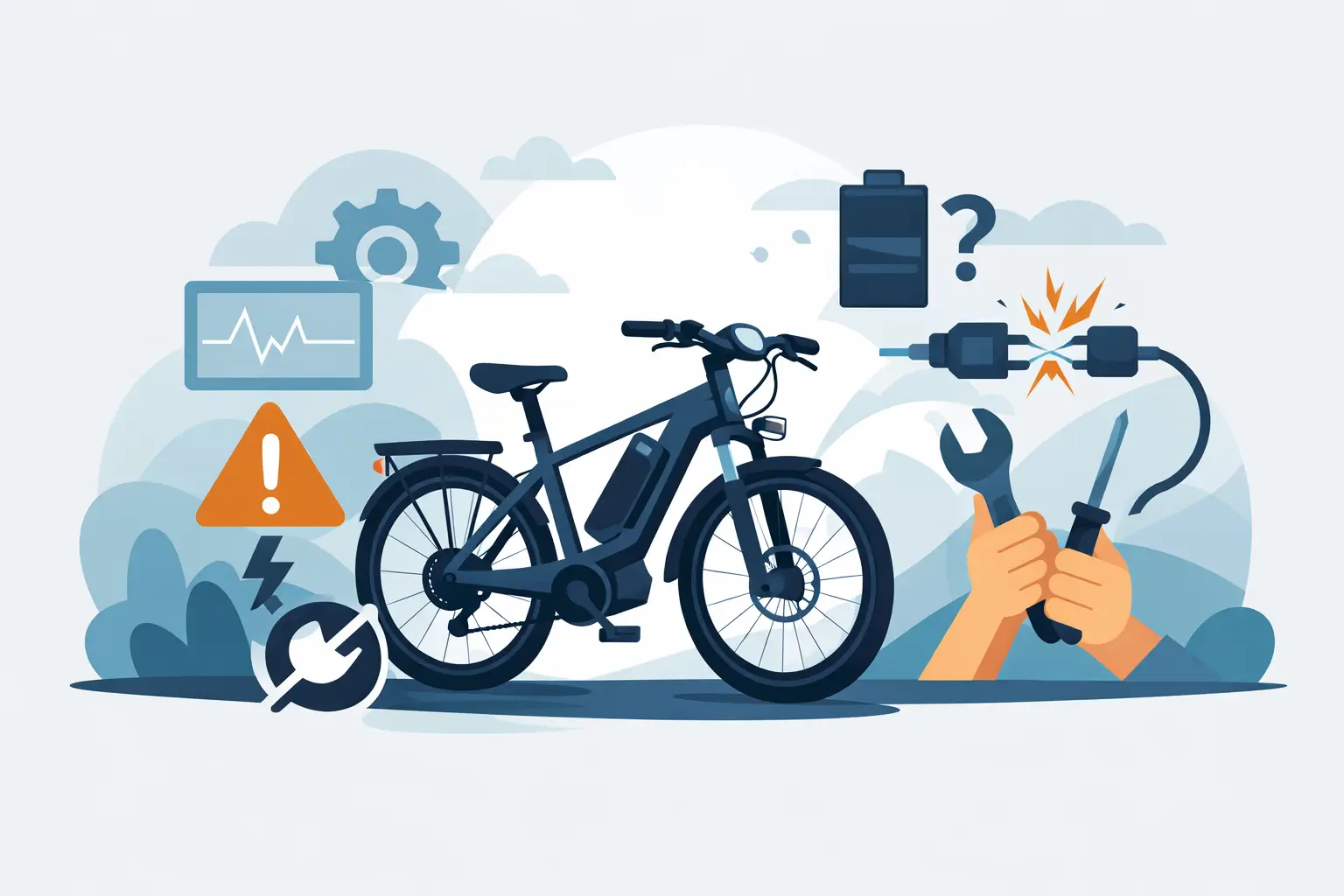
A bike that suddenly will not turn on at the trailhead, loses assist halfway through a commute, or flashes an unfamiliar error code is more than an inconvenience. Common ebike electrical problems can come from the battery, charger, controller, motor, display, wiring, or even a brake sensor that is telling the system not to run. The visible symptom is often simple. Finding the real cause usually is not.
For San Diego riders, heat, road vibration, coastal moisture, steep grades, and frequent charging can all expose weak connections or aging components. A proper diagnosis starts by checking the whole electrical system instead of replacing the first part that seems suspicious.
Common Ebike Electrical Problems: Where to Start
Before assuming a major component has failed, pay attention to the pattern. Does the bike power on but provide no assist? Does it run normally on a full charge, then cut out under acceleration? Did the issue begin after rain, a transport rack trip, a crash, or a battery swap? Those details help narrow down the fault.
A quick visual inspection is reasonable for most owners. With the bike turned off and the battery removed, look for loose plugs, pinched wires, corrosion, damaged insulation, or connectors that are not fully seated. Check that the battery is locked into its cradle and that its terminals are clean and dry. Do not probe battery terminals, open a battery case, or bypass wiring to “test” a component. Lithium-ion battery systems can carry enough current to cause burns, damaged electronics, or fire if handled incorrectly.
The bike will not turn on
A no-power condition is often blamed on the battery, but several parts can produce the same result. The battery may be empty, asleep, internally disconnected, or prevented from delivering power by its battery management system, also called the BMS. A damaged battery mount terminal, blown fuse, failed power switch, broken display cable, or controller fault can also leave the bike completely dead.
Start with the basics: confirm the charger is working, charge the battery fully, and make sure it clicks firmly into place. If the charger indicator stays green immediately when connected to a low battery, or the battery charge lights behave unusually, the problem may be in the charger, charge port, battery cells, or BMS.
A shop-level diagnosis checks actual battery voltage, voltage at the cradle, fuse continuity, and whether the controller receives proper power. That sequence matters. Installing a new display will not fix a battery that is shutting down internally, and installing a new battery will not fix a corroded or heat-damaged battery connection.
The battery charges but range has dropped sharply
Reduced range is not always an electrical failure. Cold weather, low tire pressure, a heavy load, strong headwinds, steep hills, and high assist settings all reduce range. But when a bike that normally handles a regular route suddenly loses half its range, the battery deserves attention.
Lithium-ion batteries lose usable capacity over time. They can also develop cell imbalance, where one weak cell group reaches its limit before the rest of the pack. The BMS may then shut the battery down early to protect it. A rider may see a battery gauge that looks normal until it quickly falls to one bar, followed by a sudden loss of power.
Battery voltage dropping excessively under load is another common clue. The bike may ride fine on level ground but shut off when climbing a hill or accelerating hard. That could point to an aging battery, high resistance at a connector, a controller drawing abnormal current, or a motor issue that is making the system work too hard. The answer depends on test results, not guesswork.
Motor cuts out, surges, or has weak assist
Intermittent motor power can be frustrating because the bike may work perfectly while it is being checked, then fail on the way home. A loose main harness connection, damaged motor cable, failing hall sensor, controller fault, or poor battery connection can all cause cutouts.
Hub motors use internal hall sensors to report rotor position to the controller. If a hall sensor signal is missing or unstable, the motor may hesitate, pulse, run roughly, or refuse to start from a stop. Phase-wire problems can create similar symptoms, often with extra noise, vibration, or a hot motor cable. On some bikes, a failing pedal-assist sensor or throttle can also look like a motor problem because the controller is not receiving a reliable command to provide power.
If a motor makes grinding, clicking, or unusually loud humming sounds, stop riding it until it has been inspected. Continuing to force a malfunctioning motor can damage the controller, wiring, or motor windings. A technical diagnostic should test the controller output, phase wiring, hall sensor signals, and motor resistance before deciding whether the motor itself needs repair or replacement.
Error codes and display communication faults
An error code is useful, but it is not always a final diagnosis. Codes vary by brand and display, and many identify the circuit where the system detected a problem rather than the exact failed part. A communication error, for example, may involve the display, controller, main wiring harness, connector pins, or software compatibility between replacement components.
A display that turns on but shows no speed, no battery reading, or no assist response may have a damaged cable near the handlebars or frame entry point. Folding bikes and moped-style ebikes are especially prone to wire fatigue where cables bend repeatedly. A connector can look plugged in from the outside while a pin inside is bent, pushed back, or corroded.
Avoid repeatedly unplugging and reconnecting components with the battery installed. Turn the system off, remove the battery, and inspect carefully. If a replacement display or controller has recently been installed, verify that it is compatible with the motor, voltage, communication protocol, and wiring layout. Similar-looking connectors are not proof that components are interchangeable.
The motor runs, but the brake light or cutoff is acting up
Most ebikes use brake cutoff sensors to stop motor power when the rider pulls a brake lever. This is a safety feature, but a stuck or failed cutoff sensor can make the bike act as though the brakes are always applied. The display may turn on normally, yet the throttle and pedal assist do nothing.
Look for a damaged brake lever cable, water inside a connector, or a lever that does not return fully. Hydraulic brake systems can add another layer: the brake itself may need service even if the electrical cutoff circuit is functioning correctly. Never permanently disconnect a brake cutoff sensor as a workaround unless a qualified technician has confirmed the system is safe and appropriate for that bike.
Electrical Problems That Need Professional Diagnosis
Some faults are clear warning signs to stop troubleshooting at home. Bring the bike in if the battery becomes unusually hot, swells, smells sweet or chemical-like, leaks, has a cracked case, or was involved in a significant impact. Do not charge or ride a damaged battery.
Professional testing is also the practical next step when the bike repeatedly blows a fuse, cuts out only under load, shows persistent error codes, has melted connectors, or has motor noise accompanied by power loss. These conditions can involve high-current faults that require systematic voltage, continuity, and signal testing.
At FixEbike, electrical diagnostics focus on the source of the failure: battery output and BMS behavior, controller operation, display communication, harness condition, phase wiring, hall sensors, and motor performance. That approach helps avoid expensive parts swapping and gives riders a clearer repair path.
Preventing Repeat Ebike Electrical Issues
A few habits go a long way. Keep connectors dry and protected, but do not pressure-wash the bike. Charge with the correct charger on a stable, nonflammable surface, and avoid storing a battery in direct sun or a hot vehicle. If the bike will sit for several weeks, store the battery in a cool, dry place at a partial charge rather than leaving it empty.
Check the motor cable and main harness during routine tire and brake service, especially where wires enter the axle, fold with the frame, or pass under the battery tray. If a new symptom appears, write down when it happens and what the display shows. A brief note about speed, battery level, terrain, and error codes can save diagnostic time and help get your bike back on the road sooner.
Electrical issues are rarely fixed by hoping they disappear. Addressing a small intermittent fault before it damages a connector, controller, or battery is usually the safer and less expensive move.