
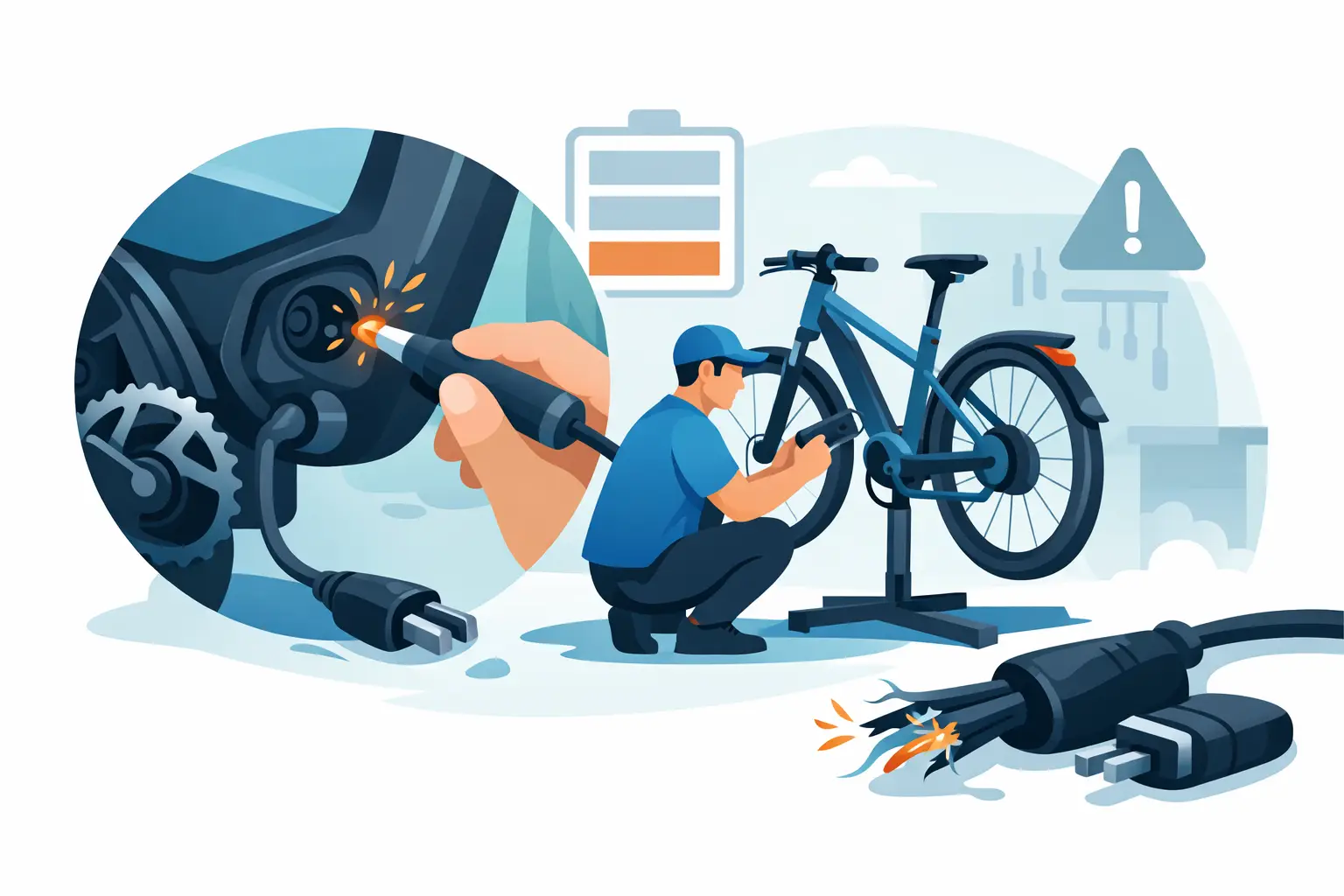
A charger that no longer clicks firmly into place, charges only when the cable is held at an angle, or leaves the battery at the same percentage can point to a charger-port problem. But ebike charger port repair is not always as simple as replacing the round socket on the battery case. The port, charger, battery management system, internal wiring, and battery cells all need to work together before an e-bike can accept a charge.
For San Diego riders, this often shows up after regular commuting, garage storage, transport on a rack, or a bike that has taken a fall. A proper diagnosis prevents paying for a new port when the actual issue is a failed charger, damaged battery wiring, or a BMS fault inside the pack.
What an E-Bike Charging Port Actually Does
The charging port is the connection point between the charger and the battery. It may be mounted directly in the battery housing, under a rubber cover on the bike frame, or inside a removable battery cradle. Depending on the battery, it can be a common barrel-style connector, an XLR connector, a magnetic connector, or a proprietary plug.
Although it looks simple from the outside, the port has to carry the correct voltage and current into the battery safely. Its terminals connect to internal wiring, and that wiring connects to the battery management system, commonly called the BMS. The BMS monitors charging and protects the cells from conditions such as overcharging, overcurrent, and unsafe temperature.
That means a bike can have a physically damaged port, an electrical connection fault behind the port, or a battery issue that merely looks like a port issue. These failures can produce nearly identical symptoms at first.
Signs You May Need Ebike Charger Port Repair
A loose connector is the most obvious warning sign. If the charger plug wiggles significantly in the port, falls out easily, or must be positioned a certain way to begin charging, the port may be worn, cracked, or pulling away from its internal mounting.
Heat is another concern. A warm charger or battery can be normal during charging, but a port that becomes unusually hot, smells burnt, shows brown discoloration, or has melted plastic needs immediate attention. Stop charging and do not keep testing it. Heat at the connector can indicate resistance from a loose terminal, corrosion, damaged wiring, or an incorrect charger.
Other common symptoms include a charger light that stays green when connected to a depleted battery, a charger light that immediately turns red but the battery never gains charge, intermittent charging, visible bent pins, or a missing protective cover that has allowed moisture and debris into the connection.
A charging problem after rain, bike washing, or coastal exposure also deserves a closer inspection. Moisture and salt air can corrode small connector contacts over time, especially when the charging port cover has been left open.
Why Charging Ports Fail
Wear from repeated plugging and unplugging is common, particularly on e-bikes used for commuting or delivery work. Pulling the charger out by its cable rather than its connector puts extra strain on both the plug and the socket. A charger cord snagged in a garage or bumped while the bike is charging can loosen the port from the battery case.
Impact damage is another frequent cause. A battery dropped while being removed from the bike can crack the housing or break a soldered connection behind the charge socket. The damage may not be visible until charging becomes intermittent.
The wrong charger can create more serious trouble. Voltage, plug size, polarity, and charging profile all matter. A plug that physically fits is not automatically compatible. Using an incorrect or low-quality charger can damage the port, blow a fuse, trigger BMS protection, or create excess heat at the connection.
Corrosion, worn terminal springs, pin damage, and frayed wires round out the usual causes. On some battery designs, the charging port itself is inexpensive, but reaching it safely requires opening a sealed battery enclosure and working around high-energy lithium-ion cells. That is where the repair becomes more than a simple connector swap.
A Proper Charging Fault Diagnosis
Good repair starts by separating the charger, port, and battery from each other. The technician first inspects the port and plug for looseness, damage, moisture, bent contacts, and heat marks. The charger should then be checked for correct output voltage and stable operation.
Next, the battery is tested at the charging connection and, when appropriate, at the discharge connection. This helps determine whether voltage is reaching the BMS and whether the BMS is allowing charging current into the pack. A battery that has been deeply discharged may refuse to charge even with a good port and charger. In other cases, an internal fuse, charge lead, or BMS charge circuit has failed.
This is why a green charger light does not automatically mean the battery is full. It can mean the charger is not seeing a valid load. Likewise, a red light does not prove the battery is charging normally. Meter readings and controlled testing tell the real story.
For e-bikes with a frame-mounted port, the diagnosis may also include the battery dock, controller wiring, and key switch circuit. Some designs route charging through more components than riders expect, and a broken wire near the battery cradle can mimic a defective charging port.
What a Professional Repair May Involve
The right repair depends on the failure. A port with damaged contacts or a broken mounting collar may need replacement. If the port is sound but its wires have broken at the solder joint, the repair may involve replacing or re-terminating the charge leads and securing them so they do not flex again.
Corroded connectors sometimes can be cleaned, but replacement is usually the more dependable choice if corrosion has eaten into the contact surface. A connector that has overheated should not simply be pushed back into service. The technician needs to find the cause of the resistance, inspect the charger plug, and check the wiring and BMS before fitting a new port.
If the port checks out, the repair may move inside the battery. That can include a blown fuse, failed BMS, damaged nickel connection, or cell-group imbalance. These are battery repair issues, not cosmetic port repairs, and they require the right equipment and safety procedures.
At FixEbike, the focus is on identifying the actual charging failure before recommending parts. That approach is especially useful when a battery will not charge, but the visible port appears fine.
What You Can Check Safely Before Bringing It In
Start with a visual inspection while the charger is unplugged from the wall and the bike. Look for dirt, bent pins, cracked plastic, burn marks, moisture, or a loose port. Make sure the charger is the original correct-voltage unit or a verified compatible replacement. Check that the wall outlet works and inspect the charger cable for cuts, kinks, or a loose strain relief near either end.
If the battery is removable, confirm it is fully seated in its cradle and that the battery contacts are clean and dry. Do not insert tools, spray liquids into the port, bend pins back aggressively, bypass a fuse, or open a lithium-ion battery case. Those actions can turn a repairable fault into a damaged battery or a safety hazard.
If the port is hot, melted, sparking, or gives off an odor, place the battery on a nonflammable surface away from living areas if it is safe to move. Do not continue charging it while waiting for service.
Preventing Future Charger-Port Problems
Use the protective port cap whenever the bike is not charging. It keeps dust and moisture out, especially on bikes stored outdoors, carried on vehicle racks, or ridden near the coast. Connect and disconnect by gripping the plug body, not the cord.
Charge on a stable surface where the cable will not be stepped on, pulled, or caught by a door. Avoid charging immediately after a wet ride until the port and battery are dry. Most importantly, use the charger specified for the battery. The cheapest replacement charger is rarely a bargain if it damages an expensive battery pack.
A charging port is a small part with a big job. If your e-bike is giving inconsistent charging signals, getting the fault diagnosed early can protect the battery, reduce downtime, and get you back to riding with confidence.