
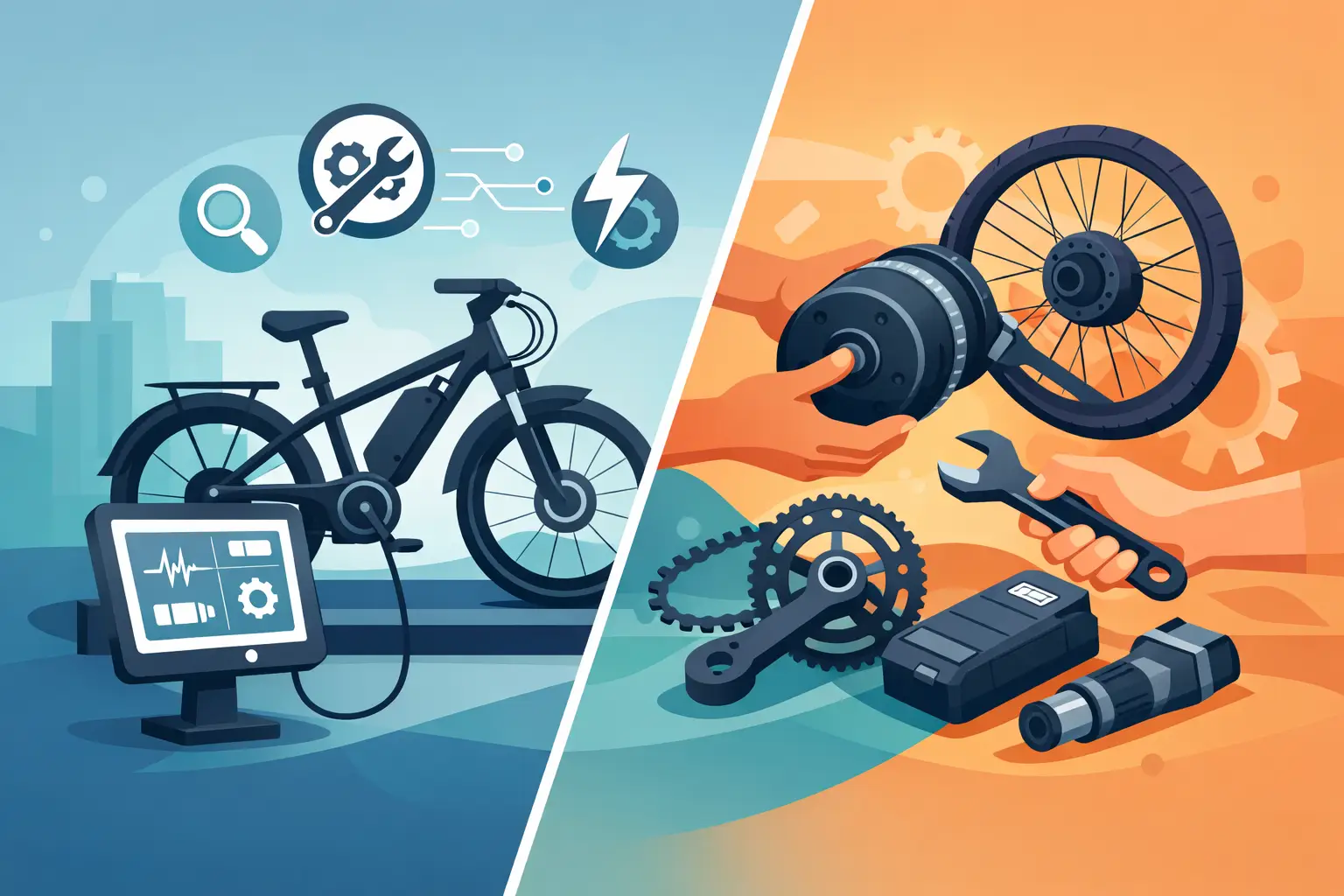
A battery that will not charge, a motor that cuts out on hills, or a display that flashes an error code can make any rider want the fastest possible answer: replace the suspected part. But ebike diagnostics versus parts swapping is not just a choice between two repair methods. It is the difference between fixing the actual fault and paying for components that were never bad.
For San Diego commuters, family riders, delivery riders, and weekend trail users, downtime matters. So does avoiding a repair bill that keeps growing because the first replacement did not solve the problem. A diagnostic-first repair process identifies what is happening in the electrical system before anyone decides whether a battery, controller, motor, display, or wiring harness needs to be replaced.
Why E-Bike Problems Are Easy to Misdiagnose
An e-bike is a system, not a collection of independent parts. The battery supplies power, the controller manages it, the motor converts it into movement, and the display, sensors, brake cutoffs, wiring, and connectors all have a role in allowing that power to flow correctly. A fault in one area can look exactly like a failure somewhere else.
Consider an e-bike that turns on normally but loses power when accelerating. It is common to blame the battery or motor. Sometimes one of those parts is the issue. But the same symptom can come from a loose battery terminal, a damaged connector, a voltage drop under load, a controller overheating, a bad hall sensor, a failing brake cutoff switch, or phase wiring with high resistance.
Replacing a battery without checking voltage behavior under load may leave the rider with the same problem and a costly new battery. Replacing a controller without confirming the motor and wiring signals can produce the same result. The new component may be perfectly good, but it cannot correct the fault still present elsewhere in the system.
This is especially common on fat-tire and moped-style e-bikes, which often see more vibration, heavier loads, and more exposure to moisture. Wiring and connectors can be stressed in ways that are not obvious from a quick visual inspection.
What Proper E-Bike Diagnostics Looks Like
Good diagnostics are not guesswork with a multimeter. They are a structured process that starts with the rider’s symptoms and works through the system logically.
A technician begins by asking when the issue occurs. Does the bike fail only on steep hills? Does it cut out after a few minutes? Did the problem start after rain, a crash, storage, or a battery replacement? Does the display power on? Does the motor make noise, jerk, or remain completely silent? Those details help narrow down the possible fault path before testing begins.
The physical inspection comes next. This includes checking battery mounting points, terminals, connectors, wiring damage, corrosion, controller connections, motor cable condition, brake levers, and signs of overheated components. A pinched cable or partly unplugged connector can create intermittent problems that mimic a major electrical failure.
Electrical testing then confirms what the system is actually doing. Depending on the bike and symptom, this may include battery voltage, charger output, voltage drop under load, continuity checks, hall sensor signals, phase wire condition, brake cutoff operation, controller output, and communication between the display and controller. Error codes can help, but they are clues, not final answers. A code may identify the circuit reporting a problem, not the exact part that caused it.
On an e-bike with a suspected battery issue, for example, checking only the battery’s resting voltage is not enough. A battery can show a normal voltage with no load and still collapse when the motor demands current. That could point to weak cells, a battery management system issue, damaged internal connections, or a poor connection between the battery and controller. Testing separates those possibilities.
When Parts Swapping Makes Sense
Parts swapping is not always wrong. It can be an efficient repair method when the evidence is clear and the component is known to be bad. A cracked display with water inside, a charger that produces no output, a visibly burned controller, or a severed wiring harness may not require an extended investigation before replacement is recommended.
Known-good test components can also be useful during diagnosis. Temporarily connecting a compatible display, controller, or battery can help isolate a fault. The key difference is intent. A technician uses a test component to confirm the diagnosis, not as a hope-based repair strategy.
Replacement also makes practical sense when a part is not economically repairable. Some sealed controllers, damaged displays, and heavily corroded battery housings are better replaced than rebuilt. The right answer depends on component availability, the condition of the rest of the bike, safety considerations, and the cost of repair compared with replacement.
The problem begins when parts are ordered based only on a symptom. A rider may replace a controller because the motor stopped working, then replace the motor because the new controller did not help, then buy a battery because the bike still will not move. In many cases, the root cause was a damaged motor cable, a brake sensor stuck in the cutoff position, or an incompatible replacement component.
The Real Cost of Guessing
The price on a replacement part is only one part of the cost. There is also installation time, shipping delays, return problems, compatibility risk, and the possibility of introducing a second issue while working on the bike. Some e-bike components look similar but use different voltage ranges, connector pinouts, communication protocols, or programming settings.
Battery replacement is where guessing can become especially expensive. A battery may be one of the highest-cost components on an e-bike, yet a charging problem could be caused by the charger, charging port, fuse, battery management system, wiring, or controller. It can also be a safety issue. Lithium battery diagnosis and repair should be handled carefully, especially if there are signs of swelling, heat, damage, water exposure, or a burnt smell.
A diagnostic charge is often easier to understand when compared with unnecessary replacement. Paying to identify the cause before approving a major part can prevent multiple wrong purchases. It also gives the rider a clear explanation of the repair options: repair the existing component, replace the failed part, address related wear, or decide the bike is not worth further investment.
Common Symptoms and What They Can Mean
A few symptoms show why a single-part assumption is risky. If the bike will not turn on, the issue could involve the battery charge level, battery lock contacts, fuse, power switch, display, controller power line, or a damaged harness. If it turns on but will not move, the brake cutoff, throttle, pedal-assist sensor, controller, motor cable, hall sensors, or motor itself may be involved.
A bike that surges, jerks, or makes a grinding sound may have hall sensor trouble, phase wire damage, a controller fault, internal motor damage, or a connector problem. If the motor cuts out only during acceleration, testing for voltage sag and connection resistance is more useful than immediately blaming the display or motor.
Even mechanical complaints can overlap with electrical symptoms. A dragging brake, low tire pressure, worn drivetrain, or loose wheel can make an e-bike feel weak. Before assuming the motor has lost power, a complete inspection should confirm the bike rolls freely and the mechanical system is safe.
A Better Repair Decision for San Diego Riders
The best repair path is usually straightforward: diagnose first, approve the repair second, and replace parts only when testing supports the decision. That approach does not mean every job takes longer. Clear failures can be handled quickly. It means difficult or intermittent faults get the attention needed to avoid repeat visits and wasted parts.
At FixEbike, the goal is to give riders a usable answer, not just a list of possible components. If a repair is worthwhile, the recommendation should explain what failed, why it failed when that can be determined, and what work will get the bike safely back on the road.
If your e-bike is acting up, avoid forcing it to run or repeatedly connecting a charger to a damaged battery. Bring the symptoms, any error messages, and the charger with you. A clear diagnostic process gives you the best chance of leaving with a repair plan that solves the problem once.