
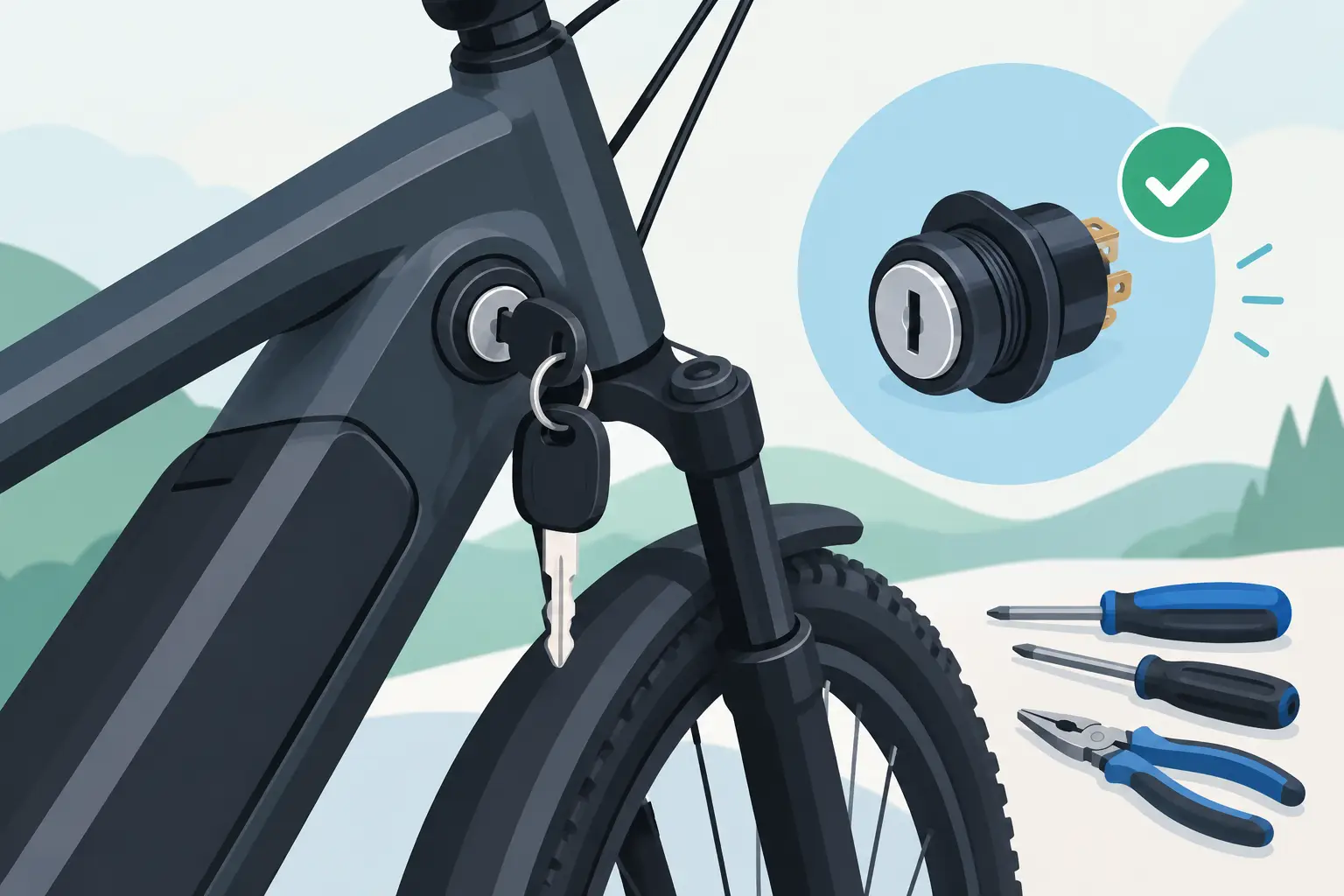
A key turns, the display stays dark, and a perfectly charged battery suddenly seems useless. That is the frustrating situation many riders face before seeking ebike key ignition switch repair. On commuter, fat-tire, moped-style, and delivery e-bikes, the key switch is a small part with an outsized job: it tells the electrical system when to wake up.
The catch is that a no-power condition is not always a bad ignition switch. A weak battery connection, failed fuse, damaged harness, controller fault, or corroded connector can create identical symptoms. The right repair starts with testing the circuit, not ordering a switch based on appearances.
What an E-Bike Ignition Switch Actually Does
On many e-bikes, the key switch is not a traditional automotive ignition that carries the full current needed to run a motor. It usually completes a low-current “electric lock” or enable circuit between the battery and controller. When the key is turned on, the controller receives battery voltage on that small signal wire and powers the display, lights, and operating system.
Other models use the switch to control a relay, while some integrate it into the battery case, display, or a combined headlight and ignition assembly. Wiring colors vary widely by brand. Red, blue, brown, and thin black wires may all appear in ignition circuits depending on the manufacturer, so wire color alone is not a reliable diagnostic method.
That design matters because the switch can look fine, turn smoothly, and still fail electrically. Internal contacts wear, solder joints crack, water enters the cylinder, or the connector behind the switch loosens from vibration. A technician needs to verify whether voltage enters the switch and whether it leaves the switch when the key is in the ON position.
Common Signs You Need Ebike Key Ignition Switch Repair
An ignition-related issue often begins intermittently. The bike may turn on after wiggling the key, pressing on the steering column, or turning the handlebars. It may work in the morning but fail after a rough ride, rain exposure, or time parked outside.
A dead display with a battery that tests good is the most common complaint. You may also see display flickering, lights that cycle on and off, sudden shutdowns over bumps, or a bike that powers up but loses electrical power when the steering is turned. If the key can be removed while the bike remains powered on, the internal lock mechanism or switch contacts may be worn.
Heat at the switch, a burnt-plastic smell, melted insulation, or a connector that looks brown or distorted requires immediate attention. Do not keep riding or repeatedly cycling the key in that condition. Excess resistance in a connection can create heat, damage the harness, and in some cases damage the controller’s ignition input.
Start With the Simple Checks
Before assuming the switch has failed, check the obvious points without opening high-voltage components. Make sure the battery is fully seated and locked, then inspect its external terminals for dirt, corrosion, or pushed-back contacts. Confirm that any external battery fuse is intact and that the display is firmly connected.
Next, turn the key while watching the display and headlight. If the bike reacts only when the key is held in a particular position, that is useful information. It points toward internal switch wear, a loose connector, or a strained wire near the head tube.
Look closely at the wire bundle from the key switch. On moped-style bikes, this harness often flexes where it passes through the steering neck or front cover. On folding e-bikes, cables can be pinched near the hinge. Do not pull hard on the wires or probe exposed contacts with a metal tool while the battery is connected. A short circuit can turn a manageable repair into a controller or battery problem.
Why Bypassing the Key Is Not a Real Repair
Riders sometimes find videos showing how to connect two ignition wires together to make an e-bike turn on. That may seem like a quick test, but it is not a durable or safe repair. It removes a basic theft deterrent, can leave live wiring exposed, and may create a poor connection that heats up under vibration.
More importantly, a bypass does not prove that the switch is the only fault. If a damaged connector, pinched harness, or controller input problem is present, joining wires may briefly power the bike without addressing the cause. On some systems, incorrect wire connections can damage low-voltage electronics.
A proper repair keeps the original system functional whenever parts are available. If the original switch is discontinued or integrated into a larger assembly, the replacement solution should match the voltage, connector type, mounting dimensions, switching function, and wiring layout of the bike. Universal key switches are not universally compatible.
How a Technician Diagnoses the Circuit
Professional ebike key ignition switch repair begins by confirming battery voltage at the source and tracing it through the power path. With the battery safely installed and the system accessed correctly, a technician can measure voltage at the switch input, switch output, fuse, controller ignition lead, and relevant connectors.
Continuity testing is useful when the battery is removed. In the OFF position, the switch should generally show an open circuit on the enable terminals. In the ON position, it should show a stable closed circuit with minimal resistance. The exact test depends on the switch design, especially when it has multiple positions for lights, accessories, or alarm functions.
The harness also needs a movement test. A wire can pass a stationary voltage test but fail when handlebars turn or when the cable is flexed. This is common when a conductor has broken inside its insulation near the steering head. The outside of the wire may look perfect.
If power reaches the controller’s ignition input but the display remains dead, the issue may be elsewhere. The controller, display, communication cable, battery management system, or main battery discharge connection may be at fault. This is why accurate diagnosis saves money. Replacing a key switch will not fix a failed controller or a battery that cuts out under load.
Repair or Replace: What Makes Sense?
A loose connector, corroded terminal, broken wire, or cracked solder joint can often be repaired without replacing the switch itself. The repair should include secure connections, proper wire gauge, insulation, strain relief, and routing that does not pull when the handlebars move.
Replacement is usually the better option when the key cylinder binds, the switch has water damage, the contacts are burnt, or the plastic housing is broken. On bikes with a removable battery and a separate key switch, it is important to distinguish between the battery lock key and the electrical ignition key. They may use the same key on some models, but they are not always the same component or circuit.
Part availability is another factor. Some brand-specific switches use molded connectors and unusual mounting brackets. A direct replacement keeps installation cleaner and reduces the risk of future wiring faults. When an exact part is unavailable, a technician should identify the function of every wire before adapting a compatible switch.
Preventing Another Ignition Failure
Key switches live in a tough environment. They are exposed to vibration, rain, road dust, sun, and riders hanging a heavy key ring from the cylinder. Keep the switch area dry when washing the bike, avoid pressure-washing the cockpit or battery area, and use only a light key ring.
If your e-bike is stored outdoors, cover it and inspect the ignition harness periodically. Make sure the steering can turn fully without stretching cables. A small routing correction made early can prevent a broken wire and a stranded ride later.
For San Diego riders who rely on an e-bike for commuting, school runs, work, or weekend riding, electrical problems are best handled before they become a full no-start. FixEbike can test the ignition circuit alongside the battery, controller, display, and wiring harness to find the actual failure point. A key switch should do one simple job reliably: turn the bike on when you are ready to ride and stay out of the way after that.