
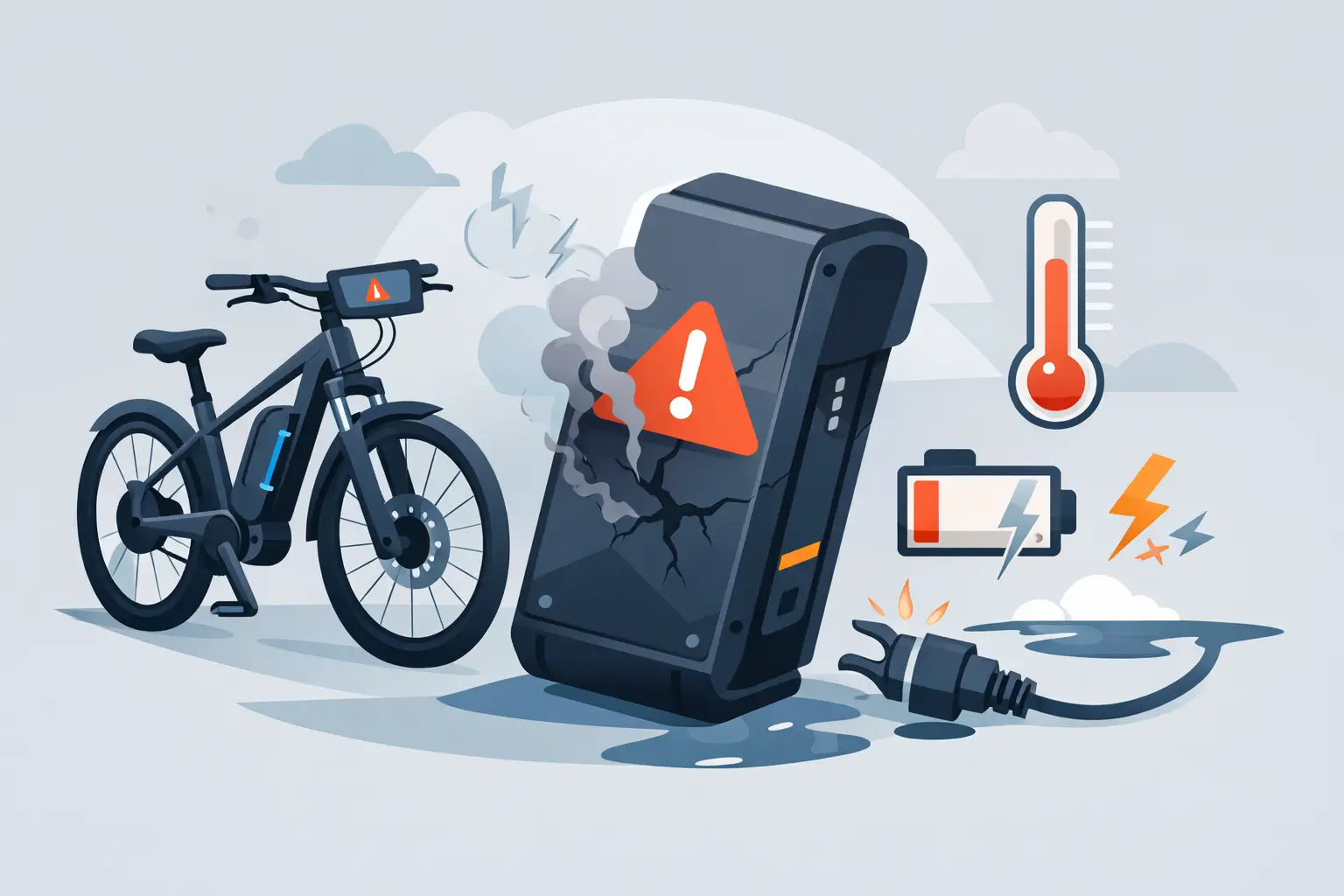
A battery problem rarely starts with a dramatic failure. More often, an e-bike that once handled a commute through Poway or a ride around Mira Mesa begins losing range, cutting out on hills, or refusing to charge consistently. Recognizing the top signs of ebike battery failure early can prevent a stranded ride, protect expensive electrical components, and help determine whether the battery is actually at fault.
Battery symptoms can overlap with charger, controller, display, wiring, and motor issues. That is why a proper diagnosis matters. Replacing a battery before testing the complete electrical system can be an expensive guess.
Top Signs of Ebike Battery Failure
Your range drops faster than it used to
A clear reduction in riding range is one of the most common warning signs. If your e-bike used to cover 25 miles and now struggles to reach 12 to 15 miles under similar conditions, the battery may have lost usable capacity.
All lithium-ion batteries gradually wear down. Every charge cycle slightly reduces their ability to store energy, and heat speeds up that process. San Diego riders may notice this after several years of use, especially with bikes stored in hot garages, left in direct sun, or regularly charged immediately after a hard ride.
Still, range loss is not automatically battery failure. Higher rider weight, steep routes, low tire pressure, dragging brakes, cold weather, stronger assist settings, and a worn drivetrain can all reduce range. A technician should compare the battery’s actual voltage behavior and capacity with the bike’s overall mechanical condition before making the call.
The battery dies or cuts out under load
An e-bike that turns on normally but shuts off when climbing a hill, accelerating hard, or carrying cargo often has a voltage-drop issue. Under load, the motor demands more current. A weak battery pack may not be able to deliver it without its voltage falling below the controller’s low-voltage cutoff.
The display may suddenly go blank, show an empty battery icon, or restart once you stop. In some cases, the bike works again after sitting for a few minutes because the voltage recovers with no load. That pattern is a strong reason to inspect the pack, battery management system, main battery terminals, and high-current wiring.
This symptom can also come from loose connectors, corrosion, damaged battery contacts, a failing controller, or an undersized aftermarket battery. The distinction matters because a wiring repair may solve the problem without replacing the pack.
Charging is inconsistent or stops too soon
A healthy battery should charge predictably with a compatible charger. Warning signs include a charger that stays green immediately, a charge light that never changes, charging that stops well before the expected time, or a battery that reports full but has very little usable range.
Start with the simple checks: inspect the charger cable and plug for damage, make sure the outlet works, and look for bent, burned, or loose charge-port contacts. If another known-good compatible charger produces the same result, the issue may be inside the battery pack.
Many packs use a battery management system, often called a BMS, to control charging and protect individual cell groups. A BMS fault, cell imbalance, failed temperature sensor, or weak cell group can prevent normal charging even when the outer case looks fine. These faults require electrical testing, not guesswork.
The battery percentage jumps around
A battery gauge that falls from 70% to 20%, then returns to 50% after a short stop, is not providing reliable information. Sometimes the display’s estimate is inaccurate, particularly after a battery has been changed or the system has not been calibrated through normal use. But frequent, large swings can point to uneven cell voltage inside the pack.
Cell groups do not always age at the same rate. One weak group can sag sooner than the others during acceleration, causing the BMS or controller to react as if the entire battery is nearly empty. Once the load drops, the voltage rises again and the display may show a higher percentage.
Voltage testing at rest and under load gives a more useful picture than relying on the display alone. It can also reveal whether the display, controller communication, or battery itself is producing the false reading.
The pack gets unusually hot, swells, smells, or leaks
Heat after charging or riding is normal to a degree. A battery that is too hot to comfortably touch, however, deserves attention. So does a swollen case, a sweet or chemical odor, melted connector plastic, discoloration around terminals, smoke, or any sign of fluid leakage.
Stop using and charging the battery if you see these symptoms. Move it away from combustible materials if it is safe to do so, and do not place it in a sealed container, vehicle, or trash bin. Do not try to open the battery case, puncture it, or continue charging to “see if it comes back.” Damaged lithium-ion packs can create a fire risk.
Physical damage also matters. A battery that was dropped, hit in a crash, exposed to deep water, or mounted loosely enough to rattle can have internal damage even if it still powers the bike. A professional inspection is the safer next step.
The battery will not turn on or communicate with the bike
Some e-bike batteries have a power button, indicator lights, key switch, fuse, or removable mount. If the battery appears dead, first check that it is fully seated and locked into its cradle. Dirty or recessed contacts can prevent the bike from receiving power.
If the battery lights turn on but the display remains dead, the problem could be a broken power lead, damaged ignition wire, blown fuse, controller fault, or a communication issue on systems that use data connections. Conversely, a display error can make a functioning battery appear defective.
This is especially common on moped-style and fat-tire e-bikes that see vibration, rough roads, or frequent battery removal. The correct repair may be as simple as restoring a damaged connector, or it may require tracing a fault through the battery cradle and controller harness.
What Causes Ebike Batteries to Fail Early?
Age and charge cycles are part of battery ownership, but storage and charging habits make a real difference. Repeatedly draining a battery to zero, storing it empty for months, leaving it at 100% in high heat, using an incorrect charger, or riding with a loose battery connection can shorten its life.
Water intrusion is another concern. Many e-bike batteries are water-resistant, not waterproof. Riding in occasional rain is different from pressure washing the bike, submerging a battery, or allowing moisture to sit in a charge port. Corrosion can create resistance at terminals and mimic a weak battery by causing voltage loss when power demand rises.
Aftermarket replacements deserve extra caution. The correct nominal voltage is only one part of compatibility. The battery also needs suitable current capability, connector wiring, physical fit, charging specification, and, on some models, communication compatibility with the controller. A bargain pack that does not match the system can cause repeated cutouts or damage components.
When to Stop Troubleshooting at Home
You can safely check whether the battery is secured, inspect visible connectors, verify that the charger and outlet are working, and look for obvious damage. Beyond that, battery diagnosis should be handled carefully. Lithium-ion packs contain high energy, and opening one without the right tools and experience can create shock, short-circuit, and fire hazards.
Bring the bike and charger with you whenever possible. Testing the complete system helps isolate whether the problem is in the battery, BMS, charger, controller, wiring harness, or motor circuit. At FixEbike, that diagnostic-first approach helps avoid replacing good parts and gets riders a clearer repair path.
If your e-bike is losing power, refusing to charge, or showing a battery reading that does not match the ride, do not wait for the issue to become a no-start situation. A timely electrical inspection can often turn an uncertain symptom into a practical repair plan and get you back on the road with confidence.