
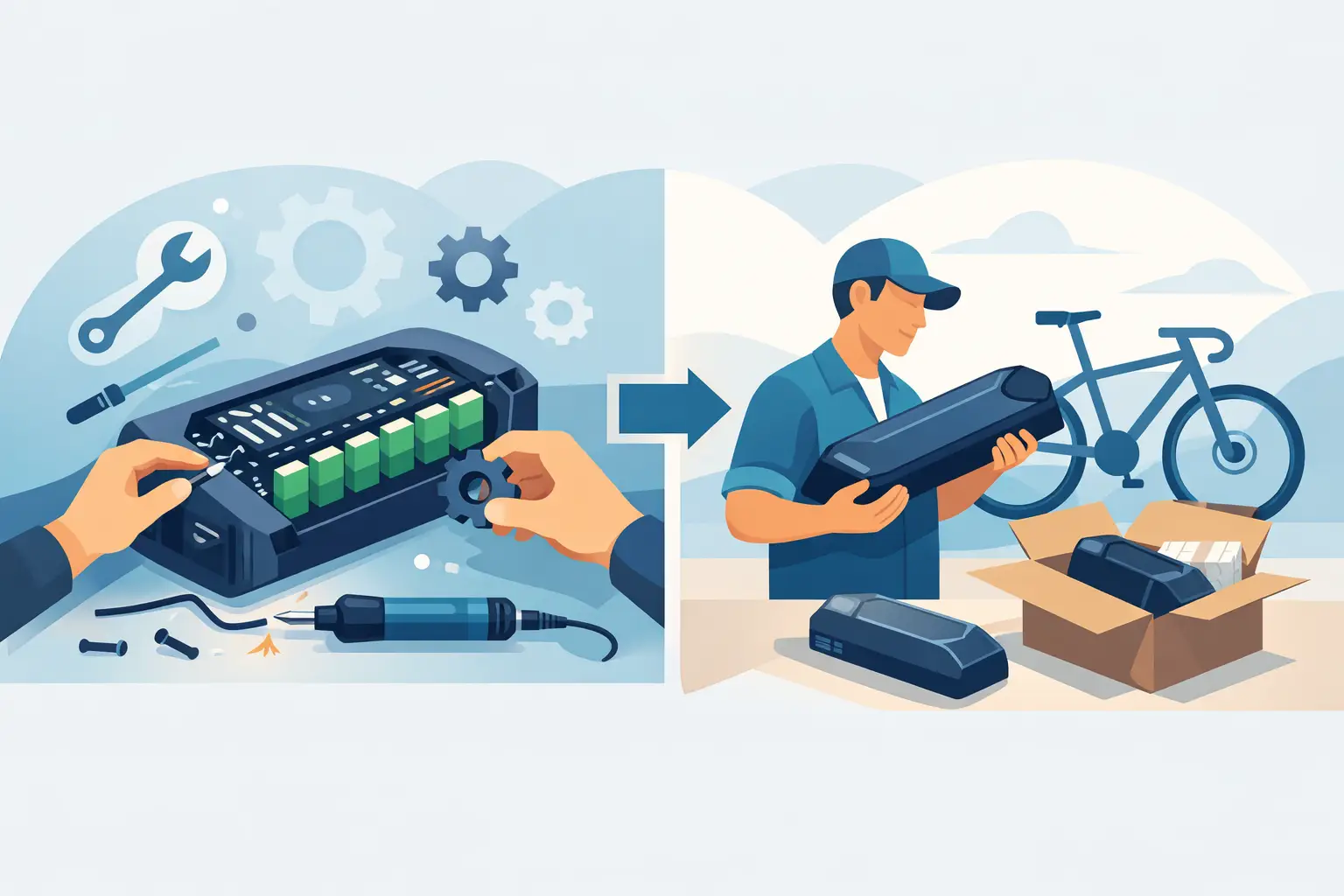
A battery that will not charge before a commute, shuts off on a hill, or drops from three bars to empty can make replacement feel like the only answer. But ebike battery repair vs replacement is not a simple age question. The right decision depends on the battery’s actual condition, the fault inside the pack, the cost of a safe repair, and whether the rest of the e-bike is operating correctly.
A weak battery can look like a controller problem. A charger fault can look like a dead battery. Even a brake cutoff switch, damaged connector, or voltage drop in the wiring can create symptoms that send riders shopping for a battery they do not need. That is why diagnosis comes first.
Start With the Battery Symptoms
Battery problems tend to show up in a few familiar ways: the charger stays green, the display will not power on, range has fallen sharply, power cuts out under load, or the battery turns on but the bike will not run. Those symptoms matter, but they do not identify the failed part by themselves.
A proper battery diagnostic checks pack voltage, charge voltage, connector condition, fuse continuity, BMS behavior, and voltage stability under load. It should also include a look at the battery cradle, charge port, main power leads, and the e-bike’s controller connections. On some bikes, a dirty or loose contact in the battery mount is enough to cause intermittent power loss.
Age is useful context, not a diagnosis. A quality lithium-ion battery that has been stored indoors and charged correctly may still be serviceable after several years. Another pack may be worn out much sooner after heavy delivery use, repeated deep discharges, heat exposure, or long periods sitting empty.
When eBike Battery Repair Makes Sense
Battery repair is often the practical choice when the cells are still healthy but a supporting component has failed. These are common cases where a repair may save a good pack from being replaced unnecessarily.
Charger, fuse, and connection faults
If the charger is not delivering the correct output voltage, the battery may never reach a full charge. If a fuse has opened, a connector has overheated, or a charge port has become loose, the pack can appear completely dead even though the cell group voltage is acceptable. These faults are often repairable, provided the battery case and internal components have not suffered heat damage.
Battery cradles deserve attention too. The spring contacts in a frame-mounted cradle carry significant current. Corrosion, weak contact pressure, melted plastic, or damaged wiring can create resistance and voltage drop. The bike may power on in the driveway but cut out when the motor draws current on an incline.
BMS problems
The battery management system, usually called the BMS, monitors cell groups and controls charging and discharge protection. A BMS can shut down a battery after detecting low voltage, overcurrent, a temperature issue, or an imbalance between cell groups. In some cases, the cells are usable and the BMS or its wiring is the failed component.
BMS repair is not a casual do-it-yourself job. A battery pack contains high current wiring and lithium-ion cells that can be damaged by incorrect handling. The technician needs to verify individual group voltages, balance behavior, temperature sensing, and the condition of nickel strips and welds before deciding whether a BMS replacement is appropriate.
Isolated wiring damage
A damaged discharge lead, broken key switch wire, failed on/off button, or loose internal connector can prevent a healthy battery from powering the bike. If the fault is isolated and the pack has no evidence of water intrusion, overheating, swelling, or degraded cell groups, repair can be a sensible option.
The key point is that a repair should address the root cause. Resetting a BMS or replacing a fuse without finding out why it tripped may only produce a temporary fix.
When Battery Replacement Is the Safer Choice
Replacement is usually the better value when the battery cells themselves are worn, damaged, or unreliable. Even if a pack can be brought back to life briefly, it may not be dependable enough for a daily commuter, a student riding to school, or a rider who depends on the bike for work.
A replacement should be strongly considered when there is visible swelling, a cracked case, water damage, a burnt smell, melted connectors, severe corrosion, or signs of heat inside the pack. Stop using and charging a battery with any of these signs. Move it away from flammable materials if it can be done safely, and have it evaluated by a qualified e-bike battery technician.
Range loss also points toward replacement when it is substantial and consistent. Every lithium-ion battery loses capacity over time, but a healthy pack should still deliver stable power through most of its charge. If range has dropped dramatically, voltage falls quickly under acceleration, or the bike shuts down well before the display reads empty, the cells may no longer support the current demand.
Cell imbalance is another deciding factor. A pack is made from groups of cells working together. When one group sags much lower than the others, the BMS may cut power to protect it. Sometimes balancing and component repair can help, but a heavily imbalanced or repeatedly failing pack may have aging cells that no longer match well enough for reliable use.
Cost Is More Than the Price of a New Pack
Comparing repair and replacement only by the initial estimate can be misleading. A lower-cost repair is a good value when it restores a structurally sound battery with healthy cells. It is not a bargain if the pack soon develops another cell-related fault or delivers too little range for the rider’s needs.
Replacement cost varies widely by voltage, capacity, case style, connector type, mounting system, and battery brand. A 48V fat-tire bike battery, for example, is not interchangeable with a 36V commuter battery simply because the plugs look similar. Using an incompatible battery can damage the controller, create charging issues, or introduce a serious safety risk.
A good replacement evaluation checks more than physical fit. The new battery must match the system voltage, have sufficient continuous discharge capability for the controller, use the correct polarity and connector arrangement, and fit securely in the frame or rear rack mount. Capacity affects range, but it does not override those electrical requirements.
For some older or less common e-bikes, a suitable original-style replacement may be difficult to source. In that situation, a careful battery repair can be especially worthwhile if the existing pack and case are safe to restore. On the other hand, if a compatible replacement has better long-term support and a clear warranty path, replacement may be the more practical decision.
Do Not Assume the Battery Is the Only Problem
An e-bike can lose power for reasons that have nothing to do with battery health. Hub motor hall sensor faults, damaged phase wiring, controller failures, display communication errors, and brake cutoff switches can all cause no-power or low-power complaints. A controller that is pulling abnormal current can also place extra stress on a battery.
That is why the battery should be tested with the rest of the electrical system in mind. If a new battery is installed without finding a shorted wire, failing controller, or high-resistance connection, the same symptom may return. In the worst case, the underlying electrical fault can damage the replacement battery.
At FixEbike, the goal is to identify whether the issue is inside the pack, at the battery connections, or elsewhere in the power system before recommending a repair path. That approach helps riders avoid paying for parts based on guesswork.
A Practical Decision for San Diego Riders
For a bike used on short neighborhood rides, a modest reduction in range may be manageable. For a commuter traveling from Rancho Bernardo to work, a delivery-style rider running long shifts, or a parent relying on an e-bike for school transportation, predictable range and power matter more. The battery does not need to be completely dead before reliability becomes the deciding factor.
Heat also deserves consideration in San Diego. Leaving a battery in a hot vehicle or charging it immediately after a hard ride in high temperatures can shorten its service life. Store the battery in a dry, moderate-temperature location when possible, use the correct charger, and avoid running it to empty on every ride.
The best choice is the one that is safe, electrically compatible, and dependable for how you actually ride. If the fault is a fuse, BMS, charge port, or connection on an otherwise healthy pack, repair may keep a good battery in service. If the cells are degraded, the pack is damaged, or power is no longer reliable under load, replacement is usually money better spent. A clear diagnostic gives you the answer before your next ride turns into another roadside stop.