
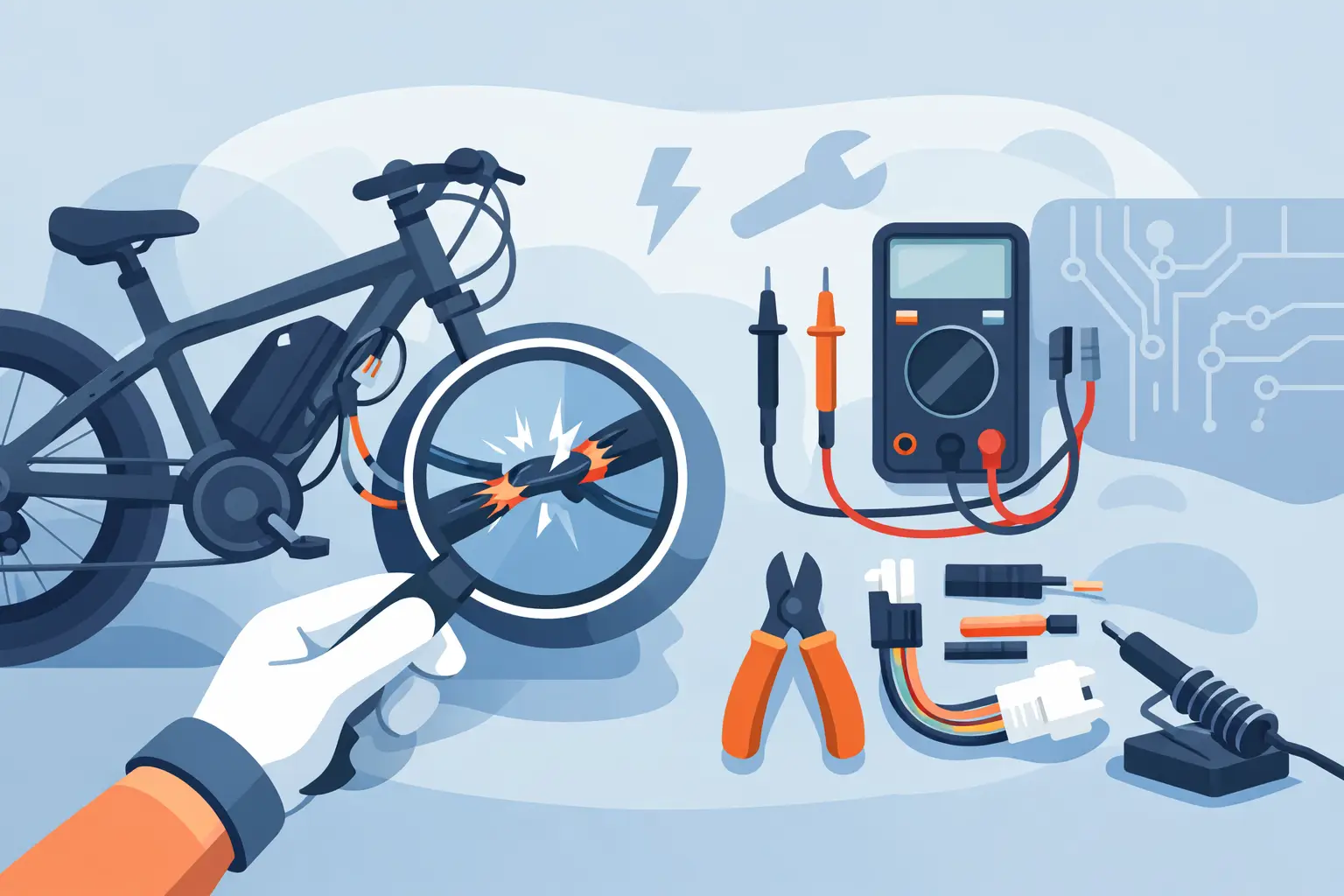
A bike can have a fully charged battery, a healthy motor, and still refuse to run because one damaged wire or connector is interrupting the system. This guide to ebike wiring harness faults explains what riders can safely look for, why these problems can be difficult to pinpoint, and when a professional electrical diagnosis is the better next step.
For San Diego riders, wiring trouble often shows up after rough roads, repeated folding or transport, water exposure, or simply years of vibration. The visible damage may be small, but the symptoms can be dramatic: a display that shuts off, a motor that cuts out under load, intermittent error codes, or a bike that will not power on at all.
What an E-Bike Wiring Harness Does
The wiring harness is the network that connects the battery, controller, motor, display, throttle, pedal-assist sensor, brake cutoff switches, lights, and other accessories. Some bikes use one main harness running through the frame. Others use several smaller harnesses connected at the handlebars, battery tray, controller compartment, and motor cable.
Not every wire carries the same type of signal. Battery and motor phase wires carry high current. Hall sensor, throttle, display, and communication wires carry low-voltage signals. That distinction matters. A loose low-voltage display connector may prevent the bike from turning on, while a damaged high-current connection can create heat, melted plastic, and a major power loss.
The controller is often where the symptoms meet. It relies on clean power from the battery and reliable input from every connected component. A harness fault can therefore look like a controller failure, battery issue, motor problem, or bad display. Testing the system in the right order avoids replacing expensive parts that were not actually defective.
Common E-Bike Wiring Harness Fault Symptoms
A wiring issue is rarely identical from bike to bike. Still, certain patterns point technicians toward the harness before they condemn a battery, controller, or motor.
An e-bike that powers on but loses assistance when accelerating may have a loose battery connection, overheated phase connector, or internal break in a wire that only opens when the frame flexes. If the motor sputters, vibrates, or makes a growling sound while the wheel barely turns, phase-wire or hall-sensor wiring should be checked closely.
A display that flickers, resets, or shows a communication error can indicate low voltage at the display connector, water intrusion, a damaged handlebar harness, or a controller communication problem. On moped-style and fat-tire e-bikes, the front harness is especially vulnerable because it moves every time the bars turn.
Brake cutoff faults are another common source of confusion. A stuck or shorted brake sensor can tell the controller that the brake is engaged, disabling motor output even though the bike appears normal. The same is true of a throttle connector that has been pulled, bent, or connected incorrectly after a repair.
If a problem appears only after hitting a bump, turning the handlebars, folding the bike, or riding in rain, the harness deserves close attention. Those clues are more useful than an error code alone.
Where Wiring Harness Faults Usually Start
The most vulnerable spots are not always inside the frame. They are usually places where wires move, rub, pull tight, or carry substantial current.
Handlebar and Head Tube Wiring
The cable bundle near the head tube is constantly flexing. It can rub on the frame, get pinched by a steering stop, or stretch too tightly when the handlebars are turned. Damage may be hidden under spiral wrap or inside the frame opening. On some bikes, a broken conductor is only exposed when the handlebars are turned to one side.
Battery Tray and Main Power Connectors
Battery contacts and main power plugs handle the highest current in the system. Corrosion, loose terminals, worn battery mounts, or a partially seated connector can cause voltage drop under acceleration. The bike might look normal on a stand but cut out on a hill or while carrying cargo.
Heat marks, discolored terminals, melted connector housings, and a burnt electrical smell are warning signs. Do not continue riding a bike with these symptoms. Heat at a power connection can damage the battery, controller, and surrounding wiring.
Motor Cable Exit Point
Hub motors have a cable that exits near the axle. That cable can be scraped, crushed, or pulled during wheel removal. A torque arm installed incorrectly, a loose axle, or a crash can also damage the cable at the point where it enters the motor.
This is a high-priority inspection area when the motor cuts in and out, runs rough, or displays a hall sensor-related fault. The cable may look fine from the outside while the conductors inside are strained or broken.
Controller Compartment
Controllers are often mounted in a frame cavity, under a rack, or behind a plastic cover. Those compartments collect dust and, on some models, moisture. Wires can also be pinched when a cover is reinstalled. Poorly matched aftermarket accessories, such as lights or turn signals, can introduce incorrect wiring or overload a circuit.
A Safe First Check Before Booking Repair
Start with the bike switched off and the battery removed when possible. Do not probe exposed battery terminals with metal tools, and do not attempt to bypass a fuse, brake cutoff, or battery management system. Those shortcuts can damage components and create a fire risk.
Look over accessible connectors for loose seating, bent pins, corrosion, cuts in insulation, or wires pulled partly out of their housings. Check whether the harness gets tight when you turn the bars from lock to lock. Inspect the battery tray and the motor cable near the axle. If there is obvious melting, heavy corrosion, or water inside a connector, stop there rather than reconnecting it repeatedly.
A basic visual inspection is useful, but it does not prove that a harness is good. Many faults are internal. A wire can break beneath intact insulation, and a connector can pass a no-load check but fail when current demand rises.
Why Voltage Drop Testing Matters
Battery voltage can appear normal at rest and still collapse at the controller because of a poor connection. That is why a proper diagnosis often includes voltage measurements while the system is under load. Technicians check voltage at the battery, then compare it with voltage arriving at the controller. A meaningful difference points to resistance in the battery mount, fuse holder, connector, or main harness.
Continuity testing is also useful, especially for hall sensors, throttle circuits, display communication lines, and brake cutoffs. But continuity alone is not enough for high-current wiring. A connector with corroded or weak terminals may show continuity on a meter while generating damaging heat during acceleration.
This is where component-level troubleshooting saves time. Instead of guessing that the controller or motor has failed, the technician can isolate the power path, signal path, and motor wiring to identify the actual source of the fault.
Repair, Replace, or Rebuild the Harness?
The right repair depends on the location of the damage, wire type, connector condition, and the bike’s overall value. A clean break in an accessible low-voltage wire may be repairable with the correct splice, insulation, strain relief, and weather protection. A damaged motor cable may require a more involved repair because wire routing and sealing at the motor are critical.
When multiple wires are brittle, corroded, melted, or altered by previous repairs, replacing or rebuilding the affected harness is usually more reliable than patching one spot at a time. The goal is not just to restore power for one ride. It is to prevent the same failure from returning after normal vibration and use.
Connector quality matters as much as the wire repair. Mismatched plugs, loose crimp terminals, and poorly insulated splices can cause intermittent faults that are harder to diagnose than the original issue. A proper repair needs secure terminals, correct wire gauge, strain relief, and protection from water and abrasion.
When a Wiring Fault Needs Professional Diagnosis
Bring the bike in for diagnosis if it has melted connectors, repeated blown fuses, battery power that cuts out under load, motor stuttering, error codes that return after resetting, or any sign of water damage in the controller area. These issues can overlap with battery management system faults, controller failure, hall sensor trouble, or motor phase problems.
FixEbike diagnoses the full electrical path rather than treating every no-power complaint as a battery replacement. That approach is especially helpful when a bike has had intermittent trouble, aftermarket accessories, prior repairs, or a fault that only occurs while riding.
Before your appointment, take note of when the problem occurs: during acceleration, after a bump, when turning the handlebars, in wet conditions, or only at a certain battery level. Those details help narrow the test process quickly. A wiring harness is not the most visible part of an e-bike, but a careful diagnosis can make the difference between another frustrating cutoff and a bike you can trust on the ride home.