
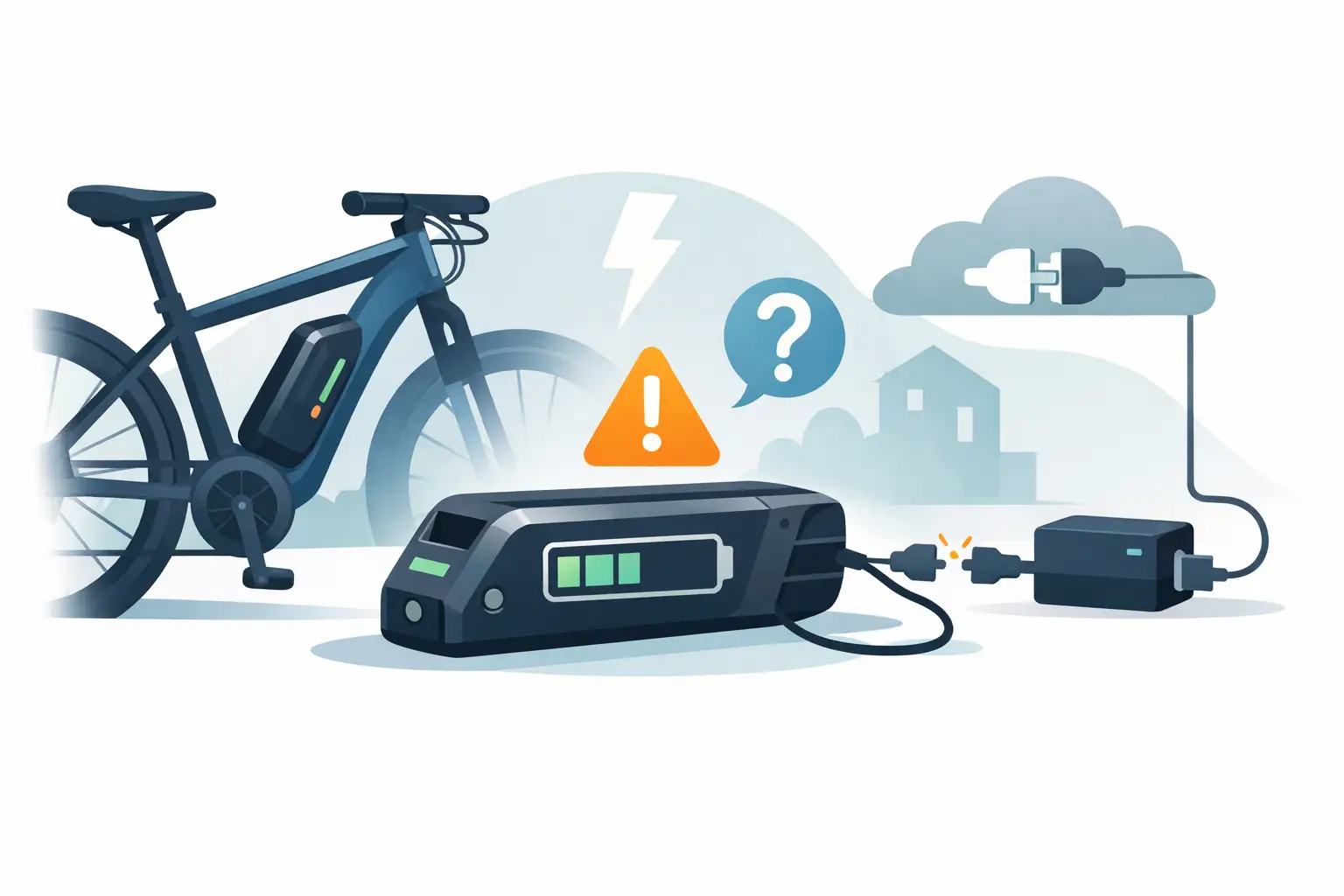
You plug the charger in, wait for the usual light change, and nothing happens. When an ebike battery not charging issue shows up, most riders are left guessing whether the problem is the battery, charger, wiring, port, or something deeper in the bike’s electrical system. That guesswork is where simple fixes get missed and expensive parts get replaced too soon.
What an ebike battery not charging usually means
Charging problems are not all the same. Sometimes the battery is healthy and the charger has failed. Sometimes the charge port is loose or damaged from repeated use. In other cases, the battery management system, or BMS, has shut charging down to protect the pack from a low-voltage, high-temperature, or internal cell problem.
That matters because the symptoms can look almost identical from the outside. A battery that shows no response on the charger can be suffering from a bad fuse, corroded contacts, broken charge leads, a failed charger brick, damaged port pins, or a pack that has dropped below safe recovery voltage. The right fix depends on proper testing, not assumptions.
Start with the simple checks first
Before treating the battery as failed, check the basics carefully. Make sure the outlet works and the charger is actually receiving power. It sounds obvious, but a dead garage outlet or tripped GFCI causes plenty of service calls.
Next, look at the charger indicator lights. Some chargers show a green light even when they are not actually delivering proper output voltage. If the charger stays green immediately after connecting to a low battery, that can point to a charger fault, a broken connection, or a battery BMS that is not allowing charge current in.
Inspect the charge port on both the charger and battery side. Bent center pins, loose sockets, dirt, moisture, and heat discoloration are common. On many e-bikes, the port takes more abuse than riders realize, especially if the plug gets bumped while charging or the bike is stored in a tight garage.
If your battery is removable, take it off the bike and inspect the terminals. Look for corrosion, recessed pins, cracked plastic, or signs of arcing. A battery may also fail to charge because the mounting cradle or discharge connection has an unrelated fault that affects communication or power flow.
Charger problems are more common than people think
A failed charger is one of the most common reasons an ebike battery is not charging, and it is also one of the easiest problems to confirm with the right tools. Chargers can fail completely, or they can fail partially by producing unstable voltage under load.
A charger may look normal from the outside while the internal board, fuse, or output cable has gone bad. Repeated bending near the charger plug is especially common. If the light changes when you wiggle the cable, that is a strong sign of a broken conductor or damaged connector.
The trade-off here is simple. Swapping in a known-good compatible charger is a useful test, but only if it truly matches the battery chemistry and output specifications. Using the wrong charger can damage the pack or create a safety risk. If there is any doubt, confirm voltage and connector type before testing.
Battery port and wiring faults can stop charging
A charge port fault sits in the middle ground between minor and serious. Sometimes the fix is a port replacement or a wiring repair. Other times, the damaged port has already caused heat buildup that traveled into the battery harness or BMS board.
We often see ports loosen internally even when the outside looks fine. The plug may fit, but the internal solder joint or lead has cracked. In that case, the charger light can behave unpredictably, or charging may start only if the connector is held at a certain angle.
If you see black marks, melted plastic, or a hot smell near the charge port, stop trying to charge it. Heat damage means resistance has built up somewhere in the connection, and repeated attempts can make the repair more expensive.
The battery itself may have a BMS or cell issue
If the charger and port test good, the next suspect is the battery pack. Most e-bike batteries use a BMS to manage charging, cell balancing, and protection. When the BMS detects an unsafe condition, it can block charging entirely.
That protection can be triggered by a genuinely bad pack, but not always. A battery that has been stored empty for too long may drop below the threshold where normal charging begins. A pack can also show decent voltage overall while one internal cell group is far enough out of balance to stop the charging cycle.
This is where riders often get mixed advice. One person says the battery is dead. Another says it just needs a reset. The truth is, it depends on what the cells and BMS are doing under test. Some low-voltage packs can be professionally evaluated and recovered. Others have internal degradation that makes repair impractical or unsafe.
Temperature matters more than most riders realize
An e-bike battery may refuse to charge simply because it is too cold or too hot. That is normal behavior for many battery systems. After a long ride in summer heat, or after sitting overnight in a cold garage, the BMS may pause charging until the pack returns to a safer range.
If the battery feels unusually hot, let it cool indoors before trying again. If it is cold, allow it to warm gradually to room temperature. Do not use heaters, direct sunlight, or improvised methods to force the temperature up. Rapid heating is not worth the risk.
In San Diego, heat-related charging complaints are more common than deep-cold ones, especially with bikes stored in sheds, garages, or car trunks. High temperature over time can shorten battery life and stress both the pack and charger.
On-bike system faults can also affect charging
Some e-bikes charge through the battery alone. Others have more integrated systems where controller, display, lock, cradle, or communication faults can complicate the picture. If the bike powers on inconsistently, shows error codes, or has recent wiring damage, the charging problem may not be isolated to the battery.
For example, water intrusion, crash damage, or a pinched harness can create voltage drops or communication faults that confuse diagnosis. Riders often focus on the battery because that is the visible symptom, but the root cause may sit elsewhere in the electrical system.
That is why a proper diagnostic process matters. Voltage readings, charger output checks, port inspection, continuity testing, and battery behavior under controlled conditions all tell a more complete story than replacing parts one at a time.
What you can safely do at home
You can check the outlet, inspect the charger, look for visible port damage, and let the battery return to room temperature. You can also confirm whether the battery has a built-in charge indicator and whether that indicator responds at all.
What you should not do is open the battery case, jump terminals, bypass the BMS, force a mismatched charger, or keep retrying a battery that is heating up, swelling, or giving off an odor. Lithium battery problems can shift from repair issue to safety issue quickly.
If the battery has taken an impact, got wet, stopped charging after a spark, or suddenly dropped from normal operation to zero response, it is better to stop testing and have it evaluated.
When professional diagnosis makes more sense
If you have already ruled out the outlet and obvious charger problems, a shop with e-bike electrical experience can usually narrow the fault down quickly. The goal is not just to say the battery is bad. The goal is to identify whether the fault is in the charger, charge port, BMS, cells, wiring, or another component affecting charge behavior.
That can save money. Replacing a battery when the real issue is a failed charger or broken port wastes time and budget. On the other hand, continuing to use a failing battery because the charger light still comes on can lead to bigger damage later.
At FixEbike, this kind of problem is handled as a diagnostic-first repair, because charging faults are rarely solved well by guesswork. The right test path is what gets riders back on the road faster.
How to reduce the chance of future charging issues
Battery life is affected by storage habits, charging habits, and physical wear. Try not to leave the battery fully drained for long periods. Avoid storing it in extreme heat. Support the charger cable instead of letting it hang from the port, and keep connectors clean and dry.
It also helps to pay attention to early warning signs. Intermittent charging, flickering charger lights, a loose plug fit, reduced range, or a battery that gets warmer than usual during charging are worth addressing before they turn into a complete no-charge condition.
A battery that will not charge does not always mean the battery is finished. Sometimes the fix is straightforward. Sometimes it points to a deeper electrical problem that needs real testing. Either way, a calm, methodical approach usually saves more time than replacing parts based on a hunch.