
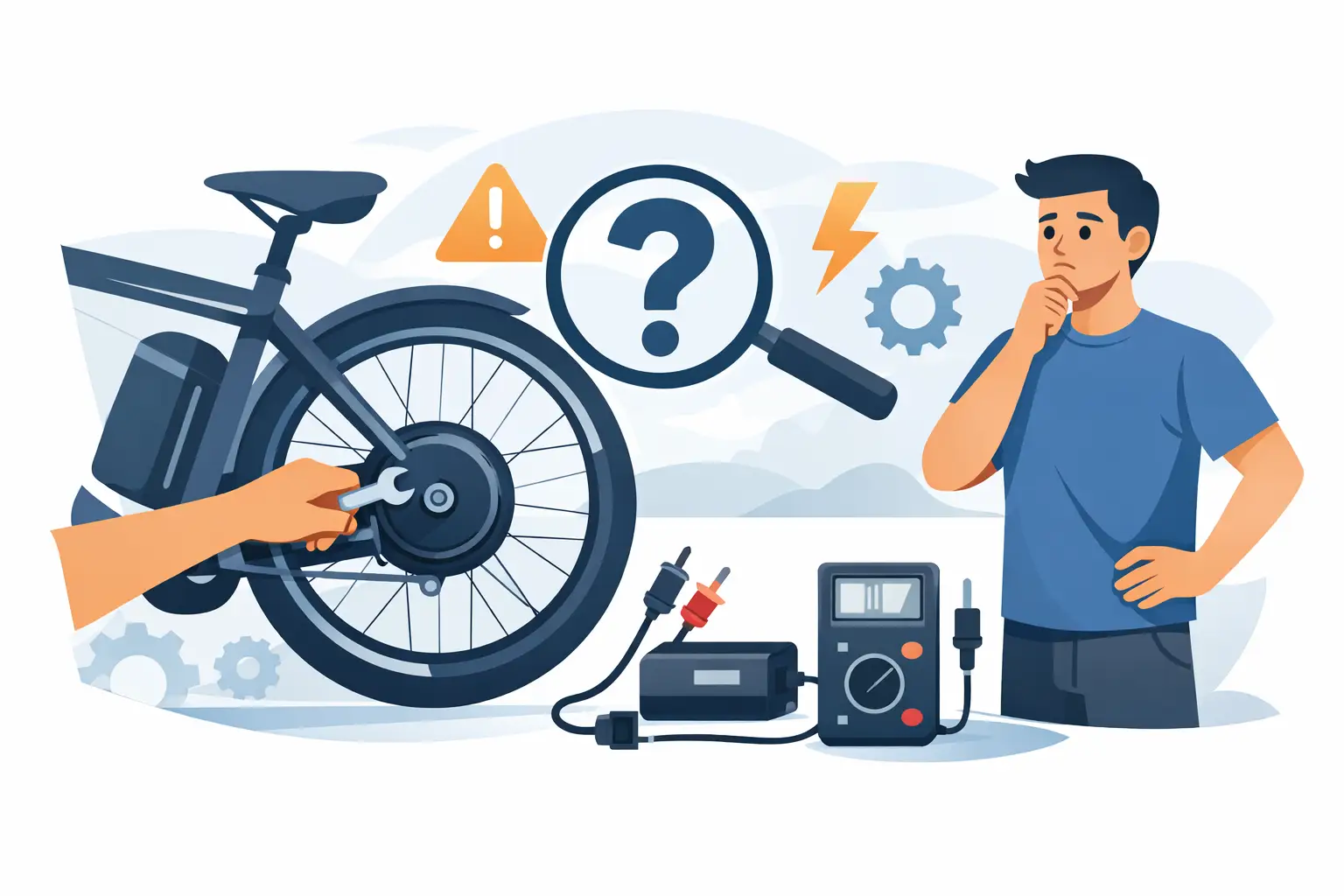
You press the throttle or start pedaling, the display lights up, and nothing happens. When an ebike motor not working issue shows up like that, the problem is usually somewhere in the power chain – battery, controller, wiring, sensors, brakes, or the motor itself. The hard part is that several different faults can feel exactly the same from the rider’s seat.
That is why guessing gets expensive. A motor that seems dead may actually be shut down by a brake cutoff switch, a bad hall sensor, a loose phase wire, low battery voltage under load, or a communication fault between the display and controller. The fastest path is to narrow it down step by step.
When an ebike motor not working problem is not really the motor
A lot of riders assume the motor failed because that is the part that stopped pulling. In practice, true motor failure is only one possibility. The motor only works when the bike sees the right conditions: enough battery voltage, a controller sending output, intact wiring, a working throttle or pedal assist signal, and no safety lockout telling the system to stay off.
For example, if your display powers on normally but the wheel does not respond, that often points away from the battery and toward a control issue. If the bike turns on and then cuts power the moment you apply load, voltage sag, battery management system faults, or a controller problem become more likely. If the motor jerks, growls, or stutters, hall sensor or phase wiring issues move higher on the list.
That is the reason a proper diagnostic matters. The symptom is simple. The cause usually is not.
Start with the obvious checks first
Before assuming you need a motor rebuild or a new controller, check the things that commonly stop the system from running.
Make sure the battery is fully seated and locked in place. Many e-bikes can power the display with a battery that is not making a solid high-current connection. That leads riders to think the system has power when it does not have enough to drive the motor.
Next, verify the battery is actually charged. A battery can show charge at rest and still drop too low when the motor asks for current. If the display flickers, resets, or shuts down during acceleration, that is a strong clue.
Then check your assist settings. It sounds basic, but some bikes will not provide throttle in certain modes, and some will not give assist if the system is in walk mode, zero assist, or a settings profile that limits output.
Look at the brake levers too. Many e-bikes use brake cutoff sensors that disable motor power the instant the brakes are pulled. If a lever is sticking, a sensor is out of position, or the switch is damaged, the bike may think the brake is engaged all the time.
Finally, inspect visible connectors. A half-loose plug near the handlebars, controller area, or rear hub can interrupt throttle, display, hall sensor, or motor phase communication. Do not force connectors together if they seem misaligned. Bent pins create bigger problems fast.
Signs the battery or BMS may be the real issue
If the bike turns on but the motor will not engage under load, battery condition needs to be checked carefully. This is especially common on older packs, bikes that sat unused for a while, or batteries exposed to heat and heavy discharge cycles.
A weak battery can still light up the display, horn, or lights because those draw relatively little current. The motor is different. The moment it asks for real power, voltage can collapse below the controller’s minimum threshold and the system shuts down or limits output.
A failing BMS can cause similar behavior. You may see charging problems, random shutoffs, inconsistent range, or a battery that works one ride and fails the next. In some cases the battery is not dead, but the BMS is interrupting current because of a cell imbalance, internal protection event, or damaged wiring inside the pack.
If your bike runs briefly after charging and then loses motor function quickly, the battery becomes even more suspect.
Controller faults can mimic a dead motor
The controller is the traffic manager between battery, display, throttle, sensors, and motor. When it fails, the bike may power on normally but never send the right output to the motor.
Controller problems often show up as no motor response, intermittent cutouts, error codes, burning smell, blown fuses, or rough engagement. Water intrusion is a common cause, especially on bikes stored outdoors or ridden through heavy spray. Heat damage and overloaded components are also common on higher-powered bikes and delivery-use bikes that see long daily mileage.
Sometimes the controller is not fully dead. It may still communicate with the display while failing on one motor phase or sensor input. That can create jerking starts, low torque, or a motor that buzzes but will not spin properly.
This is one of the areas where testing matters more than parts swapping. Replacing a controller without confirming battery health, wiring integrity, and motor condition can waste time and money.
Wiring and connector issues are more common than most riders think
E-bikes live with vibration, weather, curb impacts, folding joints, and constant movement at the bars and rear axle. Wiring problems are not rare. In fact, they are often behind an ebike motor not working complaint that appears suddenly.
A damaged motor cable near the axle is one of the biggest trouble spots, especially on hub motor bikes. That cable can get pinched, twisted, rubbed through, or strained during wheel removal. When phase wires or hall sensor wires are damaged there, the motor may cut out, pulse, run rough, or stop completely.
Handlebar wiring is another weak point. Display, throttle, and brake sensor cables can develop internal breaks where they bend repeatedly. The outside insulation may look fine while the conductors inside are failing.
Corrosion also causes hidden issues. A connector that looks only slightly dirty can create enough resistance or signal loss to stop the system from operating correctly.
Motor-related faults that actually come from inside the drive unit
Sometimes the motor really is the problem. On hub motors, common internal faults include hall sensor failure, damaged phase wiring, worn bearings, water intrusion, and in some cases burned windings. On mid-drives, you can also see internal gear wear, torque sensor faults, or drivetrain-related issues that feel like motor loss.
Hall sensor failure is especially common in hub motor systems. The bike may shudder, run backward briefly, stutter under throttle, or refuse to start smoothly. A single failed hall sensor can make the motor act far worse than riders expect.
Mechanical drag inside the motor can also matter. If the wheel does not spin freely by hand, there may be bearing damage, internal debris, or brake drag adding confusion to the diagnosis. That is why it helps to separate electrical symptoms from mechanical resistance before ordering parts.
What you can safely check at home
There are a few checks that are reasonable for most riders. Confirm battery fitment and charge status, inspect connectors for looseness or obvious corrosion, make sure both brake levers return fully, and see whether the bike behaves differently with throttle versus pedal assist. If your display shows an error code, write it down exactly as shown.
You can also lift the drive wheel and gently test for motor engagement. If it works in the air but fails under rider weight, battery sag, controller stress, or a phase issue becomes more likely. If it does not respond at all, the fault may be in the input side, safety cutoff side, controller, or motor itself.
Avoid probing wires randomly, bypassing safety systems, or opening a battery unless you know exactly what you are doing. E-bike electrical systems can be damaged by incorrect testing, and battery work carries real safety risk.
When professional diagnostics save money
If the bike has power but no drive, cuts out under load, throws repeating error codes, smells hot, or has visible harness damage, professional testing is usually the better move. The same goes for bikes with nonstandard parts, aftermarket controllers, dual-battery setups, or previous repair attempts.
A good diagnostic process checks the system in order: battery voltage and load behavior, controller output, continuity and connector condition, brake and throttle inputs, hall sensor signals, phase wiring, and motor function. That approach finds the root cause instead of just replacing the most obvious part.
For riders in San Diego, especially if the bike is your commuter, your kid’s daily transportation, or part of your work routine, turnaround matters almost as much as the repair itself. Shops that regularly handle controller faults, battery issues, wiring repairs, and hub motor diagnostics can usually spot patterns faster than a general bike shop.
FixEbike sees a lot of these cases where the motor gets blamed first and the real failure turns out to be elsewhere.
The real goal is a reliable repair
When your motor stops working, the question is not just how to make the wheel spin again. The better question is why the system failed in the first place and whether the repair will hold up next week, not just today.
That is why the best fix is usually the one that accounts for the whole electrical system, the bike’s age, how it is ridden, and whether components are still healthy as a set. If your e-bike has been acting up, trust the symptom but do not trust the guess – a careful diagnosis is what gets you back on the road with confidence.