
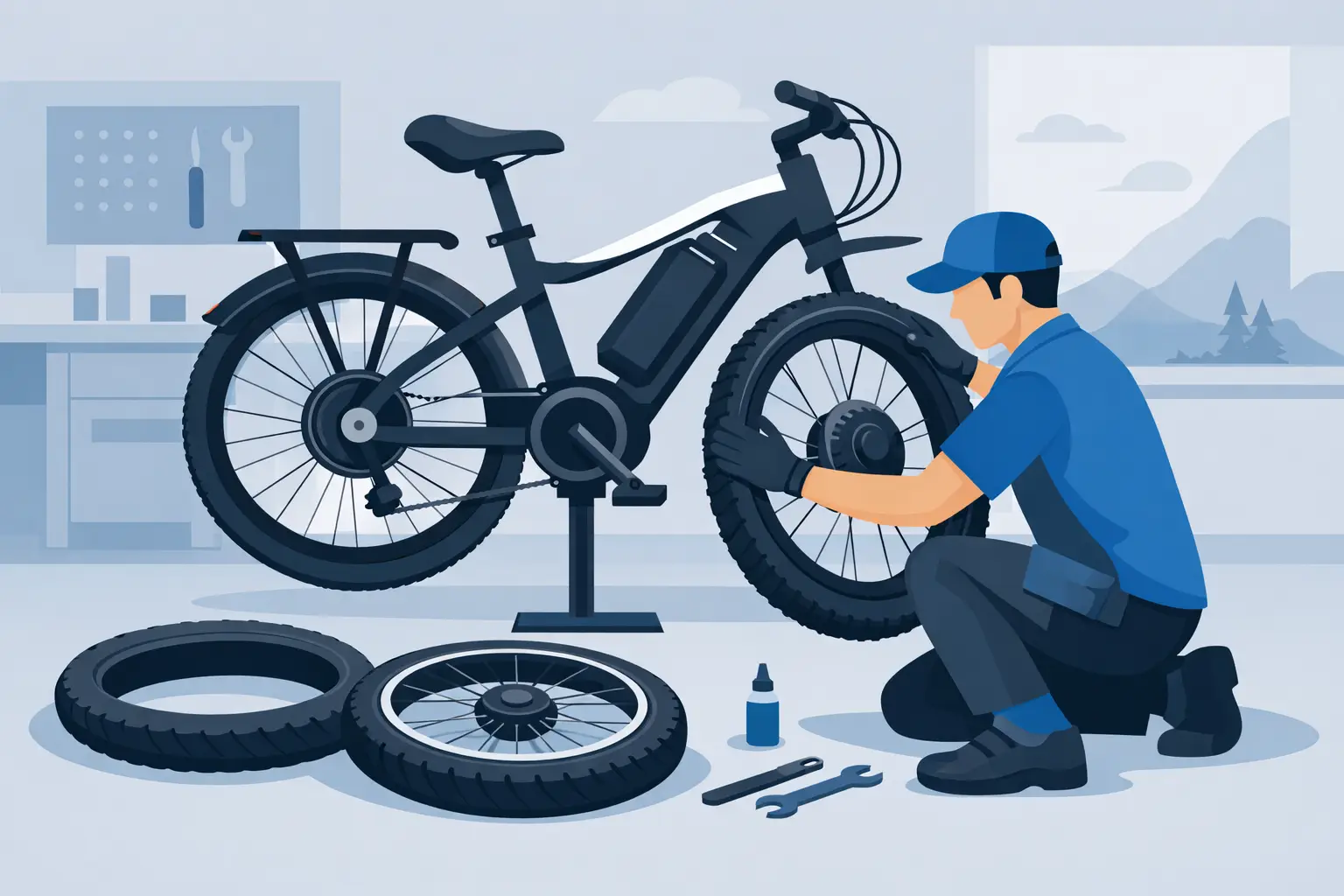
A rear tire that wears flat in the center, a front tire with sidewall cracking, or a tube that keeps going soft after every ride usually means the same thing – your ebike tire replacement should not wait much longer. On an e-bike, tires wear faster than many riders expect because the bike is heavier, the motor adds torque, and speeds are often higher than on a standard bicycle. If you commute around San Diego, carry cargo, ride with a passenger, or use a fat-tire bike on mixed terrain, that wear shows up even sooner.
When ebike tire replacement is actually needed
Some tires fail suddenly after a puncture or sidewall split, but most give warning signs first. The tread may look squared off instead of rounded. You might see small cuts filled with road debris, repeated flats, exposed casing, dry rot near the sidewall, or a tire that no longer holds shape under normal pressure.
On e-bikes, rear tires usually wear faster than fronts. That is not surprising. The rear often handles more rider weight, more cargo weight, and in many models the drive force from the hub motor or mid-drive system. If your rear tire is noticeably more worn than the front, that is normal. If both are worn unevenly or very quickly, there may be a pressure issue, alignment issue, brake drag, or riding condition that needs attention.
A lot of riders ask whether they should replace only the damaged tire or both at the same time. It depends on tread condition, age, and how the bike is used. If one tire is still in strong shape, replacing a single tire can be reasonable. If both are older, cracked, or worn close to the limit, doing both at once usually makes more sense and helps restore predictable handling.
Why e-bike tires are not the same as regular bike tires
An e-bike places different demands on the tire than a non-electric bike. The total system weight is higher. Acceleration is stronger. Braking loads can be higher too, especially on heavier moped-style or cargo-oriented models. That means the right tire is not just about size. Load rating, puncture protection, casing strength, and tread pattern matter.
This is where riders sometimes run into trouble. A tire may fit the rim and still not be the right choice for the bike. Lightweight tires designed for a standard city bike may wear out quickly on a powerful commuter e-bike. An aggressive off-road tread may look good but create more rolling resistance and noise than you want for daily pavement use. A cheap replacement tire may save money upfront but lead to poor traction, more flats, or faster wear.
The label on the sidewall is the starting point. It tells you the tire size and often the pressure range. But for a proper ebike tire replacement, you also want to match the tire to how the bike is actually ridden. A beach cruiser used on boardwalk paths needs something different from a delivery bike making constant stops or a fat-tire e-bike seeing dirt, pavement, and curbs every day.
Choosing the right tire for your riding
If you mostly ride pavement, a smoother commuter-style tread usually gives better efficiency and lower rolling drag. If your routes include loose dirt, gravel, or uneven shoulders, a more textured tread can add grip, though it may wear faster on pavement. For riders using fat-tire e-bikes, the tire choice gets even more specific because width, casing stiffness, and pressure all affect stability and comfort.
Puncture protection is worth paying attention to in San Diego riding conditions. Goathead thorns, road debris, and worn pavement can be hard on tubes and tires. A tire with better flat resistance can reduce downtime, but it is still not a guarantee against punctures. If a wheel keeps flatting, the problem may be more than the tire itself. The rim strip could be damaged, the tube size could be wrong, a spoke could be protruding, or debris may still be embedded in the casing.
Load capacity matters too. This is especially true for riders carrying groceries, hauling gear, transporting a child seat, or using the bike for work. A tire that is technically the right diameter but not built for the bike’s weight can feel unstable and wear out early.
What makes rear ebike tire replacement more complicated
Front tire service is usually straightforward. Rear tire service on an e-bike often is not. Many rear wheels include a hub motor, axle hardware, torque washers, cable routing, and brake components that need to be handled correctly during removal and reinstallation. On some bikes, even getting the wheel out without stressing the motor cable takes experience.
That matters because a simple tire job can turn into an electrical problem if the wheel is reinstalled incorrectly. We have seen cases where a rider or general bike shop replaced the tire but pinched a motor cable, misrouted the harness, damaged a connector, or reassembled axle hardware in the wrong order. The result can be motor cutout, display errors, intermittent power loss, or no assist at all.
Mid-drive e-bikes avoid the rear hub motor issue, but rear wheel service can still be more involved because of derailleur position, tight frame clearance, and brake alignment. Fat-tire and moped-style bikes can be especially time-consuming due to heavier wheels and tighter packaging.
Tubes, liners, sealant, and tubeless setups
Not every ebike tire replacement is just a tire swap. Sometimes the tire is fine and the tube is the failed part. Sometimes both need replacement because the old tire has casing damage or the tube has been patched too many times. If the bike uses tire liners or sealant, those should be checked too.
Tubeless setups can work well on some e-bikes, but they are not automatically better for every rider. They can reduce pinch flats and seal small punctures, but they also require compatible rims, correct tape, valve condition, and ongoing maintenance. For many commuter riders, a quality tire and tube setup is still the most practical option. For off-road riders or heavier-use bikes, tubeless may be worth considering if the wheel system supports it properly.
Signs the problem is not only the tire
A worn tire is easy to spot. The harder cases are the ones where tire damage is a symptom of something else. If the tire wears unusually fast on one side, the wheel may be out of true or the bike may have alignment issues. If the tube keeps puncturing in the same place, there may be a rim or spoke problem. If the tread wears very quickly at the rear, underinflation or excess load may be part of the cause.
Brake drag is another one to watch. A rubbing rotor or binding brake can add heat and resistance, which contributes to premature wear. Suspension issues, loose hub bearings, and poor inflation habits also change how a tire wears and how the bike feels on the road.
That is why a tire replacement should be treated as more than a parts swap, especially on an electric bike. A quick inspection of the wheel, tube, rim strip, brake alignment, axle hardware, and motor cable path can prevent repeat problems.
Can you do ebike tire replacement yourself?
Sometimes yes. If you are replacing a front tire on a basic commuter e-bike and you are comfortable with bike tools, it may be manageable. If you are dealing with a rear hub motor wheel, heavier fat-tire assembly, or a bike with wiring routed tightly around the axle, the risk goes up fast.
The issue is not just getting the old tire off. The issue is putting everything back together correctly. Axle nuts need proper tightness. Washers need the right orientation. Motor cables need slack in the correct place and no twist or pinch. Brakes need to be checked before the bike goes back into service.
For riders who use their e-bike daily, a bad reinstall costs more than the original tire job. It can leave you with a no-start condition, poor wheel alignment, damaged wiring, or unsafe handling.
What to expect from a proper service
A proper ebike tire replacement should include the correct tire size and type, inspection of the tube or tubeless components, a check for debris in the casing, and a look at wheel and brake condition before the bike leaves the stand. On rear motor bikes, it should also include careful handling of motor wiring and axle hardware.
At a shop that works on e-bikes every day, tire service is approached with the same diagnostic mindset used for larger repairs. That matters because e-bike systems are integrated. A wheel, brake, motor, controller wiring, and drivetrain setup can all affect the final result. FixEbike sees that firsthand on commuter bikes, fat-tire models, moped-style e-bikes, and scooters across the San Diego area.
If your bike feels less stable, flats are becoming routine, or the tread is simply done, replacing the tire before it becomes a roadside failure is the smart move. A fresh tire does more than improve grip. It restores confidence, protects the wheel system, and makes every ride feel more predictable from the first block to the last mile.