
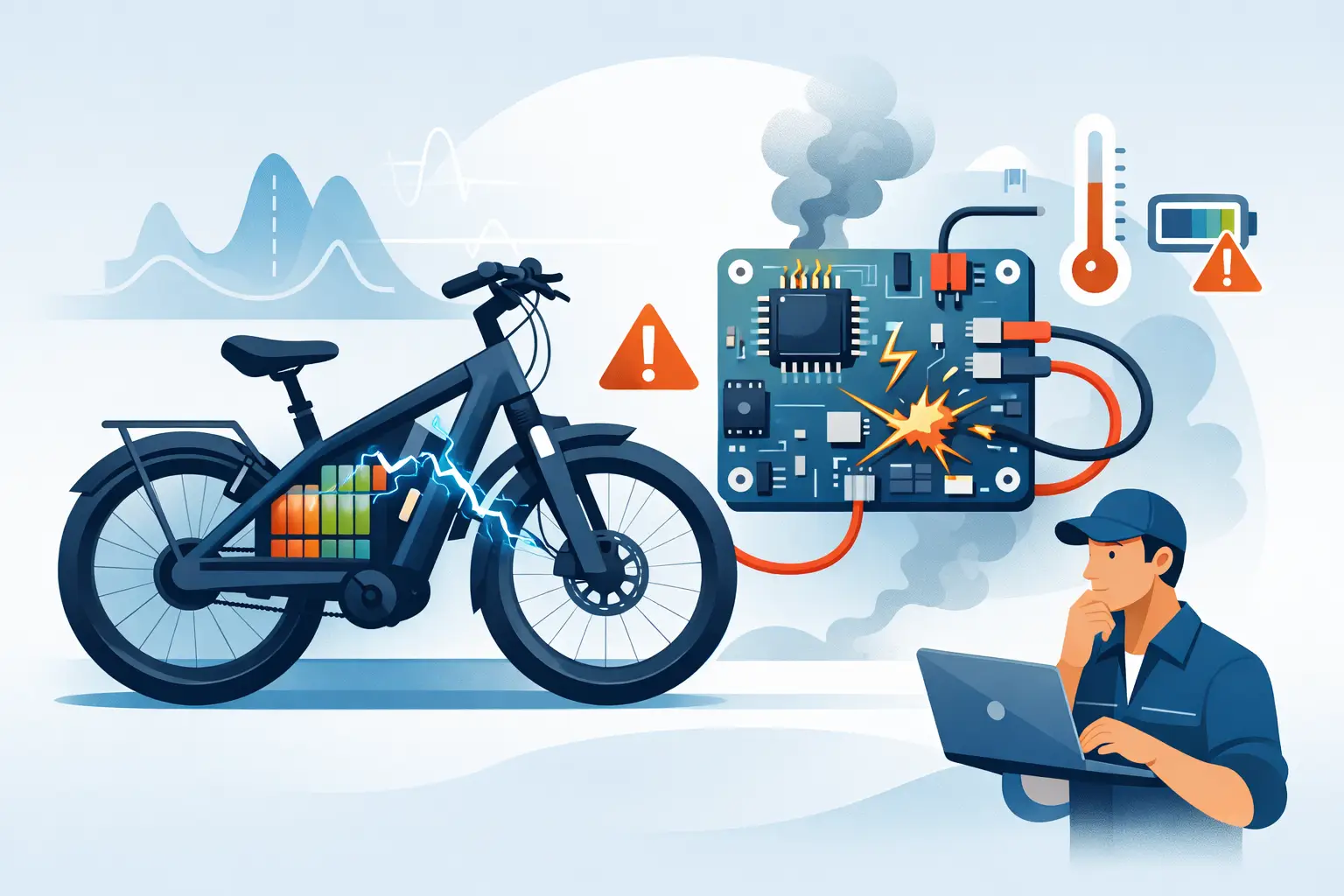
One day the bike charges normally. The next day it shows a full battery, then shuts off under load halfway up a hill. That kind of inconsistent behavior is often where an ebike BMS problem starts to show itself. Riders usually blame the charger, the controller, or the battery pack as a whole, but the battery management system is often the real reason the bike will not charge, cuts out, or refuses to deliver full power.
What an ebike BMS problem actually means
The BMS, or battery management system, is the electronic board inside the battery pack that monitors and protects the cells. It helps control charging, watches voltage levels, balances cell groups, and shuts the pack down if it sees something unsafe. If the system detects overcurrent, overvoltage, undervoltage, a temperature issue, or a serious cell imbalance, it may stop output or stop charging altogether.
That matters because many symptoms that look like a dead battery are not caused by worn-out cells alone. Sometimes the cells are still usable, but the BMS is blocking operation for a reason. Other times the BMS itself has failed, and the battery cannot communicate or function the way it should.
Common symptoms of an ebike BMS problem
A lot of riders come in with the same complaint: the bike turns on, then turns off as soon as they accelerate. Others say the charger stays green and never starts charging, even though the battery is low. Some notice the battery percentage dropping fast from full to empty, or jumping around on the display.
These are common signs, but they are not exclusive to the BMS. A bad charger, damaged charge port, weak cell group, corroded wiring, controller fault, or display error can create similar symptoms. That is why guessing usually leads to wasted time and unnecessary parts.
Charging issues
If the battery will not charge, charges for only a few minutes, or stops before reaching full voltage, the BMS may be cutting the charge path. In some cases, it is doing exactly what it should because one cell group is too high or too low. In other cases, the charging MOSFETs or related circuitry on the BMS have failed.
A charger indicator light by itself does not tell the full story. You need to know whether charger voltage is correct, whether voltage reaches the pack terminals, and whether the BMS is allowing current into the cells.
Sudden shutdown under load
This is one of the most common complaints on higher-powered bikes and heavier fat-tire models. The bike may look fine on a stand, but once a rider accelerates hard, climbs a hill, or carries extra weight, the system cuts off. That can happen when voltage sags under load and the BMS sees a low-voltage condition or overcurrent event.
Sometimes this points to aging cells with high internal resistance. Sometimes it points to a BMS that is too sensitive, overheating, or no longer handling current properly. The difference matters because the repair path is not the same.
Battery reads full but performance is poor
A battery can show a normal voltage at rest and still fail during real use. That is especially common when one cell group is weaker than the others. The pack may appear healthy until demand increases, then the weak group drops out first and the BMS shuts everything down to protect it.
This is why a simple voltage check is not enough. Proper diagnostics involve checking pack voltage, cell group balance when possible, current behavior under load, and charge acceptance.
Why BMS problems happen
Heat, vibration, age, moisture, poor-quality construction, and repeated deep discharge all take a toll on e-bike batteries. On some bikes, the BMS fails because the pack design runs hot or because the battery has been pushed hard for a long time. Delivery riders, riders in hilly areas, and owners of high-draw bikes tend to expose these weaknesses sooner.
Water intrusion is another big one. A battery does not have to be submerged to suffer damage. Moisture from washing, rain exposure, or a poorly sealed case can corrode connections or damage the BMS board over time.
Then there is cell imbalance. If one or more cell groups drift too far apart, the BMS may keep blocking full charge or discharge. In that case, the BMS may not be the original failure. It may just be reacting to a cell-level problem inside the pack.
Why DIY diagnosis often goes sideways
Battery issues look simple from the outside, but they are rarely simple once you open them up. A lot of online advice reduces everything to replacing the charger or bypassing the BMS. That is risky. The BMS is a safety device, and bypassing it can create a bigger failure, including overheating, damaged cells, or a battery that becomes unsafe to charge.
The other problem is misdiagnosis. Riders often replace a battery because the bike cuts out, only to find the real issue was a controller drawing abnormal current or a connection heating up under load. The opposite also happens. A new controller gets installed, but the battery still shuts down because the BMS is tripping on a weak cell group.
For most riders, the smartest move is to treat the battery, controller, charger, and wiring as one system until testing proves otherwise.
How a shop diagnoses an ebike BMS problem
The first step is confirming the symptom, not assuming the cause. A proper diagnostic process starts with battery voltage, charge behavior, connector condition, and load testing. From there, the technician checks whether the issue is on the charging side, discharge side, or both.
Battery and charger testing
A charger can show the right light and still be wrong on output. The battery can show a decent resting voltage and still collapse when current demand rises. Testing both sides matters. If the charger voltage is correct but the pack is not accepting current, that points in one direction. If the charger itself is off-spec, the battery may be getting blamed unfairly.
Looking for cell-level imbalance
When the pack design allows deeper testing, a technician can compare cell group voltages and look for imbalance or a weak group. If one section is well below the others, the BMS may be doing its job by shutting the battery down. In that case, replacing the BMS alone will not fix the real problem.
Checking for related electrical faults
An ebike BMS problem sometimes starts outside the battery. A shorted controller, damaged phase wiring, or even a charge port fault can trigger battery protection or make the pack seem dead. That is why component-level diagnosis is more useful than swapping parts until something works.
Repair or replace – it depends on the battery
Some battery packs are repairable. Some are not worth opening. The decision depends on battery age, cell condition, build quality, replacement cost, and whether parts are available.
If the BMS has failed but the cells test well and the pack is structurally sound, replacing the BMS may make sense. If the battery has multiple weak groups, heat damage, corrosion, or poor pack construction, a repair may not be the smartest long-term option. The cheapest fix on day one is not always the least expensive fix over the next six months.
This is especially true for riders who depend on their bike daily. A commuter or delivery rider usually needs reliability more than a temporary workaround.
When to stop riding and get it checked
If the battery gets unusually hot, cuts out unpredictably in traffic, refuses to charge, or drops power hard under load, it is worth having it diagnosed sooner rather than later. Intermittent shutdowns are not just annoying. They can leave you without assist at the worst time, and repeated attempts to force a failing battery to work can make the damage worse.
For riders around San Diego, especially those using their bikes for commuting, school drop-offs, or regular weekend riding, fast and accurate electrical diagnosis saves a lot of frustration. Shops like FixEbike handle these cases every week, and that matters because battery problems are rarely solved by guesswork.
A good battery system should feel boring. It should charge normally, deliver power consistently, and stay out of your way. If your bike has started doing the opposite, that is usually your cue to stop chasing symptoms and find the actual fault.