
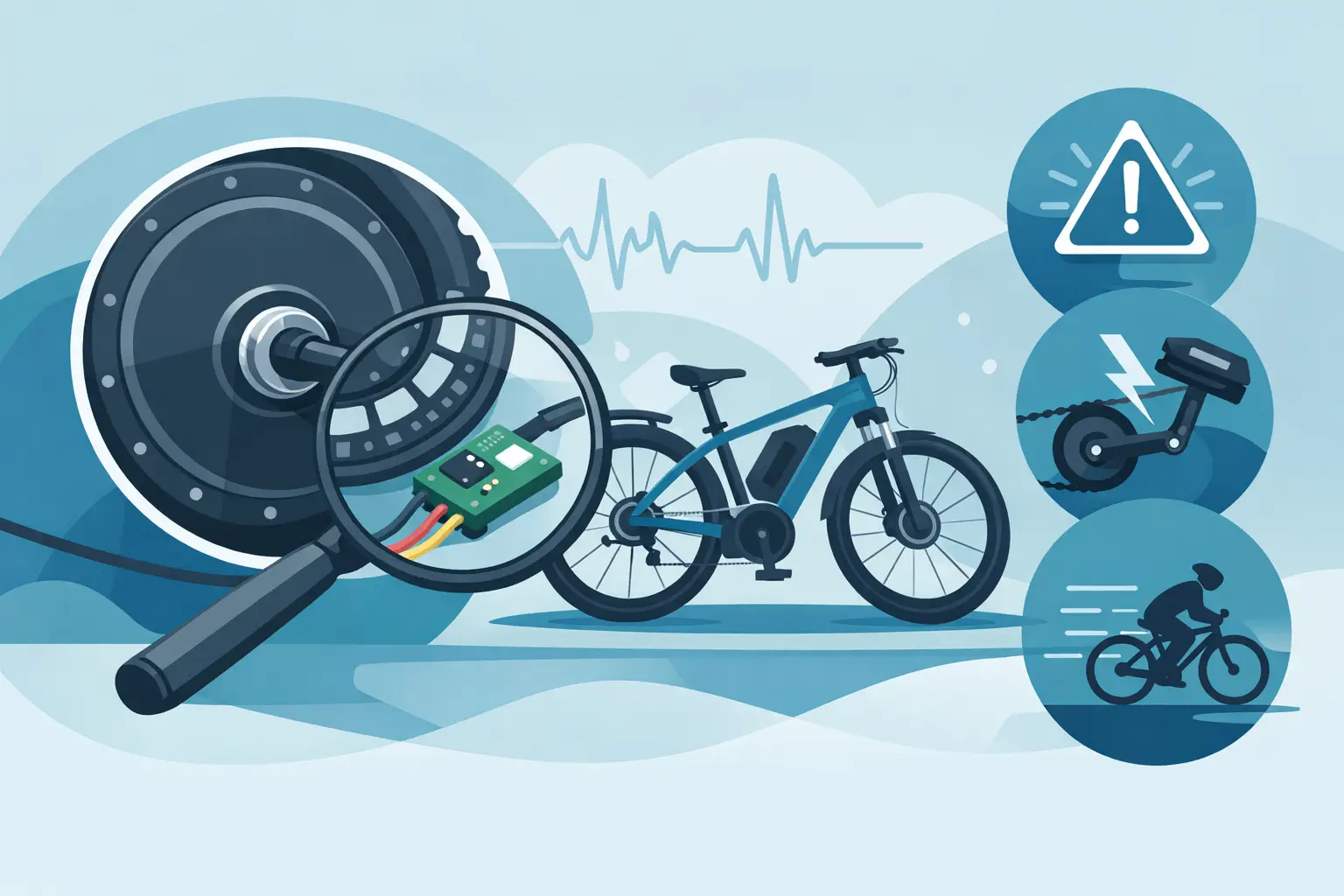
A bike that powers on normally but jerks, shudders, or refuses to pull under throttle often points riders toward one question: are these hall sensor ebike symptoms, or is something else failing in the drive system? That distinction matters, because a bad hall sensor can feel a lot like a controller problem, damaged phase wiring, or even a motor issue that only shows up under load.
Hall sensors are small electronic components inside many e-bike motors. Their job is to tell the controller the rotor position so it can send power to the right motor phases at the right time. When that signal is missing, delayed, or inconsistent, the motor and controller stop working in sync. The result is usually rough performance, poor startup, or complete loss of drive.
Common hall sensor ebike symptoms
The most common symptom is a motor that tries to start but feels rough or choppy. You may apply throttle and feel a repeated stutter instead of smooth acceleration. On some bikes, the wheel will move a little, hesitate, then surge. On others, the motor just growls or vibrates without building real power.
Another common sign is loss of torque at low speed. A bike with hall sensor trouble may still move once it gets rolling, but takeoff feels weak, delayed, or inconsistent. Riders sometimes describe this as the bike feeling “confused” when starting from a stop. That description is actually pretty accurate. The controller is trying to guess motor position instead of receiving a clean signal.
Intermittent cutout is also high on the list. The bike may run normally for a few minutes, then lose power suddenly when climbing, accelerating, or hitting a bump. If the fault is in the hall wiring rather than the sensor itself, movement and vibration can change the connection just enough to make the problem come and go.
Some e-bikes show an error code related to motor communication or hall failure. Others do not. A missing code does not rule out a hall issue. Many systems, especially on lower-cost bikes or mixed-component setups, simply behave badly without giving a precise fault message.
You might also notice the motor running hot. When commutation timing is off, the motor can draw current inefficiently. That creates extra heat in the motor and controller. If the bike has been ridden while stuttering or grinding under power, overheating can become a second problem on top of the original one.
What a bad hall sensor feels like on the road
Most riders do not describe failures in technical terms. They say the bike suddenly feels weak, noisy, shaky, or unreliable. That matters because the riding feel is often the first clue.
If the bike launches with a harsh jerk and then smooths out at higher speed, hall sensor failure is possible. If it only acts up under heavy load, like a hill or a rider plus cargo, that can still fit the pattern. A weak or missing signal may be enough to confuse startup timing even if the motor eventually spins.
If the rear wheel spins fine in the air but struggles with a rider on the bike, do not assume the motor itself is good. Hall-related faults often show themselves under load, when timing and current demand become less forgiving.
Grinding or rattling sensations can also fool riders into thinking something mechanical is broken inside the motor. Sometimes that is true. But electrical miscommutation can create a rough, mechanical-sounding response even when the gears or internals are not the main issue.
Why hall sensor ebike symptoms get misdiagnosed
Hall sensor faults are easy to confuse with controller, throttle, battery, or phase wire problems. That is why e-bike diagnostics should start with testing, not guessing.
A weak battery can cause voltage sag and power loss that feels similar under acceleration. A damaged phase wire can create choppy motor operation and heat. A bad controller can send incorrect signals even if the hall sensors are working perfectly. Corrosion in a motor connector can interrupt hall signals without the sensors themselves being defective.
This is where experience matters. Replacing a motor because the bike is stuttering can be expensive and unnecessary. Replacing a controller first can also miss the real cause. On some bikes, the fault is a broken hall wire near the axle, where cable strain and vibration are common. On others, moisture has reached the motor and damaged the hall board.
Typical causes behind the symptoms
Inside the motor, hall sensors live in a hot, vibrating environment. Over time, heat cycling, water intrusion, impact, and normal wear can cause failure. Hub motors are especially exposed to cable stress near the axle exit point. Mid-drive systems have their own packaging and heat challenges, but the same basic signal problems can happen.
Wiring damage is one of the biggest causes we see in real-world repairs. A hall sensor can test fine, but the signal never reaches the controller because the wire is pinched, partially broken, or corroded. This is especially common after crashes, tire work, axle rotation, or repeated folding on compact bikes.
Connector issues are another common source. Loose pins, bent terminals, and water-contaminated plugs can create intermittent hall sensor ebike symptoms that seem random. The bike may work in the morning, fail in the afternoon, then work again after sitting. That kind of inconsistency usually points to a connection problem or a heat-related electronic fault.
The controller can also be the real culprit. If the controller cannot read or process hall inputs correctly, the motor behaves as if the sensors are bad. That is why part-swapping without testing often leads to wasted time and money.
How the problem is diagnosed properly
A proper diagnosis usually starts with the basics: battery voltage, connector condition, visible wiring damage, and whether the wheel spins freely without power. After that, the focus shifts to signal testing.
On a system with hall sensors, a technician typically checks whether each sensor receives the correct supply voltage and whether its signal changes cleanly as the motor rotates. If one signal stays fixed when it should switch, that points toward a failed hall sensor, damaged wiring, or a board issue inside the motor.
The phase wires also need to be checked. A motor with one damaged phase can act rough in a way that overlaps with hall failure. Controller output and compatibility matter too. Not every controller behaves the same, and some systems are more tolerant of weak hall signals than others.
This is also where “it depends” becomes real. On some bikes, replacing a hall sensor is the right repair. On others, it makes more sense to repair the motor harness, replace a damaged connector, or address a controller fault that is creating similar symptoms.
Can you keep riding with these symptoms?
Sometimes the bike will still move, but continuing to ride is usually not a good idea if the motor is stuttering, overheating, or cutting out. Running an e-bike with incorrect motor timing can stress the controller and motor windings. What starts as a small signal problem can turn into a more expensive repair if the system is pushed hard.
There is also a safety side to it. If power cuts in and out while crossing traffic, climbing, or riding with a child or cargo, the issue is no longer just inconvenient. It becomes a reliability problem that can affect control and rider confidence.
If the bike has only a mild symptom, like occasional hesitation from a stop, it is still worth getting checked early. Intermittent electrical faults rarely fix themselves. They usually get more frequent over time.
When it is probably not a hall sensor problem
Not every no-power or weak-power complaint points to the motor sensors. If the display does not turn on, the issue is more likely battery, fuse, BMS, ignition circuit, or main power wiring. If the bike powers on but the throttle and pedal assist both do nothing, the brake cutoff circuit, controller, or communication system may be involved.
If the motor spins smoothly unloaded and loaded with no noise, but range is poor and power fades gradually, battery health becomes more likely than hall failure. If the problem appears only with pedal assist and not throttle, the cadence or torque sensor may be the better place to look.
The pattern matters. That is why clear symptom reporting helps speed up the repair.
What to tell a technician
If you want faster answers, describe exactly what the bike does and when. Mention whether the issue happens from a stop, under hill load, only on throttle, only on pedal assist, or after the bike warms up. Note any clicking, grinding, vibration, or error codes. If the bike was recently dropped, ridden in heavy rain, or had wheel or tire work done, say that too.
Those details help narrow down whether the issue points toward hall sensor ebike symptoms, phase wire damage, controller failure, or another electrical fault entirely. Shops that work on advanced e-bike diagnostics, including motor and wiring issues, can usually sort this out much faster than a general bike shop guessing from the outside.
If your e-bike is acting rough, weak, or inconsistent, the best next step is simple: stop forcing it and get the system tested before a small timing fault turns into a larger repair bill. FixEbike sees this pattern often, and the earlier the diagnosis happens, the better the odds of a clean, targeted repair.