
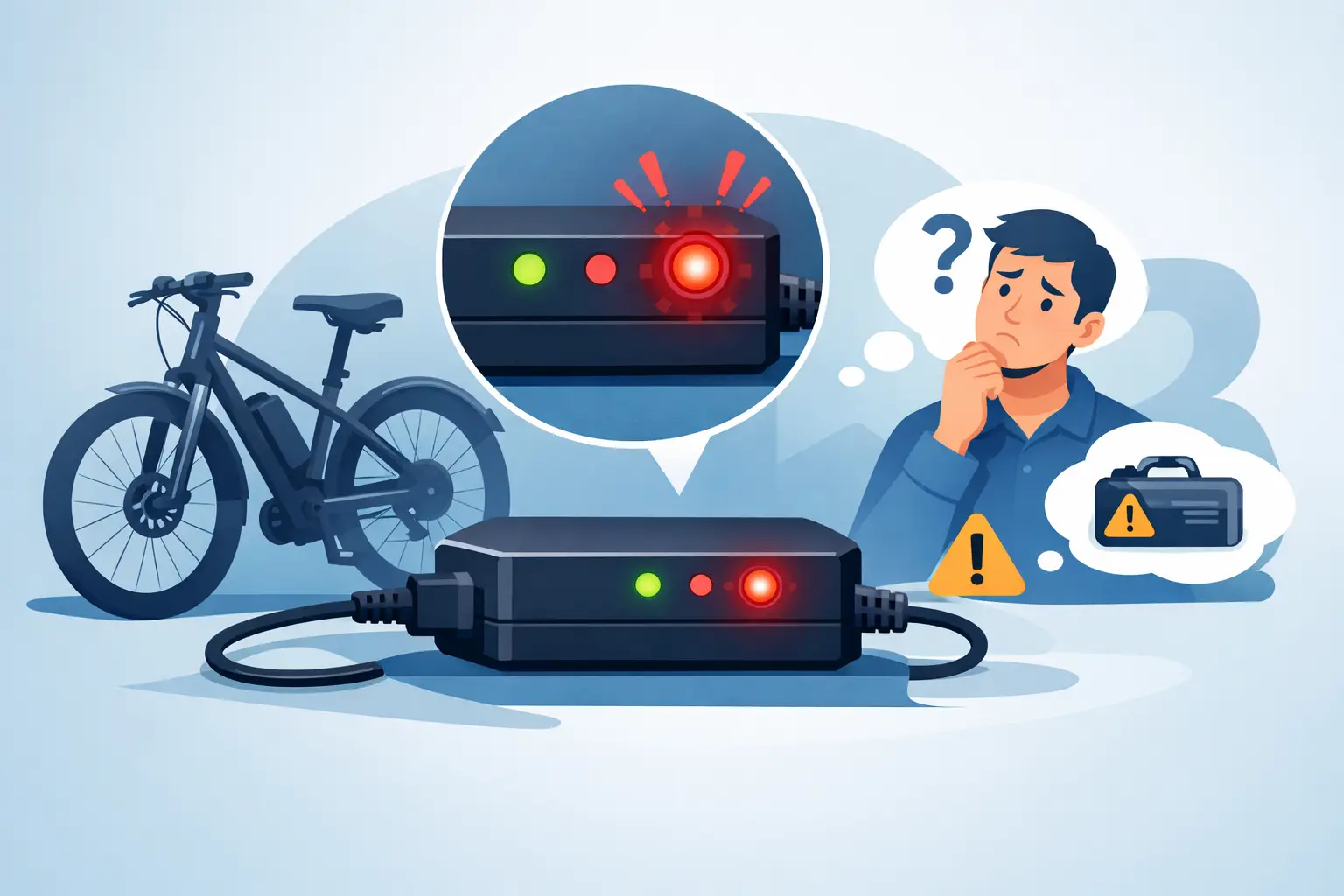
A charger that suddenly starts blinking can stop a morning commute before it starts. If you are asking, why is my ebike charger blinking, the light is usually telling you one of two things: the charger has detected a normal charging condition, or it has detected something it does not like in the battery, connection, or charger itself. The difference matters, especially when lithium-ion batteries are involved.
A blinking light is not a diagnosis by itself. Charger LED patterns vary by manufacturer, and the same red, green, or alternating pattern can mean different things on different models. The safest approach is to check the charger label and your bike manual first, then work through a few simple observations without taking apart the battery or trying to force a charge.
Why Is My Ebike Charger Blinking Instead of Charging Normally?
Most e-bike chargers use an LED to show the current stage of charging. A steady red light commonly means the battery is actively charging. A steady green light commonly means the charger sees a full battery, no battery, or a battery that is not accepting charge. Blinking may indicate charging, a standby mode, an over-temperature condition, a communication issue, or a fault.
The first question is whether the battery charge level is actually increasing. If the bike display or battery fuel gauge shows more charge after 30 to 60 minutes, a blinking LED may be normal for that charger. If the charger blinks continuously and the battery remains empty, gets unusually warm, or cuts in and out, treat it as a fault until proven otherwise.
Do not rely on color alone. Check the small print on the charger case. Many chargers include a chart that explains LED behavior, input voltage, output voltage, and charging current. That information also helps confirm whether the charger is correct for your battery.
Start With the Simple Checks
Before assuming the battery has failed, unplug the charger from the wall and battery. Inspect the power outlet, charger cable, and charge port under good lighting. A loose connector, damaged cable, or dirty port can interrupt the charge signal and cause a blinking indicator.
Try a known-good wall outlet directly, without a power strip or extension cord. Make sure the charger plug is fully seated in the battery port. On some bikes, the plug needs to be aligned carefully before it will connect all the way. Do not twist, bend, or force the connector if it resists.
Look for debris, moisture, corrosion, bent pins, or a melted plastic smell around the charging port and plug. San Diego riders often store bikes in garages, transport them in open vehicles, or ride near coastal moisture. Even light corrosion can add resistance at the port and create intermittent charging behavior.
If the battery is removable, check that it is fully locked into its frame cradle before charging on the bike. A battery that is slightly unseated can power the bike intermittently or fail to charge through the frame port.
Common Causes of a Blinking E-Bike Charger
The battery is too hot or too cold
Lithium-ion batteries should not be charged when they are excessively hot or cold. After a hard hill climb, long delivery shift, or summer ride, the battery may be warm enough for its battery management system, or BMS, to block charging temporarily. Some chargers blink while waiting for the pack to return to a safe temperature.
Bring the battery indoors and let it rest in a dry, temperature-controlled area. Do not put it in a refrigerator, place it in direct sun, or charge it immediately after a demanding ride. If it charges normally once it reaches room temperature, the blinking was likely a temperature-protection response.
The charger and battery do not match
Not every barrel connector or charging plug means the charger is compatible. E-bike batteries can have similar-looking connectors while using different voltages, polarity, charge profiles, or communication requirements. A 48V battery generally needs a charger that reaches approximately 54.6V, while a 52V battery generally needs one that reaches approximately 58.8V.
Using the wrong charger can result in blinking lights, no charging, BMS shutdown, or equipment damage. Never substitute a charger based only on whether the plug fits. Match the battery voltage, connector type, polarity, and manufacturer specifications.
A weak charger or damaged charging cable
Chargers do wear out. Internal components can fail after heat exposure, power surges, repeated transport, or years of use. A charger may still light up but be unable to produce stable output under load. The LED may blink, switch from red to green too quickly, or cycle repeatedly as the charger tries to start.
Cable damage is another common issue. Check for kinks near the charger brick and near the plug, where wires take the most stress. If the cable is cracked, frayed, hot, or intermittent when moved, stop using the charger. Electrical tape is not a safe repair for a charging cable.
A charge-port or wiring problem
The charger may be fine, but power may not be reaching the battery correctly. Charge ports can loosen internally, develop damaged solder joints, or suffer corrosion. Frame-mounted battery systems may also have worn contacts in the battery cradle or broken wires inside the frame.
This type of issue often looks inconsistent. The charger may work only when the plug is held at a certain angle, the light may change when the cable moves, or charging may work off the bike but not while the battery is installed. These are repairable faults, but they require proper testing rather than guesswork.
The BMS has put the battery into protection mode
The BMS is the circuit board inside the battery that monitors cell voltage, current, and temperature. It helps prevent overcharging, over-discharging, and unsafe operating conditions. If it sees a cell group that is too low, too high, imbalanced, or outside its allowed temperature range, it can prevent charging.
A battery that was stored empty for months, left in extreme heat, or repeatedly run to zero may develop low cell groups. In that situation, the charger may blink but the BMS will not allow normal charging. Some packs can be repaired at the component level after testing. Others need replacement, depending on cell health, battery construction, and the extent of the damage.
An internal battery connection or cell problem
An older battery may have a loose nickel connection, failed fuse, damaged thermistor, or deteriorating cell group. These issues can trigger an unstable charge cycle and may appear alongside reduced range, sudden shutdowns, incorrect battery-level readings, or power loss under acceleration.
This is not a do-it-yourself charging problem. Do not open a lithium battery pack, bypass the BMS, jump terminals, or attempt to revive it with an unapproved power supply. A battery that has swollen, leaked, smells sharp or chemical-like, or becomes hot while charging should be disconnected and moved away from combustible materials if it is safe to do so.
When You Should Stop Charging Immediately
Unplug the charger from the wall first, then disconnect it from the battery, if you notice smoke, sparking, swelling, hissing, a burning smell, melted connectors, or excessive heat. A charger can get warm during use, but it should not be too hot to touch briefly.
Also stop charging if the LED rapidly cycles between colors, the charge port feels loose, or the battery repeatedly accepts charge for a few minutes and then shuts off. Do not leave a questionable charger or battery charging overnight, in a hot garage, or near doors and exits.
Place the battery on a nonflammable surface away from flammable materials while you arrange a professional inspection. If there is active smoke or fire, move away, call emergency services, and follow local fire department guidance. Do not attempt to handle an actively burning lithium-ion battery.
What a Proper Charger Diagnostic Includes
The quickest path to an answer is testing, not buying random replacement parts. A qualified e-bike technician can measure charger output voltage, inspect the connector and port, test voltage at the battery terminals, and determine whether the BMS is allowing charge current into the pack.
For batteries that appear faulty, deeper diagnostics may include checking cell-group balance, internal fuse continuity, temperature sensor readings, BMS behavior, and frame-cradle contacts. That matters because a blinking charger can point to a $20 cable issue, a failed charger, a worn charge port, or a battery problem. The symptoms overlap, but the repairs and costs do not.
FixEbike diagnoses charging faults across commuter, fat-tire, moped-style, and off-road e-bikes. Bringing in the bike, battery, and charger together gives the technician the best chance of finding the actual failure in one visit.
A blinking charger does not automatically mean you need a new battery. Start with the charger instructions, a clean connection, and a safe-temperature battery. If the light keeps blinking and the battery will not charge, stop forcing the issue and have the charging system tested before your next ride.