
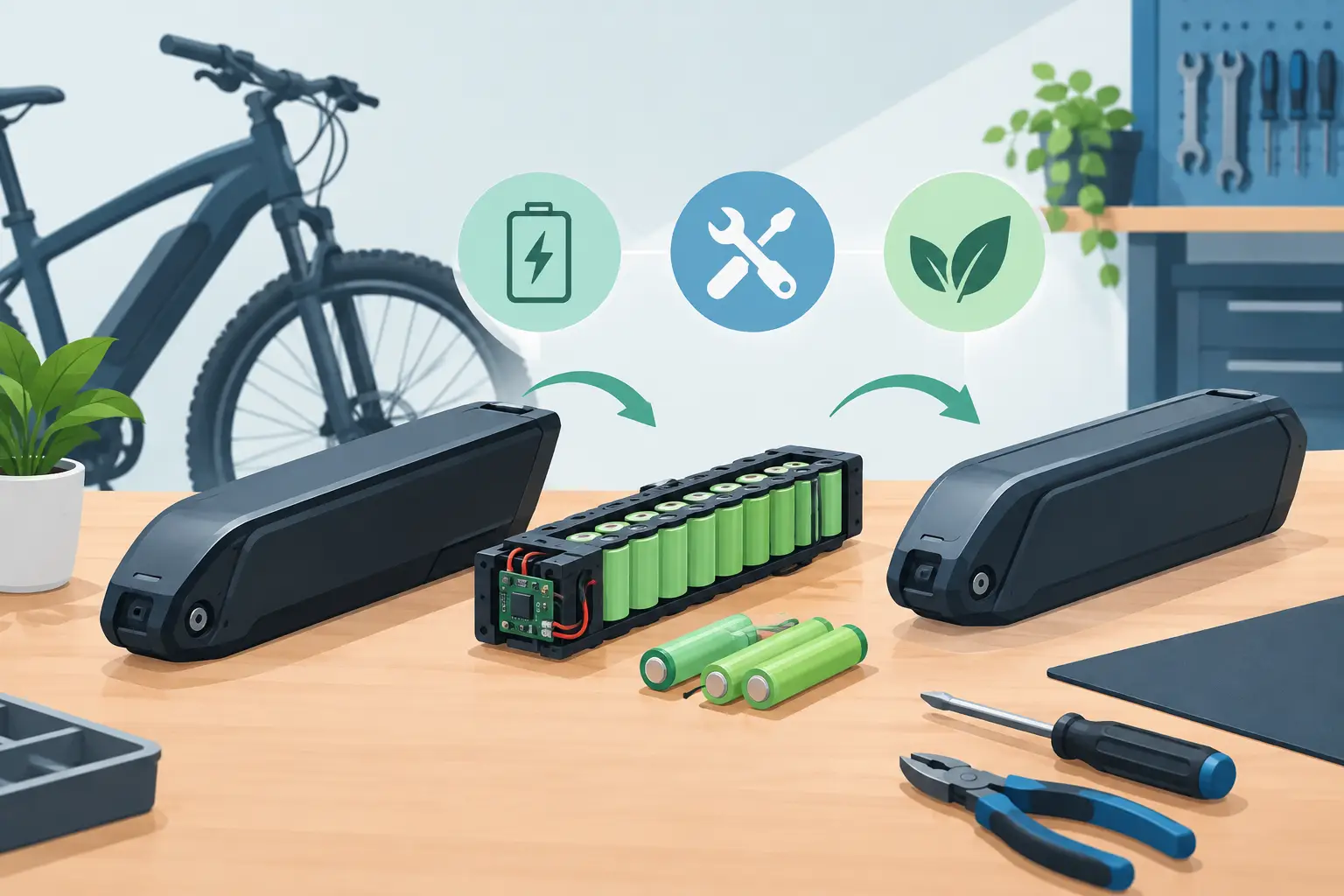
A battery that suddenly stops charging can make an otherwise good e-bike feel finished. But can an ebike battery be rebuilt? In some cases, yes. A qualified technician may be able to replace failed cell groups or a faulty battery management system (BMS). In other cases, rebuilding is unsafe, impractical, or costs enough that a replacement pack is the better decision.
The key is diagnosing the actual fault before anyone opens the battery case. A charging problem is not always a bad battery. The charger, charge port, wiring, controller, display, or a loose connection can create symptoms that look exactly like battery failure.
What rebuilding an e-bike battery actually means
An e-bike battery is not one large rechargeable cell. Most packs contain dozens of lithium-ion cells connected in series and parallel, along with nickel strips, insulation, temperature sensors, heavy-gauge output wiring, a fuse, and a BMS. The BMS monitors cell voltage, limits current, and can shut the pack down when it detects a fault.
Rebuilding generally means opening the sealed battery housing, inspecting the internal components, testing the cell groups, and replacing the failed parts. Depending on the pack, the work may involve replacing damaged cells, rebuilding matched cell groups, installing a compatible BMS, repairing spot-welded connections, or replacing the charge port and internal wiring.
This is not the same as attaching a new connector or swapping in a charger. It is component-level electrical work on a high-energy lithium battery. Done correctly, it requires the right test equipment, matched cells, proper spot welding, insulation, and a final load and charging test.
When an e-bike battery can be rebuilt
A rebuild may be worth considering when the battery case is intact, the pack has no signs of overheating or water damage, and the problem is isolated. For example, one weak parallel cell group can cause the BMS to cut power early even though the battery still appears to charge. A failed BMS can also leave a healthy pack unable to deliver power or accept a charge.
A technician should first measure the pack’s overall voltage and each cell group voltage. A 48-volt pack that reads far below its expected resting voltage may have a deeply discharged group, a BMS lockout, or internal damage. The reading alone does not tell the whole story. Voltage behavior under load, charging response, balance across cell groups, and visible condition all matter.
Rebuilding is often most reasonable for a quality battery from a known e-bike brand, especially when a direct replacement is unavailable or unusually expensive. It can also make sense for some older commuter, cargo, fat-tire, or moped-style e-bikes where the battery case and mounting system are proprietary.
Common rebuildable faults
Some faults are more favorable than others. A damaged charge port, failed fuse, broken discharge lead, loose nickel connection, or failed BMS may be repairable without replacing every cell. Packs with a small number of weak but otherwise identifiable cell groups can sometimes be rebuilt using properly matched cells.
Cell matching is not optional. Mixing random old cells with new cells, using unknown cells, or installing cells with different capacity and discharge ratings creates imbalance. The stronger cells get pushed harder, the weaker cells drop voltage sooner, and the BMS may repeatedly shut the bike down. That kind of repair can turn a limited problem into a safety problem.
When rebuilding is not the right answer
Not every battery should be opened or repaired. A replacement battery is usually the safer recommendation if the pack is swollen, has a burnt smell, shows melted plastic, has corrosion from water intrusion, or has been involved in a crash. Those conditions can affect more than the one component that first appears damaged.
A pack that has been stored dead for months can also be difficult to recover safely. Lithium-ion cells that have been deeply discharged may have permanent internal damage. Forcing charge back into them is not a responsible fix.
The age and condition of the full pack matter too. If most cells have lost capacity after years of daily use, replacing one weak group may get the battery running but will not restore the remaining worn cells. In that situation, a complete rebuild with new, matched cells may be possible, but the cost can approach or exceed a new OEM-quality replacement.
Battery availability also affects the decision. A new battery that fits correctly, communicates with the bike, and comes from a reliable source may offer better long-term value than rebuilding an aging pack. On the other hand, low-cost online replacement packs can have questionable cells, poor weld quality, inaccurate capacity claims, or a BMS that cannot support the bike’s controller current. Cheap is not always a bargain when the battery is the most energy-dense component on the bike.
Why DIY battery rebuilding is risky
Online videos can make battery rebuilding look simple: buy cells, use a spot welder, copy the old layout, and close the case. The missing part is the diagnosis and safety process.
Lithium-ion cells can deliver very high current if accidentally shorted. A metal tool across the wrong terminals can heat up instantly. Damaging cell wraps, overheating a cell, puncturing insulation, using a soldering iron directly on cells, or routing a balance wire incorrectly can create a delayed failure that does not show up until the battery is charging in a garage.
There is also the issue of pack design. The BMS must match the battery’s series count, charge and discharge current, temperature setup, and sometimes the communication requirements of the bike. Some branded batteries include data communication between the BMS, charger, controller, and display. A generic BMS may not work even if the voltage appears correct.
For riders in San Diego, heat adds another reason to be cautious. A battery already weakened by age can be stressed further by hot-car storage, steep climbs, high assist levels, or long delivery-style rides. A repair needs to account for how the bike is actually used, not just whether it powers on at the workbench.
Start with battery diagnosis, not a rebuild decision
A proper battery evaluation starts outside the pack. The technician verifies charger output, checks the charge port and connector condition, looks for voltage drop in the main wiring, and confirms that the controller and display are behaving normally. A no-power condition can be caused by a blown fuse, a failed brake cutoff switch, a controller fault, or damaged wiring near the frame hinge or rear wheel.
If the battery is the likely source, the next step is to test its resting voltage, charging behavior, BMS response, and voltage under load. A pack may show normal voltage with no load but collapse when the motor demands current. That often points to weak cells, high-resistance connections, or a BMS issue.
This diagnostic approach prevents unnecessary battery work. FixEbike regularly sees e-bikes brought in for a “dead battery” that actually have a charger, connector, controller, or wiring fault. Finding the root cause first protects both the rider and the repair budget.
What to ask before approving a battery rebuild
Before you authorize any battery repair, ask whether the issue is confirmed inside the pack and what components are being replaced. You should also know whether the replacement cells are new, matched, and appropriate for the bike’s current draw.
Ask how the pack will be tested after repair. A responsible service process includes checking charge cutoff, discharge behavior, balance between cell groups, connector condition, and operation under a realistic load. It should also include inspection of the battery mount and frame-side terminals, since vibration and arcing at loose contacts can damage a repaired or new battery.
Be cautious of any service that promises to increase capacity dramatically without discussing the battery case, cell format, BMS limits, charger compatibility, or controller current. More amp-hours can be useful, but only when the design supports it. Capacity, range, current capability, and safety all have to work together.
Signs you should stop riding and charging
Stop using the battery immediately if it becomes unusually hot, swells, leaks, smells sweet or burnt, makes hissing or popping sounds, or has melted terminals. Do not continue charging it to see whether the issue goes away. Move away from combustible materials if it can be done safely, avoid handling a hot or damaged pack, and seek professional guidance.
For normal care, avoid leaving a battery at 100% for long periods, especially in heat. Use the correct charger, keep connectors clean and dry, and store the battery in a cool, dry location. If the bike will sit for weeks, storing the pack at a moderate charge level is generally easier on the cells than leaving it full or completely empty.
A rebuild can be a practical way to keep a good e-bike on the road, but it should never be treated as a shortcut. Get the electrical system tested, weigh the condition and age of the pack against replacement cost, and choose the option that gives you dependable miles without gambling on battery safety.