
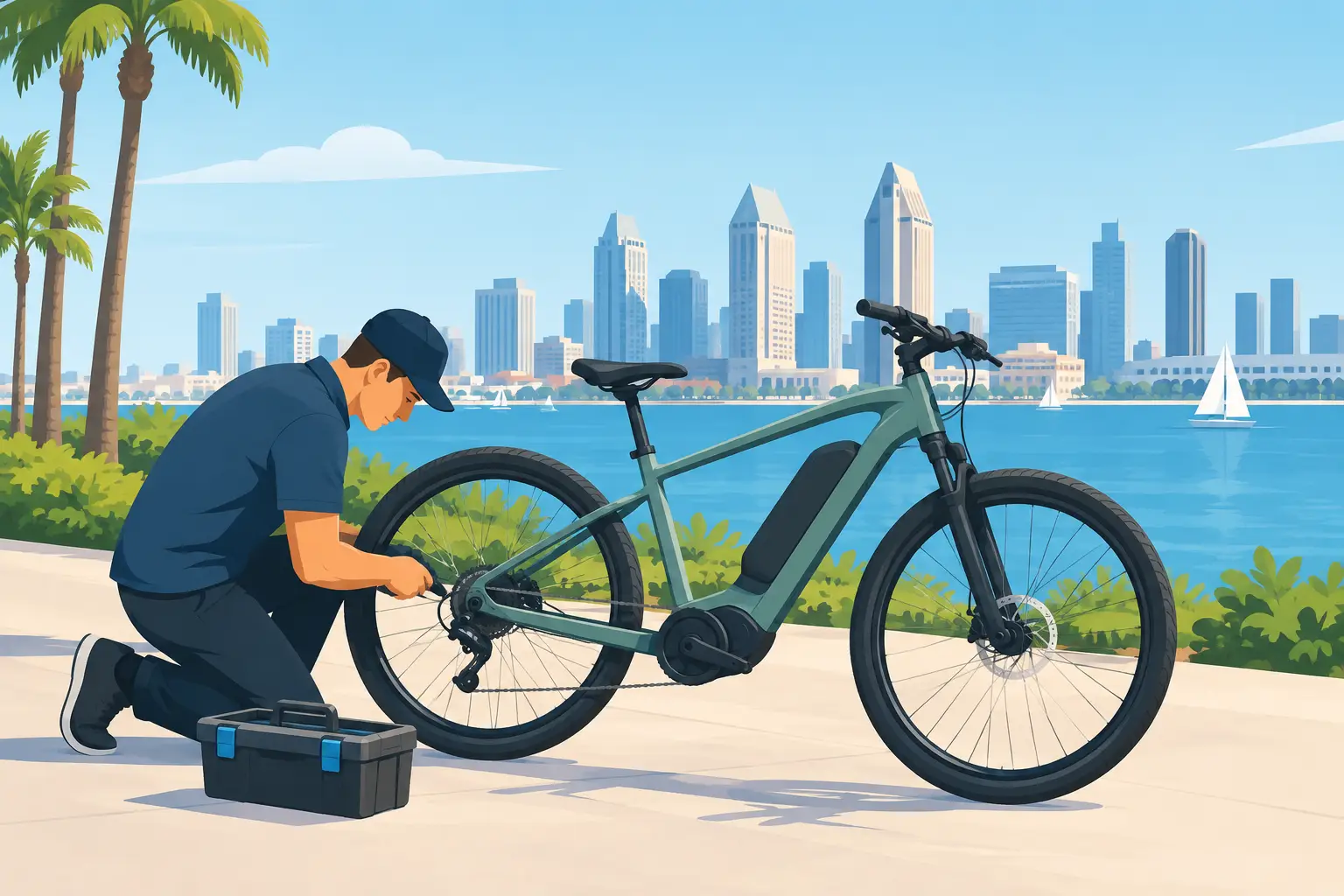
A commuter e-bike that suddenly loses power on the way up a Poway hill is not having a minor inconvenience. Neither is a teen’s fat-tire bike that will not charge before school, or a delivery rider’s scooter showing an error code between orders. This San Diego ebike service guide helps you separate routine maintenance from electrical problems that need a real diagnostic process.
E-bikes combine standard bicycle parts with a battery, motor, controller, display, sensors, and wiring. A tire or brake adjustment may be straightforward. When the bike powers on but will not assist, cuts out under load, or refuses to charge, guessing can turn one failed part into a longer repair. The goal is to identify the actual cause before replacing components.
Start With the Symptom, Not the Part
Many riders assume the battery is bad whenever an e-bike will not run. Sometimes that is correct. Just as often, the issue is a damaged charge port, weak connector, blown fuse, controller fault, brake cutoff sensor, display communication error, or wiring problem near the frame hinge or rear axle.
Pay attention to exactly what the bike does. Does the display stay completely dark? Does it power on but show no battery bars? Does pedal assist work until you climb a hill? Does the motor stutter, make a clicking sound, or stop after a few minutes? Those details help narrow the diagnostic path quickly.
A useful rule is simple: if a problem repeats under the same condition, document that condition. Note the battery charge level, terrain, throttle or pedal-assist setting, weather, and any error message. A technician can do more with “power cuts out after five minutes of uphill riding at half charge” than “it feels weak.”
Routine Ebike Service That Prevents Bigger Repairs
San Diego’s generally dry weather is easier on bikes than constant rain, but it does not eliminate wear. Dust, coastal air, heat, rough pavement, and long climbs all affect an e-bike differently than a regular bicycle. The added weight and speed of an e-bike place more demand on brakes, tires, chains, spokes, and suspension components.
Brakes and Tires Need More Attention
Brake pads can wear quickly on heavier commuter, cargo, fat-tire, and moped-style e-bikes. Squealing, vibration, a soft lever, or longer stopping distance should be checked promptly. Hydraulic brake systems may need pad replacement, rotor inspection, alignment, or a bleed. Mechanical brakes may need cable adjustment, but adjustment alone will not fix contaminated pads or a worn rotor.
Tires deserve the same attention. Check pressure regularly using the range printed on the tire sidewall, while considering rider weight, cargo, and terrain. Underinflated tires increase rolling resistance and make the motor work harder. They also raise the risk of pinch flats. Overinflation can reduce traction and make a ride harsh, especially on uneven roads and trails.
Inspect the tire tread for glass, thorns, cracking, and embedded debris. On fat tires, do not assume a large tire is immune to flats. A slow leak can also point to a damaged valve, rim tape issue, or puncture too small to see at first glance.
Drivetrain Care Protects Range and Ride Quality
A dry or worn chain does not just make noise. It can reduce pedaling efficiency, wear the cassette and chainring, and create rough shifting under motor load. Clean and lubricate the chain as needed, especially after dusty rides or wet road conditions. If the chain skips under pressure, do not keep forcing it uphill. A worn chain, bent derailleur hanger, damaged cassette, or poor adjustment can lead to further damage.
For hub-motor bikes, the motor may be independent of the chain, but the mechanical drivetrain still matters for safe and efficient riding. Mid-drive bikes place motor power through the chain and gears, so drivetrain wear is often more significant and should be addressed early.
Battery Service: What Is Normal and What Is Not
Battery range changes with hills, rider weight, tire pressure, wind, assist level, temperature, and riding style. A modest range drop over time can be normal. A sudden change is not something to ignore.
Warning signs include a battery that will not charge, charges only intermittently, shuts off with bars still showing, gets unusually hot, or has a loose-fitting connector. A battery that works on flat ground but fails under acceleration or on steep grades may be experiencing voltage sag, high internal resistance, a weak cell group, connector resistance, or a battery management system issue.
Avoid opening a battery pack at home. Lithium-ion battery repair requires proper testing procedures, safe handling, and an understanding of the battery management system, often called the BMS. Replacing a charger without verifying voltage and connector compatibility can also create problems. The right charger must match the battery’s voltage, chemistry, and charging requirements.
For daily care, store the battery in a dry, temperature-controlled area when possible. Do not leave it in direct sun inside a hot vehicle. Keep charging ports clean and dry, and avoid riding with a battery that has visible case damage, swelling, a burning odor, or signs of water intrusion. Those are stop-riding conditions.
When Motor or Electrical Diagnostics Are Needed
Electrical faults are where an e-bike-specific service center becomes especially valuable. A bike can look mechanically perfect while a hidden wiring or communication problem keeps it from operating correctly.
Hub motors may develop hall sensor faults, damaged phase wires, axle cable damage, bearing issues, or internal connection failures. Symptoms can include jerky starts, grinding, vibration, a motor that hums but does not turn, or power that disappears when the wheel moves a certain way. The wiring near the rear axle is a common inspection point because it can be stressed by wheel removal, torque, and impact.
Controllers manage power between the battery and motor. A failed controller can cause no-assist conditions, throttle problems, overheating, error codes, or inconsistent power delivery. Displays can also fail or lose communication with the controller, making the bike appear dead even when the battery has voltage.
Brake cutoff sensors are another commonly overlooked cause. If the system thinks a brake lever is engaged, it may disable motor power as a safety measure. This can feel like a dead throttle or nonworking pedal assist, even though the motor itself is fine.
A proper diagnostic process checks the battery’s output, wiring continuity, connectors, controller behavior, display signals, motor phases, hall sensors, and mechanical condition. Replacing parts before these checks can be expensive and may not solve the problem.
Choosing the Right San Diego Ebike Service
Not every bicycle shop handles component-level electrical work. Before bringing in a bike, describe the model, age, symptoms, error codes, and whether it has been modified. Mention aftermarket batteries, controllers, throttles, lights, alarms, or conversion-kit parts. This information matters because compatibility and wiring layouts vary widely between brands.
Ask whether the shop performs diagnostics before recommending a battery, motor, or controller replacement. A good service process should explain what was tested, what failed, what repair options are available, and whether replacement makes better financial sense than repair. On an older or heavily modified bike, the answer may depend on parts availability and the condition of the rest of the system.
For riders in Poway, Rancho Bernardo, Sabre Springs, Mira Mesa, Escondido, and nearby communities, FixEbike handles both regular mechanical service and difficult electrical faults. That includes battery and charging concerns, controller and display issues, hub motor problems, wiring repairs, brakes, tires, and complete tune-ups.
What to Do Before You Bring It In
Bring the battery and charger if the concern involves charging, range, or intermittent power. If you have keys, display passwords, app access, or a specific charger adapter, bring those too. Take a photo of any error code before it disappears. Do not cut wires, bypass connectors, or use a random charger to test the system. Those shortcuts can make diagnosis harder and may damage working components.
If the bike has been in a crash, has a bent wheel, exposed cable, damaged battery case, or melted connector, stop riding until it is inspected. Electrical damage is not always visible from the outside, and continuing to ride can turn a repairable issue into a safety concern.
The best time to schedule service is when you notice the first change in performance, not after the bike leaves you stranded. A brake rub, a charging interruption, or a brief power cut is often the bike’s early warning. Address it while the problem is still clear, repeatable, and easier to trace.