
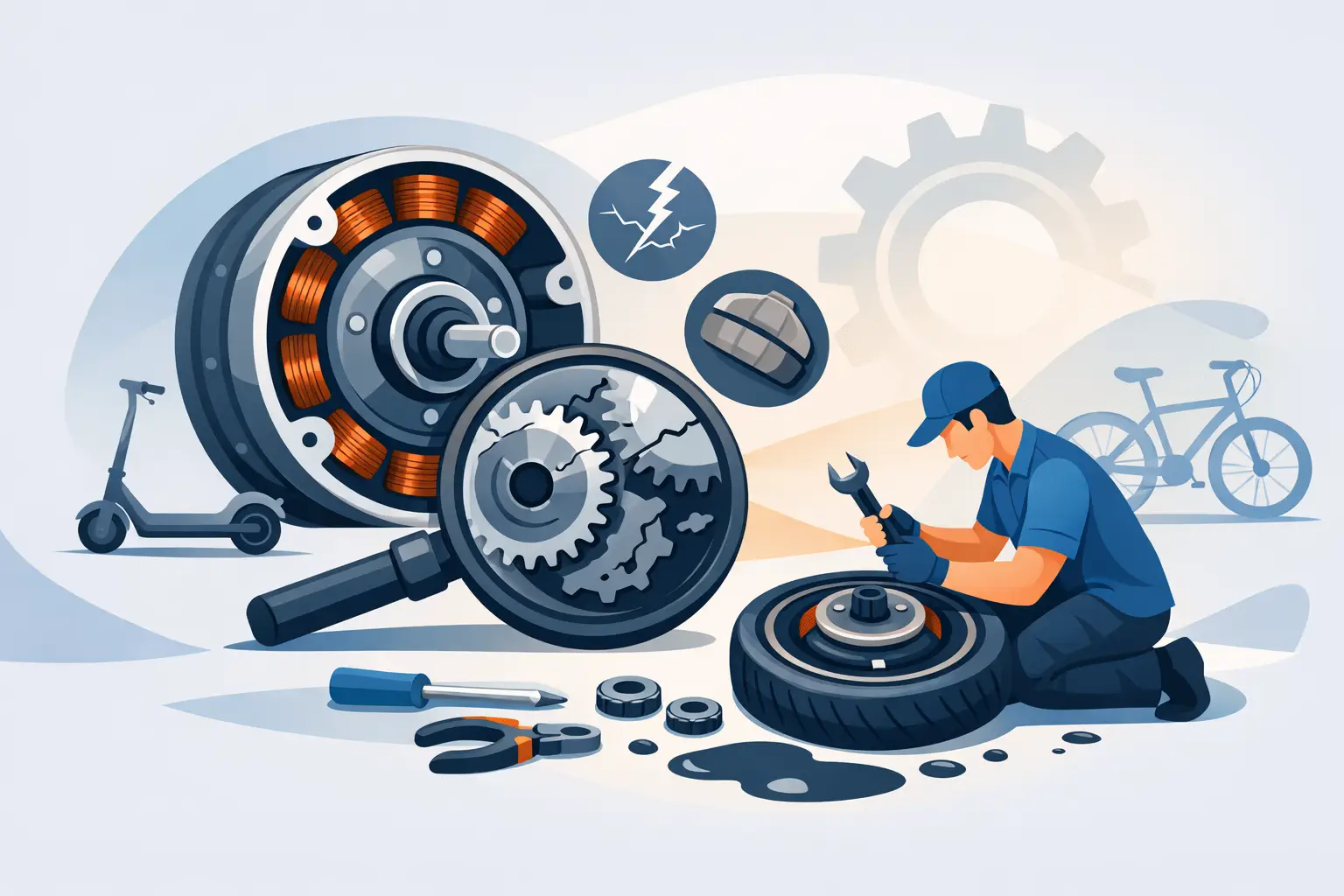
A hub motor that suddenly loses power, makes grinding noise, cuts in and out, or throws an error code usually is not telling you one simple story. Hub motor repair is rarely about swapping one obvious part and calling it done. On e-bikes, the motor, controller, battery, display, wiring, and sensors all depend on each other, which is why a problem that feels like a bad motor can turn out to be a hall sensor fault, phase wire damage, axle cable issue, or even a voltage drop under load.
That is where many riders get stuck. The bike still turns on, maybe the screen looks normal, but the wheel jerks, hums, or does nothing at all. At that point, guessing gets expensive fast.
What hub motor repair actually involves
A hub motor sits in the center of the front or rear wheel and drives the bike directly. Compared with mid-drive systems, hub motors are mechanically simpler in some ways, but electrical faults can be harder to spot without testing. A proper repair starts by separating motor failure from system failure.
That means checking more than the wheel itself. We look at motor phase continuity, hall sensor signal behavior, axle cable condition, connector integrity, controller output, battery voltage under load, and whether the display is reporting a communication problem. If a shop skips that process, there is a real chance you replace a motor that was never the problem.
Some hub motor problems are internal. Others come from the parts feeding it power and control signals. Riders often describe both the same way: “The motor stopped working.” Technically, that can mean several very different things.
Common problems that lead to hub motor repair
One of the most common issues is hall sensor failure. Hall sensors tell the controller where the motor is in its rotation so it can time power delivery correctly. When one sensor starts failing, the bike may stutter on takeoff, run roughly, lose torque, or stop driving altogether. In some cases the motor will still spin with the wheel off the ground but fail badly under rider load.
Phase wire damage is another frequent culprit. These wires carry high current from the controller to the motor. If one is burned, broken, or partially shorted, you may hear grinding, feel heavy resistance, or notice the wheel shudder instead of turning smoothly. Heat damage near the axle is especially common because that area sees flex, vibration, and tight cable routing.
Axle cable damage deserves its own mention because it causes a wide range of symptoms. The cable where it exits the axle is a known weak point on many e-bikes. If it gets pinched, twisted during wheel installation, or pulled over time, the damage may affect hall signals, phase wires, or both. Sometimes the bike works intermittently depending on handlebar position or wheel angle, which can make the problem seem random.
There are also internal gear issues on geared hub motors. If the motor spins but the bike does not move correctly, stripped planetary gears or a damaged clutch can be part of the problem. That sounds different from an electrical fault. Riders often report clicking, slipping under load, or sudden loss of drive while the bike still powers on normally.
Bearing wear is less dramatic but still important. Rough bearings can cause noise, drag, or side-to-side play that feels like a motor problem even when the electrical side is fine. On older or heavily used bikes, especially heavier fat-tire or delivery-style models, bearing replacement can make a major difference.
When it is not really a motor problem
A lot of bikes come in for hub motor repair when the actual failure sits somewhere else in the system. That is normal. The motor is where you feel the symptom, but not always where the fault starts.
A weak battery can mimic motor trouble, especially under acceleration or on hills. If pack voltage sags too far under load, the controller may cut power to protect the system. To the rider, it feels like the motor is failing, but the root cause is battery performance.
Controller faults can look nearly identical. If the controller is not sending clean output to the motor, you can get jerking, no-start conditions, intermittent assist, or overheating. The same is true for damaged connectors, corrosion, and communication issues between the display and controller on certain models.
Brake cutoff sensors can also create confusion. If the system thinks the brake is engaged, motor output may be blocked. That problem is simple once identified, but frustrating if no one checks it early in the process.
Can a hub motor be repaired, or does it need replacement?
It depends on what failed, how badly it failed, and whether parts are available. Many riders assume a bad hub motor means full replacement. Sometimes that is true. Sometimes it is not.
Hall sensors can often be replaced. Damaged axle wiring can sometimes be repaired or rebuilt if the rest of the motor is in good condition. Bearings and internal gears are often serviceable on certain motor designs. If the magnets and stator are intact and there is no severe internal burn damage, repair may be the better value.
Replacement makes more sense when the motor has major internal damage, the shell or axle is compromised, water intrusion has caused widespread corrosion, or the labor required to rebuild it exceeds the cost of a reliable replacement. Another factor is compatibility. Some e-bike brands use less common motor and controller combinations, so installing a new motor is not always as simple as matching wheel size and connector shape.
This is where experience matters. The cheapest-looking option on paper is not always the lowest final cost. A replacement motor that does not communicate correctly with the controller, torque sensor, or display can create a second round of problems.
What a proper hub motor repair diagnosis should include
Before any recommendation is made, the system should be tested as a system. That means verifying battery condition, checking controller behavior, inspecting connectors, and testing the motor electrically and mechanically.
On a technical level, that may include checking hall sensor switching, resistance balance between phase wires, signs of short-to-case faults, insulation damage, wheel drag, freewheel behavior on geared motors, and heat damage at connectors or cable exits. Error codes can help, but they are only one piece of the picture. Plenty of bikes have no useful code even when a real fault is present.
Road testing matters too. Some failures only show up under load. A bike that spins normally on a stand may cut out when ridden uphill or from a dead stop. That difference is exactly why quick visual checks often miss the problem.
Signs you should stop riding and get it checked
If the motor is making harsh grinding noise, overheating, surging unexpectedly, or cutting in and out during traffic riding, it is smart to stop using the bike until it is diagnosed. Intermittent power delivery is not just annoying. It can be a safety issue, especially for commuters, parents managing family e-bikes, or riders using heavier moped-style and fat-tire bikes.
The same goes for a wheel that feels unusually resistant when rolling, a burnt electrical smell, melted connectors, or visible cable damage near the axle. Continuing to ride can turn a repairable issue into a larger and more expensive one.
Why hub motor repair is often brand-specific
Not every hub motor system is built the same way. Connector types, controller logic, motor wattage, hall sensor layout, axle dimensions, and wheel build quality all vary. Some brands also use proprietary communication between components, which affects what can be repaired directly and what has to be matched more carefully.
That is why general bike repair experience does not always translate well to e-bike electrical faults. A shop can be excellent with brakes, tires, and tune-ups and still not be set up to diagnose a phase imbalance, controller output issue, or internal motor fault.
For riders in San Diego dealing with inconsistent assist, no-start motor issues, or unexplained hub drive problems, the best next step is a diagnosis that looks at the entire electrical system rather than just the wheel. FixEbike handles exactly that kind of work, with a focus on finding the actual fault before recommending parts.
A good repair should leave you with more than a working bike for the moment. It should give you a clear explanation of what failed, what was tested, and whether the fix is likely to hold up for how you actually ride. That kind of clarity is what gets you back on the road with confidence.